


MHT CET · Maths · Differential Equations
In a certain culture of bacteria, the rate of increase is proportional to the number
present. It is found that the number doubles in 4 hours. Then the number of times
the bacteria are increased in 12 hours is
- A 6
- B 8
- C 12
- D 4
Answer & Solution
Correct Answer
(B) 8
Step-by-step Solution
Detailed explanation
Let \(x\) be the number of bacteria in certain culture at time \(t\). Then rate of increase is \(\frac{d x}{d t}\) which is proportional to \(x\).
\(\begin{array}{l}
\therefore \frac{\mathrm{dx}}{\mathrm{dt}} \propto \mathrm{x} \Rightarrow \frac{\mathrm{dx}}{\mathrm{dt}}=\mathrm{Kx} \Rightarrow \frac{\mathrm{dx}}{\mathrm{x}}=\mathrm{Kdt} \Rightarrow \int \frac{\mathrm{dx}}{\mathrm{x}}=\mathrm{K} \int \mathrm{dt} \\
\therefore \log \mathrm{x}=\mathrm{Kt}+\mathrm{c} ...(1)\\
\text { Initially when } \mathrm{t}=0, \operatorname{let} \mathrm{x}=\mathrm{x}_{0} \\
\therefore \log \mathrm{x}=0+\mathrm{c} \Rightarrow \mathrm{c}=\log \mathrm{x}_{0} \\
\therefore \text { from }(1) \log \mathrm{x}=\mathrm{kt}+\log \mathrm{x}_{0} \\
\therefore \log \left(\frac{\mathrm{x}}{\mathrm{x}_{0}}\right)=\mathrm{Kt}...(2)
\end{array}\)
Given number doubles in 4 hrs i.e. when \(t=4, x=2 x_{0}\) \(\therefore \log \left(\frac{2 \mathrm{x}_{0}}{\mathrm{x}_{0}}\right)=4 \mathrm{~K} \Rightarrow \mathrm{K}=\frac{1}{4} \log 2\)
\(\therefore\) from (2) \(\log \left(\frac{x}{x_{0}}\right)=\frac{t}{4} \log 2\)
When \(\mathrm{t}=12\)
\(\log \left(\frac{x}{x_{0}}\right)=\frac{12}{4} \log 2=3 \log 2=\log 2^{3}=\log 8\)
\(\therefore \frac{x}{x_{0}}=8 \Rightarrow x=8 x_{0}\)
This problem can be alternatively solved as follows :
Let the intial number of bacteria be \(\mathrm{x}\).
\(\therefore\) Number of bacteria after \(4 \mathrm{hrs}=2 \mathrm{x}\)
Number of bacteria after \(8 \mathrm{hrs}=2(2 \mathrm{x})=4 \mathrm{x}\)
Number of bacteria after \(12 \mathrm{hrs}=2(4 \mathrm{x})=8 \mathrm{x}\)
\(\begin{array}{l}
\therefore \frac{\mathrm{dx}}{\mathrm{dt}} \propto \mathrm{x} \Rightarrow \frac{\mathrm{dx}}{\mathrm{dt}}=\mathrm{Kx} \Rightarrow \frac{\mathrm{dx}}{\mathrm{x}}=\mathrm{Kdt} \Rightarrow \int \frac{\mathrm{dx}}{\mathrm{x}}=\mathrm{K} \int \mathrm{dt} \\
\therefore \log \mathrm{x}=\mathrm{Kt}+\mathrm{c} ...(1)\\
\text { Initially when } \mathrm{t}=0, \operatorname{let} \mathrm{x}=\mathrm{x}_{0} \\
\therefore \log \mathrm{x}=0+\mathrm{c} \Rightarrow \mathrm{c}=\log \mathrm{x}_{0} \\
\therefore \text { from }(1) \log \mathrm{x}=\mathrm{kt}+\log \mathrm{x}_{0} \\
\therefore \log \left(\frac{\mathrm{x}}{\mathrm{x}_{0}}\right)=\mathrm{Kt}...(2)
\end{array}\)
Given number doubles in 4 hrs i.e. when \(t=4, x=2 x_{0}\) \(\therefore \log \left(\frac{2 \mathrm{x}_{0}}{\mathrm{x}_{0}}\right)=4 \mathrm{~K} \Rightarrow \mathrm{K}=\frac{1}{4} \log 2\)
\(\therefore\) from (2) \(\log \left(\frac{x}{x_{0}}\right)=\frac{t}{4} \log 2\)
When \(\mathrm{t}=12\)
\(\log \left(\frac{x}{x_{0}}\right)=\frac{12}{4} \log 2=3 \log 2=\log 2^{3}=\log 8\)
\(\therefore \frac{x}{x_{0}}=8 \Rightarrow x=8 x_{0}\)
This problem can be alternatively solved as follows :
Let the intial number of bacteria be \(\mathrm{x}\).
\(\therefore\) Number of bacteria after \(4 \mathrm{hrs}=2 \mathrm{x}\)
Number of bacteria after \(8 \mathrm{hrs}=2(2 \mathrm{x})=4 \mathrm{x}\)
Number of bacteria after \(12 \mathrm{hrs}=2(4 \mathrm{x})=8 \mathrm{x}\)
See the Complete Solution
Get step-by-step explanations for this and 2.5 Lakh+ more JEE, NEET & CET questions.
- Unlock all solutions
- Practice the full chapter
- Track accuracy across PYQs
4.8 rated on Google Play · 14,000+ reviews
More questions from Maths
- If slope of a tangent to the curve \(x y+a x+b y=0\) at the point \((1,1)\) on it is 2 , then \(a-b\) isMHT CET 2023 Easy
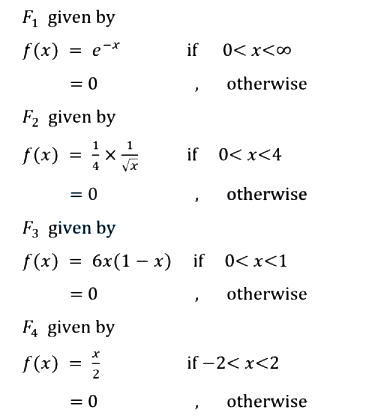
- Which of the following functions is not p.d.f. of a continuous random variable X?
 MHT CET 2020 Medium
 - \(\pi+\left(\sin ^{-1} \frac{4}{5}+\sin ^{-1} \frac{5}{13}+\sin ^{-1} \frac{16}{65}\right)\) is equal toMHT CET 2023 Medium
- The angle between the lines \(\bar{r}=(3 \hat{i}+2 \hat{j}-4 \hat{k})+\lambda(\hat{i}+2 \hat{j}+2 \hat{k})\) and \(\bar{r}=(5 \hat{i}-2 \widehat{k})+\mu(3 \hat{i}+2 \hat{j}+6 \widehat{k})\)MHT CET 2022 Easy
- A straight line through the origin 0 meets the line \(3 \mathrm{y}=10-4 x\) and \(8 x+6 y+5=0\) at the points \(A\) and \(B\) respectively. Then 0 divides the segment \(A B\) in the ratio.MHT CET 2025 Medium
- For the set of 50 observation, the sum of their squares is 3050 , their arithmetic mean is 6 . Hence the standard deviation of these observations isMHT CET 2021 Easy
More PYQs from MHT CET
- A point mass ' \(m\) ' attached at one end of a massless, inextensible string of length ' \(\ell\) ' performs a vertical circular motion and the string rotates in vertical plane, as shown in the diagram. The increase in the centripetal acceleration of the point mass when it moves from point \(A\) to point C is
[ \(\mathrm{g}=\) acceleration due to gravity.]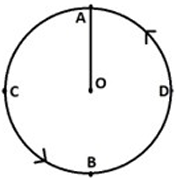 MHT CET 2025 Medium
 - When wavefronts pass from denser medium to rarer medium, the width of the wavefrontMHT CET 2024 Easy
- What is the EAN of Zn in \(\left[\mathrm{Zn}\left(\mathrm{NH}_3\right)_4\right]^{2+}\) ?MHT CET 2024 Easy
- The statement pattern \((p \wedge q) \vee(\sim p \wedge q) \vee(r \wedge \sim q)\) is logical equivalent toMHT CET 2022 Easy
- Which from following carbocations is least stable?MHT CET 2024 Easy
- The angle between the line \(\frac{x+1}{2}=\frac{y-2}{1}=\frac{z-3}{-2}\) and plane \(x-2 y-\lambda z=3\) is \(\cos ^{-1}\left(\frac{2 \sqrt{2}}{3}\right)\), then value of \(\lambda\) isMHT CET 2023 Easy