


MHT CET · Maths · Probability
In a Binomial distribution consisting of 5 independent trials, probabilities of exactly 1 and 2 successes are 0.4096 and 0.2048 respectively, then the probability, of getting exactly 4 successes, is
- A \(\frac{80}{243}\)
- B \(\frac{40}{243}\)
- C \(\frac{32}{625}\)
- D \(\frac{4}{625}\)
Answer & Solution
Correct Answer
(D) \(\frac{4}{625}\)
Step-by-step Solution
Detailed explanation
Let \(\mathrm{P}(\mathrm{X}=1)\) be probability of one success and \(\mathrm{P}(\mathrm{X}=2)\) be probability of two success
\(\begin{array}{ll}
\therefore \quad & P(X=1)={ }^5 \mathrm{C}_1 \mathrm{p}^1 \mathrm{q}^4=0.4096 ...(i)\\
& \mathrm{P}(\mathrm{X}=2)={ }^5 \mathrm{C}_2 \mathrm{p}^2 \mathrm{q}^3=0.2048...(ii)
\end{array}\)
Where \(p=\) probability of success
\(\mathrm{q}=\) probability of failure
\(\therefore \quad\) Dividing (i) by (ii), we get
\(\begin{aligned}
& \frac{{ }^5 \mathrm{C}_1 \mathrm{pq}^4}{{ }^5 \mathrm{C}_2 \mathrm{p}^2 \mathrm{q}^3}=\frac{0.4096}{0.2048} \\
& \frac{5 \mathrm{q}}{10 \mathrm{p}}=2 \\
& \Rightarrow \mathrm{q}=4 \mathrm{p} \\
\therefore \quad & \text { Also, } \mathrm{p}+\mathrm{q}=1 \\
\therefore \quad & p+4 p=1
\end{aligned}\)
\(\begin{array}{ll}\therefore & p=\frac{1}{5} \\ & \therefore \\ & q=\frac{4}{5}\end{array}\)
Now, Probability of getting 4 successes
\(\begin{aligned}
& =\mathrm{P}(\mathrm{X}=4) \\
& ={ }^5 \mathrm{C}_4 \mathrm{p}^4 \mathrm{q} \\
& =5 \times\left(\frac{1}{5}\right)^4 \times \frac{4}{5} \\
& =\frac{4}{625}
\end{aligned}\)
\(\begin{array}{ll}
\therefore \quad & P(X=1)={ }^5 \mathrm{C}_1 \mathrm{p}^1 \mathrm{q}^4=0.4096 ...(i)\\
& \mathrm{P}(\mathrm{X}=2)={ }^5 \mathrm{C}_2 \mathrm{p}^2 \mathrm{q}^3=0.2048...(ii)
\end{array}\)
Where \(p=\) probability of success
\(\mathrm{q}=\) probability of failure
\(\therefore \quad\) Dividing (i) by (ii), we get
\(\begin{aligned}
& \frac{{ }^5 \mathrm{C}_1 \mathrm{pq}^4}{{ }^5 \mathrm{C}_2 \mathrm{p}^2 \mathrm{q}^3}=\frac{0.4096}{0.2048} \\
& \frac{5 \mathrm{q}}{10 \mathrm{p}}=2 \\
& \Rightarrow \mathrm{q}=4 \mathrm{p} \\
\therefore \quad & \text { Also, } \mathrm{p}+\mathrm{q}=1 \\
\therefore \quad & p+4 p=1
\end{aligned}\)
\(\begin{array}{ll}\therefore & p=\frac{1}{5} \\ & \therefore \\ & q=\frac{4}{5}\end{array}\)
Now, Probability of getting 4 successes
\(\begin{aligned}
& =\mathrm{P}(\mathrm{X}=4) \\
& ={ }^5 \mathrm{C}_4 \mathrm{p}^4 \mathrm{q} \\
& =5 \times\left(\frac{1}{5}\right)^4 \times \frac{4}{5} \\
& =\frac{4}{625}
\end{aligned}\)
See the Complete Solution
Get step-by-step explanations for this and 2.5 Lakh+ more JEE, NEET & CET questions.
- Unlock all solutions
- Practice the full chapter
- Track accuracy across PYQs
4.8 rated on Google Play · 14,000+ reviews
More questions from Maths
- If the volume of spherical ball is increasing at the rate of then the rate of change of its surface area when the volume is isMHT CET 2017 Easy
- The distance of the point \((-1,-5,-10)\) from the point of intersection of the line \(\frac{x-2}{3}=\frac{y+1}{4}=\frac{z-2}{12}\) and the plane \(x-y+z=5\) isMHT CET 2023 Medium
- If \(|\vec{a}|=\sqrt{27},|\bar{b}|=7\) and \(|\vec{a} \times \bar{b}|=35\), then \(\bar{a} \cdot \bar{b}\) is equal toMHT CET 2024 Easy
- Let \(\hat{a}\) and \(\hat{b}\) be two unit vectors. If the vectors \(\bar{c}=\hat{a}+2 \hat{b}\) and \(\bar{d}=5 \hat{a}+4 \hat{b}\) are perpendicular to each other, then the angle between \(\hat{a}\) and \(\hat{b}\) isMHT CET 2024 Medium
- If the population grows at the rate \(5 \%\) peryear, then the time taken for the population
to become double is \(\quad\) (Given \(\log 2=0.6912\) )MHT CET 2020 Easy - The joint equation of pair of lines through the origin and making an angle of \(\frac{\pi}{6}\) with the line \(3 x+y-6=0\) isMHT CET 2024 Medium
More PYQs from MHT CET
- What percentage of photosynthetically active radiation (PAR) can be captured by plants?MHT CET 2023 Easy
- The termination of process of oogenesis is indicated by formation of __________ .MHT CET 2018 Medium
- What is IUPAC name of following compound?
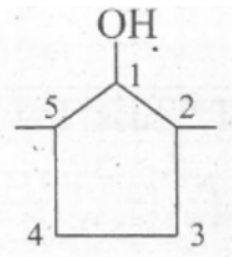 MHT CET 2024 Easy
 - Three thin rods, each of mass ' \(M\) ' and length ' \(L\) ' are placed along \(X, Y\) and Z axes which are mutually perpendicular. One end of each rod is at origin. M. I. of the system about Z axis isMHT CET 2024 Medium
- A uniform rope of length ' \(L\) ' and mass ' \(\mathrm{m}_1\) ' hangs vertically from a rigid support. A block of mass ' \(\mathrm{m}_2\) ' is attached to the free end of the rope. A transverse wave of wavelength ' \(\lambda_1\) ' is produced at the lower end of the rope. The wavelength of the wave when it reaches the top of the rope is ' \(\lambda_2\) '. The ratio \(\frac{\lambda_1}{\lambda_2}\) isMHT CET 2023 Medium
- Structure of ammonia isMHT CET 2007 Easy