


MHT CET · Maths · Linear Programming
If \(\mathrm{Z}=10 x+25 y\) subject to \(0 \leq x \leq 3,0 \leq y \leq 3, x+y \leq 5, x \geq 0, \mathrm{y} \geq 0\) then \(\mathrm{z}\) is maximum at the point
- A \((2,4)\)
- B \((1,6)\)
- C \((2,3)\)
- D \((4,3)\)
Answer & Solution
Correct Answer
(C) \((2,3)\)
Step-by-step Solution
Detailed explanation
(A)
First we draw the lines \(A B, C D\) and \(E F\) whose equation are \(x=3, y=3\) and \(x+y=5\) respectively.

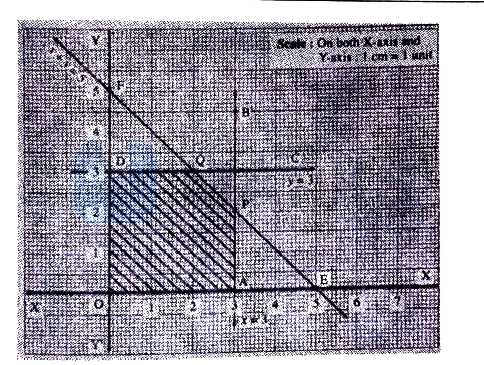
The feasible region is OAPQDO which is shaded in the graph.
The vertices of the feasible region are \(\mathrm{O}(0,0), \mathrm{A}(3,0), \mathrm{P}, \mathrm{Q}\) and \(\mathrm{D}(0,3)\).
\(P\) is the point of intersection of the lines \(x+y=5\) and \(x=3 \Rightarrow P \equiv(3,2)\)
\(Q\) is the point of intersection of the lines \(x+y=5\) and \(y=3 \Rightarrow Q=(2,3)\)
The values of the objective function \(Z=10 x+25 y\) at these vertices are
\(Z_{(0)}=10(0)+25(0)=0+0=0\)
\(Z_{(A)}=10(3)+25(0)=30+0=30\)
\(Z_{(P)}=10(3)+25(2)=30+50=80\)
\(Z_{(Q)}=10(2)+25(3)=20+75=95\)
\(Z_{(D)}=10(0)+25(3)=0+75=75\)
\(\therefore Z\) has maximum value 95, when \(x=2\) and \(y=3\).
First we draw the lines \(A B, C D\) and \(E F\) whose equation are \(x=3, y=3\) and \(x+y=5\) respectively.
The feasible region is OAPQDO which is shaded in the graph.
The vertices of the feasible region are \(\mathrm{O}(0,0), \mathrm{A}(3,0), \mathrm{P}, \mathrm{Q}\) and \(\mathrm{D}(0,3)\).
\(P\) is the point of intersection of the lines \(x+y=5\) and \(x=3 \Rightarrow P \equiv(3,2)\)
\(Q\) is the point of intersection of the lines \(x+y=5\) and \(y=3 \Rightarrow Q=(2,3)\)
The values of the objective function \(Z=10 x+25 y\) at these vertices are
\(Z_{(0)}=10(0)+25(0)=0+0=0\)
\(Z_{(A)}=10(3)+25(0)=30+0=30\)
\(Z_{(P)}=10(3)+25(2)=30+50=80\)
\(Z_{(Q)}=10(2)+25(3)=20+75=95\)
\(Z_{(D)}=10(0)+25(3)=0+75=75\)
\(\therefore Z\) has maximum value 95, when \(x=2\) and \(y=3\).
See the Complete Solution
Get step-by-step explanations for this and 2.5 Lakh+ more JEE, NEET & CET questions.
- Unlock all solutions
- Practice the full chapter
- Track accuracy across PYQs
4.8 rated on Google Play · 14,000+ reviews
More questions from Maths
- If
\(\mathrm{I}=\int \frac{\sin x+\sin ^3 x}{\cos 2 x} \mathrm{~d} x=\mathrm{P} \cos x+\mathrm{Q} \log \left|\frac{\sqrt{2} \cos x-1}{\sqrt{2} \cos x+1}\right|+\mathrm{c},\)
(where \(\mathrm{c}\) is a constant of integration), then the values of \(\mathrm{P}\) and \(\mathrm{Q}\) are respectivelyMHT CET 2023 Hard - \(\int_0^\pi x \sin x \cos ^4 x d x=\)MHT CET 2021 Medium
- \(\lim _{x \rightarrow 2}\left(\frac{5 x-8}{8-3 x}\right)^{\frac{3}{2 x-4}}=\)MHT CET 2022 Easy
- If is a prime number less than 12} and B = {x | , x is factor of 10}, then =…MHT CET 2019 Easy
- \(\int \frac{\mathrm{d} x}{3-2 \cos 2 x}=\frac{\tan ^{-1}(\mathrm{f}(x))}{\sqrt{5}}+\mathrm{c}\), (where c is constant of integration), then \(f(\pi / 4)\) has the valueMHT CET 2024 Medium
- The derivative of \(\tan ^{-1}\left(\frac{\sqrt{1+x^2}-1}{x}\right)\) w.r.t. \(\tan ^{-1}\left(\frac{2 x \sqrt{1-x^2}}{1-2 x^2}\right)\) at \(x=0\) isMHT CET 2025 Medium
More PYQs from MHT CET
- What volume of chlorine gas (molar mass 71) is evolved at STP during electrolysis of fused NaCl by passage of 1 amp current for 965 second? (At STP, V = \(22.4 . \mathrm{dm}^3\) )MHT CET 2024 Easy
- Considering mode of asexual reproduction, match the Column I with II and select the correct option:
Column I Column II i. Yeast a. fragmentation ii. Penicillium b. zoospores iii. Filamentous algae c. budding iv. Chlamydomonas d. conidia MHT CET 2015 Medium - The Cartesian equation of the lien passing through the points \(\mathrm{A}\) \((2,2,1)\) and \(B(1,3,0)\) isMHT CET 2021 Easy
- In series LCR circuit, 'R' represents resistance of electric bulb. If the frequency of a.c. supply is doubled, the value of inductance ' L ' and capacitance ' C ' should beMHT CET 2024 Easy
- If \(A=\left[\begin{array}{cc}1 & 2 \\ -5 & 1\end{array}\right]\) and \(A^{-1}=x A+y I\), where \(I\) is unit matrix of order 2 , then the values of \(x\) and \(y\) are respectivelyMHT CET 2020 Medium
- For the formation of 140 angiospermic seeds how many meiotic cell divisions are expected?MHT CET 2019 Easy