


MHT CET · Maths · Differential Equations
If \(y=y(x)\) is the solution of the differential equation \(x \frac{\mathrm{dy}}{\mathrm{d} x}+2 y=x^2\) satisfying \(y(1)=1\), then the value of \(y\left(\frac{1}{2}\right)\) is
- A \(\frac{7}{64}\)
- B \(\frac{1}{4}\)
- C \(\frac{13}{6}\)
- D \(\frac{49}{16}\)
Answer & Solution
Correct Answer
(D) \(\frac{49}{16}\)
Step-by-step Solution
Detailed explanation
\(\begin{aligned} & x \frac{\mathrm{~d} y}{\mathrm{~d} x}+2 y=x^2 \\ & \frac{\mathrm{~d} y}{\mathrm{~d} x}+\left(\frac{2}{x}\right) y=x \\ & \text { I.F. }=\mathrm{e}^{\int \frac{2}{x} \mathrm{~d} x}=\mathrm{e}^{2 \log x}=x^2\end{aligned}\)
\(\therefore \quad\) Solution of differential equation is
\(\begin{aligned}
& \quad y \cdot x^2=\int x \cdot x^2 \mathrm{~d} x+\mathrm{c} \\
& \quad y x^2=\frac{x^4}{4}+\mathrm{c} ...(i)\\
& \therefore \quad \\
& y=\frac{x^2}{4}+\frac{\mathrm{c}}{x^2}
...(ii)\end{aligned}\)
\(\begin{aligned} & \text { Given, } y(1)=1 \\ & \Rightarrow 1=\frac{1}{4}+\mathrm{c} \\ & \Rightarrow \mathrm{c}=\frac{3}{4}\end{aligned}\)
\(\therefore \quad\) equation (i) becomes,
\(\begin{aligned}
& y=\frac{x^2}{4}+\frac{3}{4 x^2} \\
\therefore \quad & y\left(\frac{1}{2}\right)=\frac{\left(\frac{1}{2}\right)^2}{4}+\frac{3}{4 \times\left(\frac{1}{2}\right)^2}=\frac{1}{16}+3=\frac{49}{16}
\end{aligned}\)
\(\therefore \quad\) Solution of differential equation is
\(\begin{aligned}
& \quad y \cdot x^2=\int x \cdot x^2 \mathrm{~d} x+\mathrm{c} \\
& \quad y x^2=\frac{x^4}{4}+\mathrm{c} ...(i)\\
& \therefore \quad \\
& y=\frac{x^2}{4}+\frac{\mathrm{c}}{x^2}
...(ii)\end{aligned}\)
\(\begin{aligned} & \text { Given, } y(1)=1 \\ & \Rightarrow 1=\frac{1}{4}+\mathrm{c} \\ & \Rightarrow \mathrm{c}=\frac{3}{4}\end{aligned}\)
\(\therefore \quad\) equation (i) becomes,
\(\begin{aligned}
& y=\frac{x^2}{4}+\frac{3}{4 x^2} \\
\therefore \quad & y\left(\frac{1}{2}\right)=\frac{\left(\frac{1}{2}\right)^2}{4}+\frac{3}{4 \times\left(\frac{1}{2}\right)^2}=\frac{1}{16}+3=\frac{49}{16}
\end{aligned}\)
See the Complete Solution
Get step-by-step explanations for this and 2.5 Lakh+ more JEE, NEET & CET questions.
- Unlock all solutions
- Practice the full chapter
- Track accuracy across PYQs
4.8 rated on Google Play · 14,000+ reviews
More questions from Maths
- \(\int \frac{3 x-2}{(x+1)(x-2)^2} d x=\)
(where \(C\) is a constant of integration.)MHT CET 2022 Medium - The joint equation of two lines passing through \((-2,3)\) and parallel to the bisectors of the angle between the co-ordinate axes isMHT CET 2025 Medium
- \(\int_{-4}^{4} \log \left(\frac{8-x}{8+x}\right) d x=\)MHT CET 2020 Easy
- Two cards are drawn simultaneously from a well shuffled pack of 52 cards. If \(X\) is the random variable of getting queens, then the value of \(2 E(X)+3 E\left(X^2\right)\) for the number of queens isMHT CET 2025 Medium
- \(\int_{0}^{\frac{\pi}{2}} \frac{1-\cot x}{\operatorname{cosec} x+\cos x} d x=\)MHT CET 2020 Easy
- The L.P.P. , minimize \(z=30 x+20 y, \quad x+y \leqslant 8, \quad x+2 y \geqslant 4, \quad 6 x+4 y \geqslant 12\), \(x \geqslant 0, y \geqslant 0\) hasMHT CET 2025 Medium
More PYQs from MHT CET
- With gradual increase in frequency of an a.c. supply, the impedance of an LCR series circuitMHT CET 2024 Easy
- Two long parallel wires carrying currents \(8 \mathrm{~A}\) and \(15 \mathrm{~A}\) in opposite directions are placed at a distance of \(7 \mathrm{~cm}\) from each other. A point ' \(\mathrm{P}\) ' is at equidistant from both the wires such that the lines joining the point to the wires are perpendicular to each other. The magnitude of magnetic field at point ' \(\mathrm{P}\) ' is \((\sqrt{2}=1.4)\) ( \(\mu_0=4 \pi \times 10^{-7}\) SI units)MHT CET 2023 Hard
- A random variable If values of mean and variance of are and respectively then total number of possible values of areMHT CET 2017 Easy
- A wire of length \(L\) carries a current \(i\). If the wire is turned into a circular coil and kept in a uniform magnetic field \(B\), the maximum magnitude of torque in the given magnetic field will beMHT CET 2022 Medium
- The centre and radius of a circle \(x=4 a\left(\frac{1-t^{2}}{1+t^{2}}\right), y=\frac{8 a t}{1+t^{2}}\), are respectivelyMHT CET 2020 Medium
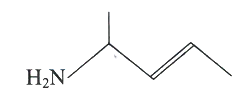
- What is the IUPAC name of following compound?
 MHT CET 2023 Easy