


MHT CET · Maths · Differentiation
If
\(y=[(x+1)(2 x+1)(3 x+1) \ldots \ldots \ldots(\mathrm{n} x+1)]^2,\)
then \(\frac{\mathrm{d} y}{\mathrm{~d} x}\) at \(x=0\) is
- A \(2 \mathrm{n}(\mathrm{n}+1)\)
- B \(\mathrm{n}(\mathrm{n}+1)\)
- C \(\frac{\mathrm{n}(\mathrm{n}+1)}{2}\)
- D \(\left(\frac{\mathrm{n}(\mathrm{n}+1)}{2}\right)^2\)
Answer & Solution
Correct Answer
(B) \(\mathrm{n}(\mathrm{n}+1)\)
Step-by-step Solution
Detailed explanation
\(y=[(x+1)(2 x+1)(3 x+1) \ldots(\mathrm{n} x+1)]^2\)
Taking 'log' on both sides, we get
\(\log y=2[\log (x+1)+\log (2 x +1)+\log (3 x+1)\) \(+\ldots+\log (n x+1)]\)
Differentiating w.r.t. \(\dot{x}\), we get
\(\frac{1}{y} \cdot \frac{\mathrm{~d} y}{\mathrm{~d} x}=2\left(\frac{1}{x+1}+\frac{2}{2 x+1}+\frac{3}{3 x+1}+\ldots+\frac{\mathrm{n}}{\mathrm{n} x+1}\right) \)
\(\therefore \frac{\mathrm{d} y}{\mathrm{~d} x}=2 y\left(\frac{1}{x+1}+\frac{2}{2 x+1}+\frac{3}{3 x+1}+\ldots+\frac{\mathrm{n}}{\mathrm{n} x+1}\right)\)
Now at \(x=0, y=[(1)(1)(1) \ldots(1)]^2=1\)
\(\therefore \left(\frac{\mathrm{d} y}{\mathrm{~d} x}\right)_{x=0} =2(1)\left(\frac{1}{0+1}+\frac{2}{0+1}+\frac{3}{0+1}+\ldots+\frac{\mathrm{n}}{0+1}\right) \)
\( =2(1+2+3+\ldots+\mathrm{n}) \)
\( =2 \times \frac{\mathrm{n}(\mathrm{n}+1)}{2}=\mathrm{n}(\mathrm{n}+1)\)
Taking 'log' on both sides, we get
\(\log y=2[\log (x+1)+\log (2 x +1)+\log (3 x+1)\) \(+\ldots+\log (n x+1)]\)
Differentiating w.r.t. \(\dot{x}\), we get
\(\frac{1}{y} \cdot \frac{\mathrm{~d} y}{\mathrm{~d} x}=2\left(\frac{1}{x+1}+\frac{2}{2 x+1}+\frac{3}{3 x+1}+\ldots+\frac{\mathrm{n}}{\mathrm{n} x+1}\right) \)
\(\therefore \frac{\mathrm{d} y}{\mathrm{~d} x}=2 y\left(\frac{1}{x+1}+\frac{2}{2 x+1}+\frac{3}{3 x+1}+\ldots+\frac{\mathrm{n}}{\mathrm{n} x+1}\right)\)
Now at \(x=0, y=[(1)(1)(1) \ldots(1)]^2=1\)
\(\therefore \left(\frac{\mathrm{d} y}{\mathrm{~d} x}\right)_{x=0} =2(1)\left(\frac{1}{0+1}+\frac{2}{0+1}+\frac{3}{0+1}+\ldots+\frac{\mathrm{n}}{0+1}\right) \)
\( =2(1+2+3+\ldots+\mathrm{n}) \)
\( =2 \times \frac{\mathrm{n}(\mathrm{n}+1)}{2}=\mathrm{n}(\mathrm{n}+1)\)
See the Complete Solution
Get step-by-step explanations for this and 2.5 Lakh+ more JEE, NEET & CET questions.
- Unlock all solutions
- Practice the full chapter
- Track accuracy across PYQs
4.8 rated on Google Play · 14,000+ reviews
More questions from Maths
- A box contains 100 tickets numbered 1 to 100 . A ticket is drawn at random from the box. Then the probability, that number on the ticket is a perfect square, isMHT CET 2023 Medium
- The slopes of the lines, making angle of measures \(45^{\circ}\) with the line \(2 x-3 y=5\) areMHT CET 2022 Easy
- \(\int \frac{\sin 2 x \cos 2 x}{\sqrt{4-\cos ^4 2 x}} \mathrm{~d} x=\)MHT CET 2025 Medium
- If \(A=\left[\begin{array}{ccc}1 & 3 & -2 \\ -3 & 0 & -5 \\ 2 & 5 & 0\end{array}\right]\) and \(A(\operatorname{adj} A)=K I\), then the value of \(K\) is (where \(I\) is unit matrix of order 3)MHT CET 2022 Easy
- The unit vector which is orthogonal to the vector \(3 \hat{i}+2 \hat{j}+6 \hat{k}\) and coplanar with the vectors \(2 \hat{i}+\hat{j}+\hat{k}\) and \(\hat{i}+\hat{j}+\hat{k}\) isMHT CET 2023 Easy
- If \(\mathrm{A}+\mathrm{B}=\frac{\pi}{2}\) then the maximum value of \(\cos \mathrm{A} \cdot \cos \mathrm{B}\) isMHT CET 2025 Medium
More PYQs from MHT CET
- The length of latus rectum of the parabola whose focus is at \((1,-2)\) and directrix is
the line \(x+y+3=0\) isMHT CET 2020 Medium - Which of the following molecules has zero dipole moment?MHT CET 2024 Medium
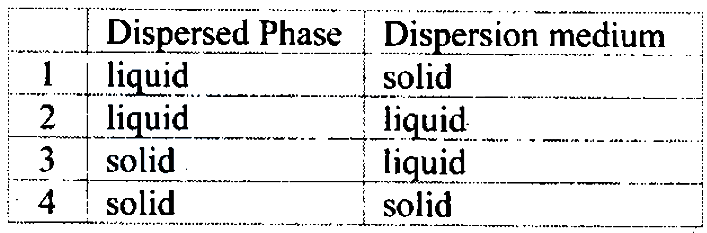
- Identify dispersed phase and dispersion medium in cheese.
 MHT CET 2024 Easy
 - Which among the following salts turns red litmus blue in its aqueous solution?MHT CET 2025 Easy
- Calculate the volume of unit cell having four particles in it with density \(19.0 \mathrm{~g} \mathrm{~cm}^{-3}\) [molar mass of element \(=190 \mathrm{~g} \mathrm{~mol}^{-1}\) ]MHT CET 2022 Easy
- Calculate velocity of an electron having de Broglie's wavelength 58 nm and mass \(9.1 \times 10^{-31} \mathrm{~kg} ?\left[\mathrm{~h}=6.63 \times 10^{-34} \mathrm{Js}\right]\)MHT CET 2025 Medium