


MHT CET · Maths · Differentiation
If \(y\) is a function of \(x\) and \(\log (x+y)=2 x y\), then the value of \(y^{\prime}(0)\) is
- A 1
- B -1
- C 2
- D 0
Answer & Solution
Correct Answer
(A) 1
Step-by-step Solution
Detailed explanation
\(\log (x+y)=2 x y\)
Differentiating w.r.t. \(x\), we get
\(\begin{aligned}
& \frac{1}{x+y}\left(1+\frac{\mathrm{d} y}{\mathrm{~d} x}\right)=2 x \frac{\mathrm{d} y}{\mathrm{~d} x}+2 y \\
& \frac{1}{x+y}+\frac{1}{(x+y)} \frac{\mathrm{d} y}{\mathrm{~d} x}=2 x \frac{\mathrm{d} y}{\mathrm{~d} x}+2 y \\
& \left(\frac{1}{x+y}-2 x\right) \frac{\mathrm{d} y}{\mathrm{~d} x}=2 y-\frac{1}{x+y} \\
& \frac{\mathrm{d} y}{\mathrm{~d} x}\left(\frac{1}{x+y}-2 x\right)=2 y-\frac{1}{x+y} \\
& \frac{\mathrm{d} y}{\mathrm{~d} x}=\frac{\left(2 y-\frac{1}{x+y}\right)}{\left(\frac{1}{x+y}-2 x\right)} \\
& \text { For } x=0, \log (y)=0 \\
& \Rightarrow y=1 \\
& \left.\frac{\mathrm{d} y}{\mathrm{~d} x}\right|_{(0,1)}=\frac{\left(2-\frac{1}{0+1}\right)}{\left(\frac{1}{0+1}-0\right)}=1
\end{aligned}\)
Differentiating w.r.t. \(x\), we get
\(\begin{aligned}
& \frac{1}{x+y}\left(1+\frac{\mathrm{d} y}{\mathrm{~d} x}\right)=2 x \frac{\mathrm{d} y}{\mathrm{~d} x}+2 y \\
& \frac{1}{x+y}+\frac{1}{(x+y)} \frac{\mathrm{d} y}{\mathrm{~d} x}=2 x \frac{\mathrm{d} y}{\mathrm{~d} x}+2 y \\
& \left(\frac{1}{x+y}-2 x\right) \frac{\mathrm{d} y}{\mathrm{~d} x}=2 y-\frac{1}{x+y} \\
& \frac{\mathrm{d} y}{\mathrm{~d} x}\left(\frac{1}{x+y}-2 x\right)=2 y-\frac{1}{x+y} \\
& \frac{\mathrm{d} y}{\mathrm{~d} x}=\frac{\left(2 y-\frac{1}{x+y}\right)}{\left(\frac{1}{x+y}-2 x\right)} \\
& \text { For } x=0, \log (y)=0 \\
& \Rightarrow y=1 \\
& \left.\frac{\mathrm{d} y}{\mathrm{~d} x}\right|_{(0,1)}=\frac{\left(2-\frac{1}{0+1}\right)}{\left(\frac{1}{0+1}-0\right)}=1
\end{aligned}\)
See the Complete Solution
Get step-by-step explanations for this and 2.5 Lakh+ more JEE, NEET & CET questions.
- Unlock all solutions
- Practice the full chapter
- Track accuracy across PYQs
4.8 rated on Google Play · 14,000+ reviews
More questions from Maths
- If \(\int x^{x}(1+\log x) d x=k x^{x}+c\), then \(k=\)MHT CET 2020 Medium
- The principal solutions of the equation \(\sec x+\tan x=2 \cos x\) areMHT CET 2023 Easy
- \(\mathrm{f}(x)=(\cos x+\mathrm{i} \sin x) \cdot(\cos 3 x+\mathrm{i} \sin 3 x) \cdots \cdots\)\([\cos (2 \mathrm{n}-1) x+\mathrm{i} \sin (2 \mathrm{n}-1) x], \mathrm{n} \in \mathbb{N} \text { Then }\) \(\mathrm{f}^{\prime \prime}(x)\) \(=,(\text {Where } i=\sqrt{-1})\)MHT CET 2025 Medium
- Let \(\bar{a}=\alpha \hat{i}+3 \hat{\mathrm{j}}-\hat{\mathrm{k}}, \overline{\mathrm{b}}=3 \hat{i}-\hat{\mathrm{j}}+\beta \hat{\mathrm{k}}\) and \(\overline{\mathrm{c}}=\hat{i}+2 \hat{\mathrm{j}}-2 \hat{\mathrm{k}}\) where \(\alpha, \beta \in \mathbb{R}\), be three vectors. If the projection of \(\bar{a}\) on \(\bar{c}\) is \(\frac{10}{3}\) and \(\overline{\mathrm{b}} \times \overline{\mathrm{c}}=-6 \hat{i}+10 \hat{\mathrm{j}}+7 \hat{\mathrm{k}}\), then the value of \((\alpha+\beta)\) is equal toMHT CET 2025 Medium
- \( \int_{0}^{\frac{\pi}{2}} \frac{d x}{1+\cos x}= \)MHT CET 2020 Medium
- The solution set of the inequalities \(4 x+3 y \leq 60, y \geq 2 x, x \geq 3, x, y \geq 0\) is represented by region
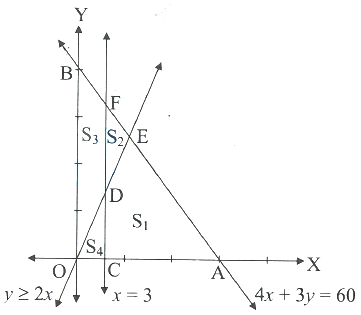 MHT CET 2023 Hard
More PYQs from MHT CET
- The approximate value of \(3^{2.001}\), if \(\log 3=1.0986\) isMHT CET 2024 Easy
- Calculate the wave number of photon emitted during transition from the orbit \(\mathrm{n}=2\) to \(\mathrm{n}=1\) in hydrogen atom \(\left(\mathrm{R}_{\mathrm{H}}=109677 \mathrm{~cm}^{-1}\right)\)MHT CET 2022 Medium
- The common name of Benzene-1,3-diol is:MHT CET 2023 Easy
- A body of mass \(m\) slides down an incline and reaches the bottom with a velocity \(V\). If the same mass were in the form of a disc which rolls down this incline, the velocity of the disc at bottom would have beenMHT CET 2024 Hard
- Which is NOT correct regarding stock notation?MHT CET 2025 Medium
- If \(\mathrm{f}(x)=\left(\frac{2^{x}-1}{1-3^{x}}\right)\), for \(\mathrm{x} \neq 0\) is continuous at \(x=0\), then \(\mathrm{f}(0)=\)MHT CET 2020 Easy