


MHT CET · Maths · Application of Derivatives
If \(y=\mathrm{a} \log x+\mathrm{b} x^2+x\) has its extremum values at \(x=-1\) and \(x=2\), then
- A \(\mathrm{a}=2, \mathrm{~b}=-1\)
- B \(\mathrm{a}=2, \mathrm{~b}=-\frac{1}{2}\)
- C \(\mathrm{a}=-2, \mathrm{~b}=\frac{1}{2}\)
- D \(\mathrm{a}=2, \mathrm{~b}=\frac{1}{2}\)
Answer & Solution
Correct Answer
(B) \(\mathrm{a}=2, \mathrm{~b}=-\frac{1}{2}\)
Step-by-step Solution
Detailed explanation
\(y=a \log x+b x^2+x \)
\( \therefore \frac{\mathrm{~d} y}{\mathrm{~d} x}=\frac{\mathrm{a}}{x}+2 \mathrm{~b} x+1 \)
\( \Rightarrow\left(\frac{\mathrm{~d} y}{\mathrm{~d} x}\right)_{x=-1}=-\mathrm{a}-2 \mathrm{~b}+1=0 \)
\( \Rightarrow \mathrm{a}+2 \mathrm{~b}=1...(i)\)
and \(\left(\frac{\mathrm{d} y}{\mathrm{~d} x}\right)_{x=2}=\frac{\mathrm{a}}{2}+4 \mathrm{~b}+1=0\)
\(\Rightarrow a+8 b+2=0...(ii)\)
Solving (i) and (ii), we get
\(a=2, b=-\frac{1}{2}\)
\( \therefore \frac{\mathrm{~d} y}{\mathrm{~d} x}=\frac{\mathrm{a}}{x}+2 \mathrm{~b} x+1 \)
\( \Rightarrow\left(\frac{\mathrm{~d} y}{\mathrm{~d} x}\right)_{x=-1}=-\mathrm{a}-2 \mathrm{~b}+1=0 \)
\( \Rightarrow \mathrm{a}+2 \mathrm{~b}=1...(i)\)
and \(\left(\frac{\mathrm{d} y}{\mathrm{~d} x}\right)_{x=2}=\frac{\mathrm{a}}{2}+4 \mathrm{~b}+1=0\)
\(\Rightarrow a+8 b+2=0...(ii)\)
Solving (i) and (ii), we get
\(a=2, b=-\frac{1}{2}\)
See the Complete Solution
Get step-by-step explanations for this and 2.5 Lakh+ more JEE, NEET & CET questions.
- Unlock all solutions
- Practice the full chapter
- Track accuracy across PYQs
4.8 rated on Google Play · 14,000+ reviews
More questions from Maths
- The equation of circle passing through the points \((1,-2)\) and \((4,-3)\) and whose centre lies on the line \(3 x+2 y=7\) isMHT CET 2022 Easy
- The straight line passing through \((-3,6)\) and midpoint of the line segment joining the points \((4,-5)\) and \((-2,9)\) have inclinationMHT CET 2025 Easy
- If \(\mathrm{f}(x)=x \mathrm{e}^{x(1-x)}, x \in \mathrm{R}\), then \(\mathrm{f}(x)\) isMHT CET 2023 Hard
- The mean of the numbers \(a, b, 8,5,10\) is 6 and the variance is \(6 \cdot 8\). Then which of the following gives possible values of \(a\) and \(b\) ?MHT CET 2024 Easy
- If \(\int \frac{\cos \theta}{5+7 \sin \theta-2 \cos ^2 \theta} d \theta=A \log _e|f(\theta)|+c\) (where \(\mathrm{c}\) is a constant of integration), then \(\frac{f(\theta)}{A}\) can beMHT CET 2023 Medium
- The radius of a cylinder is increasing at the rate \(2 \mathrm{~cm} / \mathrm{sec}\) and its height is decreasing at the rate of \(3 \mathrm{~cm} / \mathrm{sec}\), then the rate of change of volume, when radius is \(3 \mathrm{~cm}\) and the height is \(5 \mathrm{~cm}\), isMHT CET 2022 Medium
More PYQs from MHT CET
- How much part of an atom occupies each corner of bcc unit cell?MHT CET 2020 Easy
- Which of the following person is in an inertial frame of reference?MHT CET 2024 Easy
- The megasporangium proper of an angiosperm ovule is represented byMHT CET 2017 Medium
- The coil and magnet are moved in the same direction with same speed (V). The induced e.m.f. is
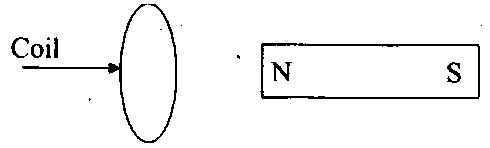 MHT CET 2024 Medium
 - Match the diseases in Column I with the type of microbe causing them in Column II.
Choose the correct optionColumn I Column II i Elephantiasis a. virus ii Typhoid b. nematode parasite iii Dermatophytosis c. Gram -ve bacteria iv Dengue d. Protist v Malaria e. fungus MHT CET 2023 Hard - If the function \(P[X=x]=\left\{\begin{array}{cc}\frac{K \cdot 2^x}{x !}, & x=0,1,2,3 \ 0, & \text { otherwise }\end{array}\right.\) Forms p.m.f., then value of \(K\) isMHT CET 2022 Medium