


MHT CET · Maths · Differentiation
If \(x=\log t, y+1=\frac{1}{t}, \quad\) then \(e^{-x} \frac{d^{2} x}{d y^{2}}+\frac{d x}{d y}=\)
- A 0
- B 2
- C \(-1\)
- D 1
Answer & Solution
Correct Answer
(A) 0
Step-by-step Solution
Detailed explanation
Given \(x=\log t\) and \(y+1=\frac{1}{t}\)
\(\therefore \frac{d x}{d t}=\frac{1}{t}\) and \(\frac{d y}{d t}=\frac{-1}{t^{2}}\)
\(\therefore \frac{d x}{d y}=\frac{1}{t} \times\left(-t^{2}\right)=-t\)
\(\therefore \frac{d^{2} x}{d y^{2}}=\frac{d}{d t}\left(\frac{d x}{d y}\right) \times \frac{d t}{d y}=\frac{d}{d t}(-t) \times \frac{1}{\left(\frac{d y}{d t}\right)}=\frac{(-1)}{\left(\frac{-1}{t^{2}}\right)}=t^{2}\)
\(e^{-x}=e^{-\log t}=e^{\log (t)^{-1}}=\frac{1}{t}\)
Thus \(e^{-x} \frac{d^{2} y}{d x^{2}}+\frac{d x}{d y}\)
\(=\left(\frac{1}{t}\right)\left(t^{2}\right)+(-t)=t-t=0\)
\(\therefore \frac{d x}{d t}=\frac{1}{t}\) and \(\frac{d y}{d t}=\frac{-1}{t^{2}}\)
\(\therefore \frac{d x}{d y}=\frac{1}{t} \times\left(-t^{2}\right)=-t\)
\(\therefore \frac{d^{2} x}{d y^{2}}=\frac{d}{d t}\left(\frac{d x}{d y}\right) \times \frac{d t}{d y}=\frac{d}{d t}(-t) \times \frac{1}{\left(\frac{d y}{d t}\right)}=\frac{(-1)}{\left(\frac{-1}{t^{2}}\right)}=t^{2}\)
\(e^{-x}=e^{-\log t}=e^{\log (t)^{-1}}=\frac{1}{t}\)
Thus \(e^{-x} \frac{d^{2} y}{d x^{2}}+\frac{d x}{d y}\)
\(=\left(\frac{1}{t}\right)\left(t^{2}\right)+(-t)=t-t=0\)
See the Complete Solution
Get step-by-step explanations for this and 2.5 Lakh+ more JEE, NEET & CET questions.
- Unlock all solutions
- Practice the full chapter
- Track accuracy across PYQs
4.8 rated on Google Play · 14,000+ reviews
More questions from Maths
- Let \(\mathrm{A}=\left[\begin{array}{cc}1 & 2 \\ -1 & 4\end{array}\right]\) and \(\mathrm{A}^{-1}=\alpha \mathrm{I}+\beta \mathrm{A}, \alpha, \beta \in \mathbb{R}\), I is the identity matrix of order 2 , then \(4(\alpha-\beta)\) isMHT CET 2024 Easy
- \(f(x)=\frac{3 x+2}{5 x-3}, x \in R-\left\{\frac{3}{5}\right\}\), thenMHT CET 2020 Hard
- The graphical solution set of the system of in equations \(\mathrm{x}+\mathrm{y} \leq 70, \mathrm{x}+2 \mathrm{y} \leq 100,2 \mathrm{x}+\mathrm{y} \leq 120, \mathrm{x} \geq 0, \mathrm{y} \geq 0\) is given by
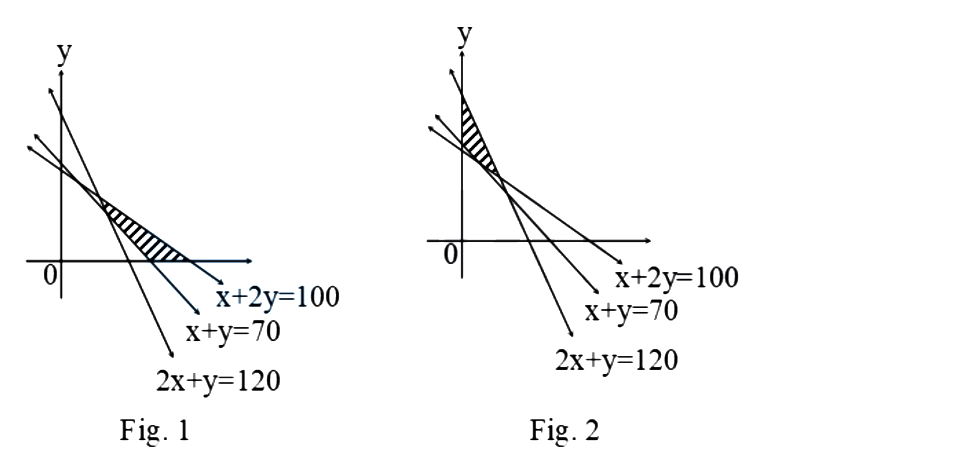
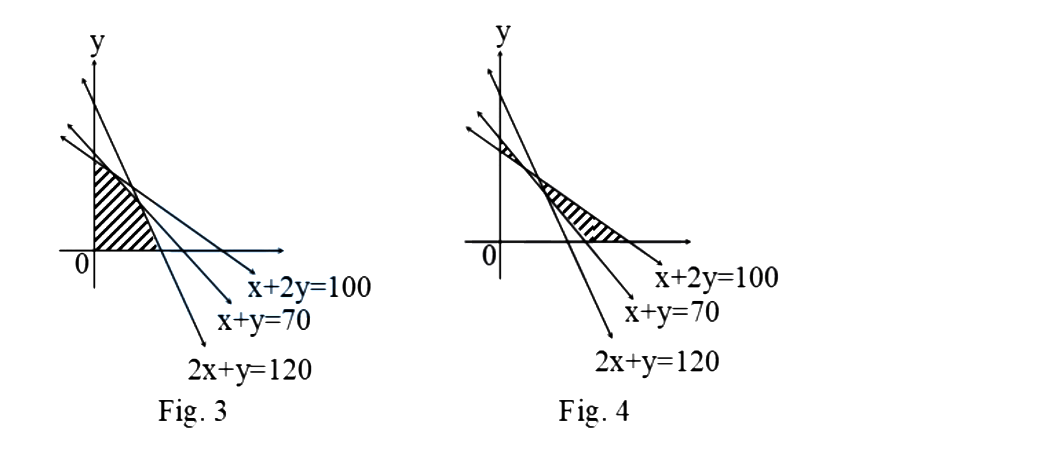 MHT CET 2022 Easy
 - The general solution of the differential equation \(\left(3 x y+y^2\right) d x\) \(+\left(x^2+x y\right) d y=0\) isMHT CET 2021 Hard
- The particular solution of the differential equation \(y(1+\log x) \frac{d x}{d y}-x \log x=0\) when \(x=e, y=e^2\) isMHT CET 2021 Medium
- Angle between the tangents to the circle \(x^2+y^2=25 x^2\) from the point \((1,7)\) isMHT CET 2022 Medium
More PYQs from MHT CET
- If \(\frac{\cos (A+B)}{\cos (A-B)}=\frac{\sin (C+D)}{\sin (C-D)}\), then \(\tan A \tan B \tan C=\)MHT CET 2021 Medium
- The equation of the tangent to the curve \(y=b e^{-x / a}\) at the point where it crosses the Y axis isMHT CET 2025 Medium
- The curve \(\left(\frac{x}{a}\right)^n+\left(\frac{y}{b}\right)^n=2, n \in N\) touches the line at the point \((a, b)\), then the equation of the line isMHT CET 2022 Hard
- The decrease in length of a metal bar of length and crosssectional area when compressed with a load along its length is ( Young's modulus of the material of metal bar)MHT CET 2018 Medium
- The solution of the differential equation. \((1+x) \frac{\mathrm{dy}}{\mathrm{d} x}-x \mathrm{y}=1-x\) isMHT CET 2025 Medium
- The depth at which acceleration due to gravity becomes \(\frac{\mathrm{g}}{\mathrm{n}}\) is [ \(\mathrm{R}\) = radius of earth, \(\mathrm{g}\) = acceleration due to gravity, \(\mathrm{n}=\) integer]MHT CET 2021 Easy