


MHT CET · Maths · Probability
If \(X \sim B(4, p)\) and \(2 P(X=3)=3 P(X=2)\) then value of \(p\) is
- A \(\frac{9}{13}\)
- B \(\frac{4}{13}\)
- C \(\frac{1}{13}\)
- D \(\frac{12}{13}\)
Answer & Solution
Correct Answer
(A) \(\frac{9}{13}\)
Step-by-step Solution
Detailed explanation
Given \(X \sim B(4, p)\) and \(2 P(X=3)=3 P(X=2)\)
\(2\left[{ }^{4} C_{3} p^{3} q^{1}\right]=3\left[{ }^{4} C_{2} p^{2} q^{2}\right]\)
\(2 \times 4 p^{3} q=3 \times 6 p^{2} q^{2}\)
\(\therefore p=\frac{9 q}{4} \Rightarrow p=\frac{9}{4}(1-p) \Rightarrow p=\frac{9}{4}-\frac{9}{4} p\)
\(\left(1+\frac{9}{4}\right) p=\frac{9}{4} \Rightarrow \frac{13 p}{4}=\frac{9}{4} \Rightarrow p=\frac{9}{13}\)
\(2\left[{ }^{4} C_{3} p^{3} q^{1}\right]=3\left[{ }^{4} C_{2} p^{2} q^{2}\right]\)
\(2 \times 4 p^{3} q=3 \times 6 p^{2} q^{2}\)
\(\therefore p=\frac{9 q}{4} \Rightarrow p=\frac{9}{4}(1-p) \Rightarrow p=\frac{9}{4}-\frac{9}{4} p\)
\(\left(1+\frac{9}{4}\right) p=\frac{9}{4} \Rightarrow \frac{13 p}{4}=\frac{9}{4} \Rightarrow p=\frac{9}{13}\)
See the Complete Solution
Get step-by-step explanations for this and 2.5 Lakh+ more JEE, NEET & CET questions.
- Unlock all solutions
- Practice the full chapter
- Track accuracy across PYQs
4.8 rated on Google Play · 14,000+ reviews
More questions from Maths
- The differential equation of all lines perpendicular to the line \(5 x+2 y+7=0\) isMHT CET 2020 Medium
- The maximum value of subject to is ________MHT CET 2019 Hard
- If the vectors \(\hat{\mathbf{i}}-3 \hat{\mathbf{j}}+2 \hat{\mathbf{k}},-\hat{\mathbf{i}}+2 \hat{\mathbf{j}}\) represents
the diagonals of a parallelogram, then its area will beMHT CET 2008 Easy - The differential equation of the circles having their centres on the line \(\mathrm{y}=8\) and touching the \(\mathrm{X}\) -axis isMHT CET 2020 Medium
- If \(A=\left[\begin{array}{ccc}1 & -1 & 1 \\ 2 & -1 & 0 \\ 3 & 3 & -4\end{array}\right]\), adj \(A=\left[\begin{array}{ccc}4 & -1 & 1 \\ 8 & -7 & a \\ 9 & -6 & b\end{array}\right]\), thenMHT CET 2022 Medium
- \(\int \cos \left(\frac{x}{16}\right) \cdot \cos \left(\frac{x}{8}\right) \cdot \cos \left(\frac{x}{4}\right) \cdot \sin \left(\frac{x}{16}\right) \mathrm{dx}=\)MHT CET 2025 Medium
More PYQs from MHT CET
- When HCl is treated with propene in presence of sodium peroxide, the major product obtained isMHT CET 2020 Medium
- If \(\mathrm{k}_{\mathrm{i}}\) are possible values of \(\mathrm{k}\) for which lines \(\mathrm{k} x+2 y+2=0,2 x+\mathrm{k} y+3=0\) and \(3 x+3 y+\mathrm{k}=0\) are concurrent, then \(\sum \mathrm{k}_{\mathrm{i}}\) has the valueMHT CET 2023 Medium
- The reagent used Gatterman-Koch formylation of arene isMHT CET 2021 Medium
- What is the type of hybridisation and the geometry respectively found in \(\left[\mathrm{CoF}_{6}\right]^{3-} ?\)MHT CET 2020 Medium
- Let \(\mathrm{A}, \mathrm{B}\) and \(\mathrm{C}\) be the three points in a uniform electric field \((\overrightarrow{\mathrm{E}})\) as shown. The electric potential is
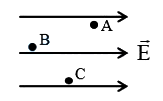 MHT CET 2021 Easy
 - If \(\mathrm{y}=\mathrm{y}(x)\) satisfies \(\left(\frac{2+\sin x}{1+y}\right) \frac{\mathrm{dy}}{\mathrm{d} x}=-\cos x\). such that \(y(0)=2\), then \(y\left(\frac{\pi}{2}\right)\) is equal toMHT CET 2025 Medium