


MHT CET · Maths · Statistics
If variance of \(x_1, x_2 \ldots \ldots, x_{\mathrm{n}}\) is \(\sigma_x^2\), then the variance of \(\lambda x_1, \lambda x_2, \ldots \ldots, \lambda x_n(\lambda \neq 0)\) is
- A \(\lambda \cdot \sigma_x\)
- B \(\lambda \cdot \sigma_x^2\)
- C \(\lambda^2 \cdot \sigma_x\)
- D \(\lambda^2 \cdot \sigma_x^2\)
Answer & Solution
Correct Answer
(D) \(\lambda^2 \cdot \sigma_x^2\)
Step-by-step Solution
Detailed explanation
When each item of a data is multiplied by \(\lambda\), variance is multiplied by \(\lambda^2\).
\(\therefore \quad\) New variance \(=\lambda^2 \cdot \sigma_x^2\)
\(\therefore \quad\) New variance \(=\lambda^2 \cdot \sigma_x^2\)
See the Complete Solution
Get step-by-step explanations for this and 2.5 Lakh+ more JEE, NEET & CET questions.
- Unlock all solutions
- Practice the full chapter
- Track accuracy across PYQs
4.8 rated on Google Play · 14,000+ reviews
More questions from Maths
- If \(A\) is a square matrix of order \(n \times n\), then \(\operatorname{adj}(\operatorname{adj} A)\) is equal toMHT CET 2007 Easy
- In \(\triangle \mathrm{ABC}\), with usual notations, if \(\frac{1}{b+c}+\frac{1}{c+a}=\frac{3}{a+b+c}\), then \(m \angle C\) is equal toMHT CET 2024 Medium
- \(\int \frac{x^{2}+1}{(x-3)(x-2)} d x=P x+Q \log |x-3|+R \log |x-2|+c\), where \(c\) is constant of
integration, then the values of \(\mathrm{P}, \mathrm{Q}, \mathrm{R}\) are, respectivelyMHT CET 2020 Medium - If a \(\cos 2 \theta+b \sin 2 \theta=c\) has \(\alpha\) and \(\beta\) as its roots, then the value of \(\tan \alpha+\tan \beta\) isMHT CET 2023 Easy
- If for some \(\alpha \in \mathbb{R}\), the lines \(\mathrm{L}_1: \frac{x+1}{2}=\frac{y-2}{-1}=\frac{z-1}{1}\) and \(\mathrm{L}_2: \frac{x+2}{\alpha}=\frac{y+1}{5-\alpha}=\frac{z+1}{1}\) are coplanar, then the line \(\mathrm{L}_2\) passes through the pointMHT CET 2024 Medium
- If , thenMHT CET 2018 Medium
More PYQs from MHT CET
- Which among the following is true for chemisorption?MHT CET 2021 Easy
- Two wires \(2 \mathrm{~mm}\) apart supply current to a \(100 \mathrm{~V}\), \(1 \mathrm{~kW}\) heater. The force per metre between the wires is \(\left(\mu_0=4 \pi \times 10^{-27}\right.\) SI unit)MHT CET 2023 Medium
- How many NAND gates are required to form an AND gate?MHT CET 2010 Easy
- The Cartesian equation of the plane, passing through the points \((3,1,1),(1,2,3)\) and \((-1,4,2)\), isMHT CET 2024 Easy
- The line joining points \((3,5,-7)\) and \((-2,1,8)\) meets yz-plane at pointMHT CET 2022 Medium
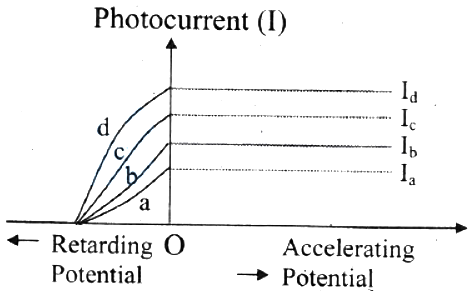
- The figure shows the variation of photocurrent with anode potential for four different radiations. Let \(\mathrm{I}_{\mathrm{a}}, \mathrm{I}_{\mathrm{b}}, \mathrm{I}_{\mathrm{c}}\) and \(\mathrm{I}_{\mathrm{d}}\) be the intensities for the curves a, b, c and d respectively \(\left[f_a, f_b, f_c\right.\) and \(f_d\) are frequencies respectively]
 MHT CET 2024 Easy