


MHT CET · Maths · Vector Algebra
If the vectors \(\bar{a}=\hat{i}-\hat{j}+2 \hat{k}, \bar{b}=2 \hat{i}+4 \hat{j}+\hat{k}\) and \(\overline{\mathrm{c}}=\mathrm{mi}+\mathrm{j}+\mathrm{nk}\) are mutually perpendicular, then \((\mathrm{m}, \mathrm{n})\) is
- A \((3,-2)\)
- B \((-2,3)\)
- C \((2,-3)\)
- D \((-3,2)\)
Answer & Solution
Correct Answer
(D) \((-3,2)\)
Step-by-step Solution
Detailed explanation
\(\overline{\mathrm{a}}=\hat{\mathrm{i}}-\hat{\mathrm{j}}+2 \hat{\mathrm{k}}, \overline{\mathrm{~b}}=2 \hat{\mathrm{i}}+4 \hat{\mathrm{j}}+\hat{\mathrm{k}} \text { and } \overline{\mathrm{c}}=m \hat{\mathrm{i}}+\hat{\mathrm{j}}+\mathrm{n} \hat{\mathrm{k}}\)
\(\overline{\mathrm{a}}\) and \(\overline{\mathrm{c}}\) are orthogonal
\(\begin{aligned}
\therefore \quad & \overline{\mathrm{a}} \cdot \overline{\mathrm{c}}=0 \\
& \mathrm{~m}(1)+(1)(-1)+\mathrm{n}(2)=0 \\
& m-1+2 \mathrm{n}=0 \\
& m+2 n=1...(i)
\end{aligned}\)
Also, \(\overline{\mathrm{b}}\) and \(\overline{\mathrm{c}}\) are orthogonal
\(\begin{array}{ll}
\therefore \quad & \bar{b} \cdot \overline{\mathrm{c}}=0 \\
& 2(\mathrm{~m})+4(1)+\mathrm{n}(1)=0 \\
& 2 \mathrm{~m}+\mathrm{n}=-4...(ii)
\end{array}\)
Solving (i) and (ii), we get
\(\begin{array}{ll}
& m=-3, \mathrm{n}=2 \\
\therefore \quad & (\mathrm{~m}, \mathrm{n})=(-3,2)
\end{array}\)
\(\overline{\mathrm{a}}\) and \(\overline{\mathrm{c}}\) are orthogonal
\(\begin{aligned}
\therefore \quad & \overline{\mathrm{a}} \cdot \overline{\mathrm{c}}=0 \\
& \mathrm{~m}(1)+(1)(-1)+\mathrm{n}(2)=0 \\
& m-1+2 \mathrm{n}=0 \\
& m+2 n=1...(i)
\end{aligned}\)
Also, \(\overline{\mathrm{b}}\) and \(\overline{\mathrm{c}}\) are orthogonal
\(\begin{array}{ll}
\therefore \quad & \bar{b} \cdot \overline{\mathrm{c}}=0 \\
& 2(\mathrm{~m})+4(1)+\mathrm{n}(1)=0 \\
& 2 \mathrm{~m}+\mathrm{n}=-4...(ii)
\end{array}\)
Solving (i) and (ii), we get
\(\begin{array}{ll}
& m=-3, \mathrm{n}=2 \\
\therefore \quad & (\mathrm{~m}, \mathrm{n})=(-3,2)
\end{array}\)
See the Complete Solution
Get step-by-step explanations for this and 2.5 Lakh+ more JEE, NEET & CET questions.
- Unlock all solutions
- Practice the full chapter
- Track accuracy across PYQs
4.8 rated on Google Play · 14,000+ reviews
More questions from Maths
- If \(X\) is a random variable with distribution given below
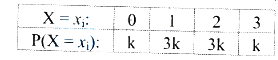
Then the value of \(k\) and its variance are respectively given byMHT CET 2024 Easy - If \(\overline{\mathrm{a}}=\hat{\mathrm{i}}-2 \hat{\mathrm{j}}+3 \hat{\mathrm{k}}\) and \(\overline{\mathrm{b}}=2 \hat{\mathrm{i}}+3 \hat{\mathrm{j}}-\hat{\mathrm{k}}\) are two vectors, then the angle between the vectors \(3 \bar{a}+5 \bar{b}\) and \(5 \bar{a}+3 \bar{b}\) isMHT CET 2024 Easy
- The symbolic form of the following circuit is (where and \(s_{2}\) closed respectively)
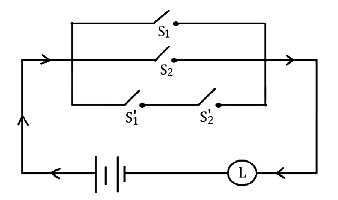 MHT CET 2020 Hard
 - For \(x>1\), if \((2 x)^{2 y}=4 e^{2 x-2 y}\), then \((1+\log 2 x)^2 \frac{d y}{d x}\) is equal toMHT CET 2022 Hard
- The general solution of the differential equation \(\left(3 x y+y^2\right) d x\) \(+\left(x^2+x y\right) d y=0\) isMHT CET 2021 Hard
- The vectors \(\overline{\mathrm{p}}=\hat{\mathrm{i}}+a \hat{\mathrm{j}}+a^2 \hat{\mathrm{k}}, \overline{\mathrm{q}}=\hat{\mathrm{i}}+b \hat{\mathrm{j}}+b^2 \hat{\mathrm{k}}\) and \(\overline{\mathrm{r}}=\hat{\mathrm{i}}+c \hat{\mathrm{j}}+c^2 \hat{\mathrm{k}}\) are non-coplanar and
\(\left|\begin{array}{lll}
a & a^2 & 1+a^3 \\
b & b^2 & 1+b^3 \\
c & c^2 & 1+c^3
\end{array}\right|=0\)
then the value of \((a b c)\) isMHT CET 2025 Hard
More PYQs from MHT CET
- Name the process that is employed to refine aluminium.MHT CET 2017 Easy
- A particle performs S.H.M. with amplitude 'A'. Its speed is tripled at the instant
when it is at a distance of \(\frac{2 \mathrm{~A}}{3}\) from the mean position. The new amplitude of the
motion isMHT CET 2020 Medium - Which of the following is ferromagnetic in nature?MHT CET 2020 Easy
- For the circuits shown below, the Boolean polynomial is
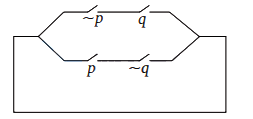 MHT CET 2008 Hard
 - If \(m\) and \(n\) are order and degree of the equation \(\left(\frac{d^{2} y}{d x^{2}}\right)^{5}+4 \cdot \frac{\left(\frac{d^{2} y}{d x^{2}}\right)^{3}}{\left(\frac{d^{3} y}{d x^{3}}\right)}+\left(\frac{d^{3} y}{d x^{3}}\right)=x^{2}-1\), thenMHT CET 2011 Easy
- During glycolysis, out of the 10 reactions, the number of irreversible reactions areMHT CET 2022 Hard