


MHT CET · Maths · Vector Algebra
If the vectors \(\overline{\mathrm{a}}=\hat{\mathrm{i}}-\hat{\mathrm{j}}+2 \hat{\mathrm{k}}, \overline{\mathrm{b}}=2 \hat{\mathrm{i}}+4 \hat{\mathrm{j}}+\hat{\mathrm{k}}\) and \(\overline{\mathrm{c}}=\lambda \hat{\mathrm{i}}+\hat{\mathrm{j}}+\mu \hat{\mathrm{k}}\) are mutually orthogonal, then \((\lambda, \mu) \equiv\)
- A \((-3,2)\)
- B \((-2,3)\)
- C \((2,-3)\)
- D \((3,-2)\)
Answer & Solution
Correct Answer
(A) \((-3,2)\)
Step-by-step Solution
Detailed explanation
As vectors \(\overline{\mathrm{a}}, \overline{\mathrm{b}}, \overline{\mathrm{c}}\) are mutually orthogonal, we get
\(\overline{\mathrm{a}} \cdot \overline{\mathrm{c}}=0 \)
\( \therefore \lambda-1+2 \mu=0 \)
\( \therefore \lambda+2 \mu=1...(i)\)
and \(\bar{b} \cdot \bar{c}=0\)
\(\therefore 2 \lambda+4+\mu=0 \)
\( \therefore 2 \lambda+\mu=-4...(ii)\)
Solving (i) and (ii), we get
\(\lambda=-3, \mu=2\)
\(\overline{\mathrm{a}} \cdot \overline{\mathrm{c}}=0 \)
\( \therefore \lambda-1+2 \mu=0 \)
\( \therefore \lambda+2 \mu=1...(i)\)
and \(\bar{b} \cdot \bar{c}=0\)
\(\therefore 2 \lambda+4+\mu=0 \)
\( \therefore 2 \lambda+\mu=-4...(ii)\)
Solving (i) and (ii), we get
\(\lambda=-3, \mu=2\)
See the Complete Solution
Get step-by-step explanations for this and 2.5 Lakh+ more JEE, NEET & CET questions.
- Unlock all solutions
- Practice the full chapter
- Track accuracy across PYQs
4.8 rated on Google Play · 14,000+ reviews
More questions from Maths
- For given data \(N=60, \sum X^2=18000\) and \(\sum X=960\), then variance of data isMHT CET 2022 Easy
- The cartesian co-ordinates of the point whose polar co-ordinates are \(\left(\frac{1}{2}, 120^{\circ}\right) \text { are }
\)MHT CET 2020 Easy - The joint equation of the pair of lines through the origin and making an equilateral triangle with the line \(x=3\) isMHT CET 2021 Easy
- The statement pattern \((p \wedge q) \vee(\sim p \wedge q) \vee(r \wedge \sim q)\) is logical equivalent toMHT CET 2022 Easy
- The value of \(\int \frac{d x}{x\left(x^{n}+1\right)}\) isMHT CET 2012 Medium
- The integral \(\int \frac{3 x^{13}+2 x^{11}}{\left(2 x^4+3 x^2+1\right)^4} d x\) is equal to (where \(C\) is a constant of integration.)MHT CET 2022 Medium
More PYQs from MHT CET
- If \(\sin ^2 x+\cos ^2 y=1\), then \(\frac{d y}{d x}=\)MHT CET 2021 Medium
- The sum of the cofactors of the elements of second row of the matrix \(\left[\begin{array}{ccc}1 & 3 & 2 \\ -2 & 0 & 1 \\ 5 & 2 &1\end{array}\right]\) isMHT CET 2020 Easy
- Which from following reactions exhibits good atom economy according to the principles of green chemistry?MHT CET 2024 Hard
- In case of gas, as shown in P-T graph, the densities at points A and B are \(\varrho_0\) and \(\frac{4}{3} \varrho_0\) respectively. The value of Y on pressure \((\mathrm{P})\) axis is
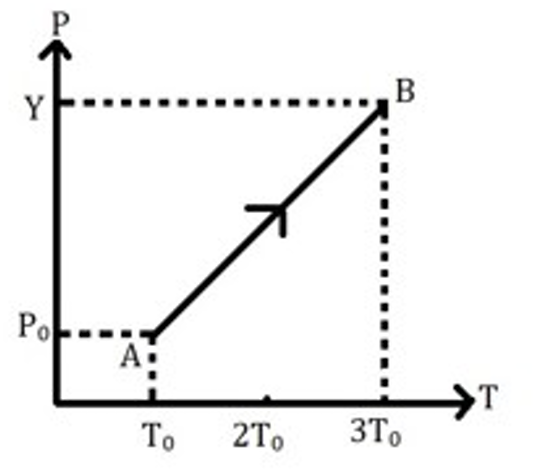 MHT CET 2025 Medium
 - The minimum value of the function isMHT CET 2018 Medium
- What is the product of Hydroborationoxidation of but-1-ene?MHT CET 2024 Easy