


MHT CET · Maths · Vector Algebra
If the vectors \(\bar{a}=\hat{i}-\hat{j}+2 \hat{k}, \bar{b}=2 \hat{i}+4 \hat{j}+\hat{k}\) and \(\overline{\mathrm{c}}=\mathrm{p} \hat{\mathrm{i}}+\hat{\mathrm{j}}+\mathrm{q} \hat{\mathrm{k}}\) are mutually orthogonal, then \((\mathrm{p}, \mathrm{q})\) is equal to
- A \((3,-2)\)
- B \((-2,3)\)
- C \((-3,2)\)
- D \((2,-3)\)
Answer & Solution
Correct Answer
(C) \((-3,2)\)
Step-by-step Solution
Detailed explanation
Since the given vectors are mutually orthogonal.
\(\therefore \quad \bar{a} \cdot \overline{\mathrm{~b}}=2-4+2=0\)
\(\overline{\mathrm{a}} \cdot \overline{\mathrm{c}}=\mathrm{p}-1+2 \mathrm{q}=0\)...(i)
\(\overline{\mathrm{b}} \cdot \overline{\mathrm{c}}=2 \mathrm{p}+4+\mathrm{q}=0\)...(ii)
Solving (i) and (ii), we get \((p, q)=(-3,2)\)
\(\therefore \quad \bar{a} \cdot \overline{\mathrm{~b}}=2-4+2=0\)
\(\overline{\mathrm{a}} \cdot \overline{\mathrm{c}}=\mathrm{p}-1+2 \mathrm{q}=0\)...(i)
\(\overline{\mathrm{b}} \cdot \overline{\mathrm{c}}=2 \mathrm{p}+4+\mathrm{q}=0\)...(ii)
Solving (i) and (ii), we get \((p, q)=(-3,2)\)
See the Complete Solution
Get step-by-step explanations for this and 2.5 Lakh+ more JEE, NEET & CET questions.
- Unlock all solutions
- Practice the full chapter
- Track accuracy across PYQs
4.8 rated on Google Play · 14,000+ reviews
More questions from Maths
- Joint equation of pair of lines through \((3,-2)\) and parallel to \(x^{2}-4 x y+3 y^{2}=0\) isMHT CET 2009 Hard
- Probability of guessing correctly atleast out of answers in a "True" or "False" test is = ______MHT CET 2016 Medium
- The maximum value of Subject to is ..MHT CET 2019 Hard
- If, \(\int \frac{d \theta}{\cos ^2 \theta(\tan 2 \theta+\sec 2 \theta)}=\lambda \tan \theta+2 \log _{\mathrm{e}}|\mathrm{f}(\theta)|+\mathrm{c}\) (where c is a constant of integration), then the ordered pair \((\lambda,|f(\theta)|)\) is equal toMHT CET 2024 Medium
- The line \(\frac{x-2}{3}=\frac{y-1}{-5}=\frac{z+2}{2}\) lies in the plane \(x+3 y-\alpha z+\beta=0\), then value of \(\alpha \beta\) isMHT CET 2021 Medium
- If \(y=2 \sin x+3 \cos x\) and \(y+A \frac{d^2 y}{d x^2}=B\), then the values of \(A\), \(\mathrm{B}\) are respectivelyMHT CET 2021 Easy
More PYQs from MHT CET
- If \(\mathrm{AX}=\mathrm{B}\), where \(\mathrm{A}=\left[\begin{array}{ccc}1 & -1 & 1 \\ 2 & -1 & 0 \\ 3 & 3 & -4\end{array}\right], \mathrm{B}=\left[\begin{array}{l}1 \\ 1 \\ 2\end{array}\right]\) and \(\mathrm{X}=\left[\begin{array}{l}x \\ y \\ z\end{array}\right]\), then \(x+y+z=\)MHT CET 2020 Medium
- With reference to human beings, find out the mis-match pair.MHT CET 2020 Easy
- The shaded figure given below is the solution set for the linear inequations. Choose the correct option
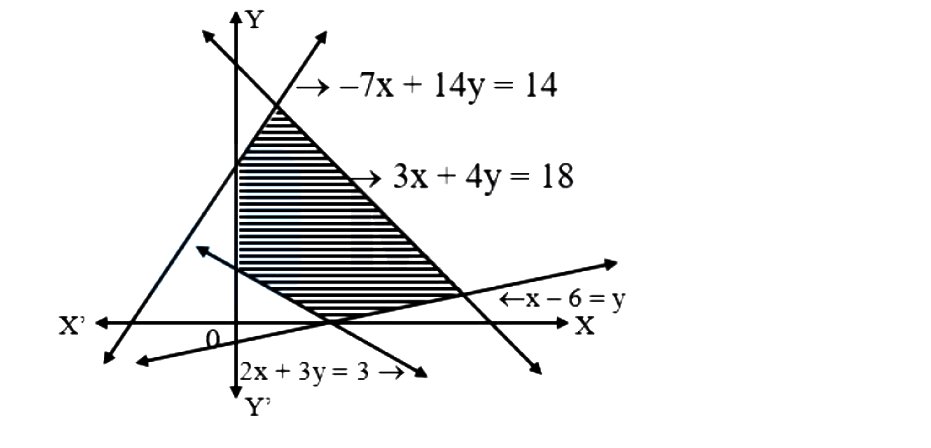 MHT CET 2021 Easy
 - If two vertices of a triangle are \(\mathrm{A}(3,1,4)\) and \(\mathrm{B}(-4,5,-3)\) and the centroid of the triangle is \(\mathrm{G}(-1,2,1)\), then the third vertex \(\mathrm{C}\) of the triangle isMHT CET 2023 Medium
- Complete the following analogy with respect to habitat of mammals.
Dossorial mammals: i :: Arboreal mammals: iiMHT CET 2024 Hard - If \(f(x)=b \cdot e^{a x}+a \cdot e^{b x}\), then \(f^{\prime \prime}(0)=\)MHT CET 2022 Easy