


MHT CET · Maths · Differential Equations
If the radius of a circle increases at the rate of \(7 \mathrm{~cm} / \mathrm{sec}\), then the rate of increase of its area after 10 minutes is
- A \(1,84,800 \mathrm{~cm}^{2} / \mathrm{sec}\)
- B \(1,64,800 \mathrm{~cm}^{2} / \mathrm{sec}\)
- C \(1,88,400 \mathrm{~cm}^{2} / \mathrm{sec}\)
- D \(1,68,400 \mathrm{~cm}^{2} / \mathrm{sec}\)
Answer & Solution
Correct Answer
(A) \(1,84,800 \mathrm{~cm}^{2} / \mathrm{sec}\)
Step-by-step Solution
Detailed explanation
\(\frac{d \varepsilon}{d t} =7 \mathrm{~cm} / \mathrm{sec} . \)
\( A =\pi \varepsilon^{2} \)
\( \frac{d A}{d t} =2 \pi \varepsilon \frac{d \varepsilon}{d t}-(1) \)
\( \text { Radius after } 10 \text { minutes } ; \varepsilon=70 \mathrm{~cm} \times 60 \mathrm{~cm} \)
\( \frac{d A}{d t} =2 \times \frac{22}{7} \times 70 \times 7 \times 60[\mathrm{Put} \text { in (1)... }\)
\( =1,84,800 \mathrm{~cm}^{2} / \mathrm{sec}.\)
\( A =\pi \varepsilon^{2} \)
\( \frac{d A}{d t} =2 \pi \varepsilon \frac{d \varepsilon}{d t}-(1) \)
\( \text { Radius after } 10 \text { minutes } ; \varepsilon=70 \mathrm{~cm} \times 60 \mathrm{~cm} \)
\( \frac{d A}{d t} =2 \times \frac{22}{7} \times 70 \times 7 \times 60[\mathrm{Put} \text { in (1)... }\)
\( =1,84,800 \mathrm{~cm}^{2} / \mathrm{sec}.\)
See the Complete Solution
Get step-by-step explanations for this and 2.5 Lakh+ more JEE, NEET & CET questions.
- Unlock all solutions
- Practice the full chapter
- Track accuracy across PYQs
4.8 rated on Google Play · 14,000+ reviews
More questions from Maths
- The vectors \(\bar{a}\) and \(\bar{b}\) are not perpendicular and \(\overline{\mathrm{c}}\) and \(\overline{\mathrm{d}}\) are two vectors satisfying \(\overline{\mathrm{b}} \times \overline{\mathrm{c}}=\overline{\mathrm{b}} \times \overline{\mathrm{d}}\) and \(\overline{\mathrm{a}} \cdot \overline{\mathrm{d}}=0\), then the vector \(\overline{\mathrm{d}}\) is equal toMHT CET 2024 Easy
- If \(f(\theta)=\cos \theta_1 \cdot \cos \theta_2 \cdot \cos \theta_3 \cdots \cdots \cdots \cdot \cos \theta_n\), then \(\tan \theta_1+\tan \theta_2+\tan \theta_3+\cdots \cdots \cdots+\tan \theta_{\mathrm{n}}=\)MHT CET 2025 Medium
- \(\int_0^1 \log (x+1) \mathrm{d} x=\)MHT CET 2025 Medium
- \(\int e^{\tan ^{-1} x}\left(1+\frac{x}{1+x^{2}}\right) d x\)MHT CET 2020 Medium
- \(\int 7^{7^{7^{x}}} 7^{7^{x}} 7^{x} \mathrm{~d} x=\)MHT CET 2020 Hard
- \(\int \frac{\tan ^4 \sqrt{x} \cdot \sec ^2 \sqrt{x}}{\sqrt{x}} d x=\)MHT CET 2021 Medium
More PYQs from MHT CET
- In the following reaction,
Ethyl alcohol \(+\mathrm{H}^{+} \quad \frac{413 \mathrm{~K}}{\longrightarrow}\)
\(\begin{array}{ll}\text { (in excess) } & \text { (from } \mathrm{H}_{2} \mathrm{SO}_{4} \text { ) }\end{array}\)
product, the product isMHT CET 2009 Medium - The graph shows the variation of voltage ' V ' across the plates of two capacitors \(A\) and \(B\) versus increase in charge ' \(Q\) ' stored in them. Then
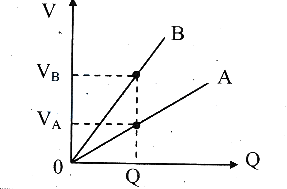 MHT CET 2024 Easy
 - A body of mass m is performing a UCM in a circle of a radius r with speed v. The work done by the centripetal force in moving it through rd of the circular path isMHT CET 2019 Easy
- In the\(F _2\) generation of a Mendelian dihybrid cross, how many plants homozygous for both the traits are found?MHT CET 2022 Easy
- Pure dihydrogen (99.5\%) is obtained by the electrolysis ofMHT CET 2021 Medium
- In homeotherms, the enzymatic reaction occurs best at ________ °C.MHT CET 2025 Medium