


MHT CET · Maths · Application of Derivatives
If the function \(f(x)=2 x^{3}-9 a x^{2}+12 a^{2} x+1\) attains its maximum and minimum at \(p\) and \(q\) respectively such that \(p^{2}=q\), then \(a\) equals
- A 0
- B 1
- C 2
- D None of these
Answer & Solution
Correct Answer
(C) 2
Step-by-step Solution
Detailed explanation
Given, \(f(x)=2 x^{3}-9 a x^{2}+12 a^{2} x+1\) attains maximum and minimum at \(p\) and \(q\) respectively. \(\therefore\)
\(
f^{\prime}(p)=0, f^{\prime}(q)=0
\)
Now,
\(
\begin{array}{c}
f^{\prime \prime}(p) < 0 \text { and } f^{\prime \prime}(q)>0 \\
f^{\prime}(p)=0
\end{array}
\)
and
\(
\begin{array}{r}
f^{\prime}(q)=0 \\
6 p^{2}-18 a p+12 a^{2}=0 \\
6 q^{2}-18 a q+12 a^{2}=0
\end{array}
\)
and
\(
\begin{array}{ll}
\Rightarrow & p^{2}-3 a p+2 a^{2}=0 \\
\text { and } & q^{2}-3 a q+2 a^{2}=0
\end{array}
\)
\(p=a, 2 a, q=a, 2 a\)
\(\begin{array}{lrl}\Rightarrow & p=a, 2 a, q=a, \\ \text { Now, } & f^{\prime \prime}(p) < 0\end{array}\)
\(\Rightarrow \quad 12 p-18 a < 0\)
\(\Rightarrow \quad p < \frac{3}{2} a\)
and \(f^{\prime \prime}(q)>0 \Rightarrow 12 q-18 a>0\)
\(\Rightarrow \quad q>\frac{3}{2} a\)
From Eqs. (i), (ii) and (iii), we get
\(\begin{aligned} p &=a, q=2 a \\ \text { Now, } \quad p^{2} &=q \end{aligned}\)
\(
\begin{array}{lc}
\Rightarrow & a^{2}=2 a \\
\Rightarrow & a=0,2
\end{array}
\)
But for \(a=0, f(x)=2 x^{3}+1\) which does not
attains a maximum or minimum for any value of \(x\). Hence, \(a=2\).
\(
f^{\prime}(p)=0, f^{\prime}(q)=0
\)
Now,
\(
\begin{array}{c}
f^{\prime \prime}(p) < 0 \text { and } f^{\prime \prime}(q)>0 \\
f^{\prime}(p)=0
\end{array}
\)
and
\(
\begin{array}{r}
f^{\prime}(q)=0 \\
6 p^{2}-18 a p+12 a^{2}=0 \\
6 q^{2}-18 a q+12 a^{2}=0
\end{array}
\)
and
\(
\begin{array}{ll}
\Rightarrow & p^{2}-3 a p+2 a^{2}=0 \\
\text { and } & q^{2}-3 a q+2 a^{2}=0
\end{array}
\)
\(p=a, 2 a, q=a, 2 a\)
\(\begin{array}{lrl}\Rightarrow & p=a, 2 a, q=a, \\ \text { Now, } & f^{\prime \prime}(p) < 0\end{array}\)
\(\Rightarrow \quad 12 p-18 a < 0\)
\(\Rightarrow \quad p < \frac{3}{2} a\)
and \(f^{\prime \prime}(q)>0 \Rightarrow 12 q-18 a>0\)
\(\Rightarrow \quad q>\frac{3}{2} a\)
From Eqs. (i), (ii) and (iii), we get
\(\begin{aligned} p &=a, q=2 a \\ \text { Now, } \quad p^{2} &=q \end{aligned}\)
\(
\begin{array}{lc}
\Rightarrow & a^{2}=2 a \\
\Rightarrow & a=0,2
\end{array}
\)
But for \(a=0, f(x)=2 x^{3}+1\) which does not
attains a maximum or minimum for any value of \(x\). Hence, \(a=2\).
See the Complete Solution
Get step-by-step explanations for this and 2.5 Lakh+ more JEE, NEET & CET questions.
- Unlock all solutions
- Practice the full chapter
- Track accuracy across PYQs
4.8 rated on Google Play · 14,000+ reviews
More questions from Maths
- If the line \(\frac{x+1}{1}=\frac{y-k}{11}=\frac{z-4}{-5}\) lies in the plane \(2 x+p y+7 z-41=0\) which is perpendicular to the plane \(x+4 \mathrm{y}-2 \mathrm{z}+13=0\) then \(\mathrm{k}=\)MHT CET 2025 Medium
- \(\lim _{n \rightarrow \infty}\left[\frac{1}{1-\mathrm{n}^4}+\frac{8}{1-\mathrm{n}^4}+\ldots \ldots \ldots \ldots . .+\frac{\mathrm{n}^3}{1-\mathrm{n}^4}\right]=\)MHT CET 2025 Medium
- If the statements \(p, q\) and \(r\) have the truth values \(F, T, F\) respectively, then the truth values of the statement patterns \((p \wedge \sim q) \rightarrow r\) and \((p \vee q) \rightarrow r\) are respectivelyMHT CET 2024 Easy
- A ladder, 5 meters long; rests against a vertical wall. If its top slides downwards at the rate of \(10 \mathrm{~cm} / \mathrm{s}\), then the angle between the ladder and the floor is decreasing at the rate of radians/second when it's lower end is \(\overline{4 \mathrm{~m} \text { away from the wall. }}\)MHT CET 2023 Medium
- If \(\bar{a}\) and \(\bar{b}\) are vectors such that \(|\bar{a}+\bar{b}|=\sqrt{29}\) and \(\bar{a} \times(2 \hat{i}+3 \hat{j}+4 \hat{k})=(2 \hat{i}+3 \hat{j}+4 \hat{k}) \times \bar{b}\), then a possible value of \((\bar{a}+\bar{b}) \cdot(-7 \hat{i}+2 \hat{j}+3 \hat{k})\) isMHT CET 2022 Medium
- The solution of the differential equation \(y(1+\log x) \frac{d x}{d y}-x \log x=0\) isMHT CET 2010 Easy
More PYQs from MHT CET
- For each \(x \in \mathbb{R}\), Let \([x]\) represent greatest integer function, then \(\lim _{x \rightarrow 0^{-}} \frac{x([x]+|x|) \sin [x]}{|x|}\) is equal toMHT CET 2024 Easy
- Which of the following is NOT an intensive property?MHT CET 2020 Easy
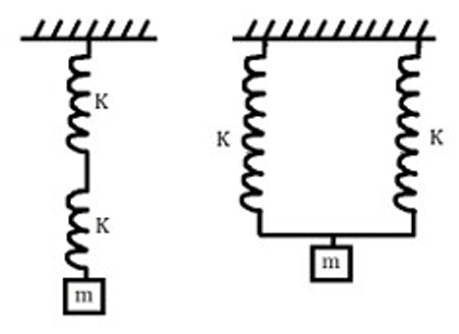
- Two identical springs of constant ' \(k\) ' are connected in series and then in parallel. A mass ' \(m\) ' is suspended from them, the ratio of their frequencies of vertical oscillations will be
 MHT CET 2025 Medium
 - What is the mass in kg of 5 mole of acetic acid \((\)mol. mass \(=60 \mathrm{~g} \mathrm{~mol}^{-1})?\)MHT CET 2024 Easy
- The sum of the magnitudes of two vectors \(\vec{A}\) and \(\vec{B}\) is 8 and magnitude of the resultant is 4. If the resultant vector is perpendicular to any one vector, then the magnitudes of the two vectors \(\vec{A}\) and \(\vec{B}\) areMHT CET 2020 Easy
- \( \int[1+2 \tan x(\tan x+\sec x)]^{\frac{1}{2}} d x= \)MHT CET 2021 Medium