


MHT CET · Maths · Application of Derivatives
If sum of two numbers is 3 , then the maximum value of the product of first number and square of the second number is
- A 6
- B 4
- C 5
- D 3
Answer & Solution
Correct Answer
(B) 4
Step-by-step Solution
Detailed explanation
Let the two numbers be a and b .
\(\begin{array}{ll}
\therefore & a+b=3 \\
\therefore & b=3-a...(i)
\end{array}\)
\(\therefore \quad\) Product of first number and square of second number \((p)=a b^2\)
\(\mathrm{p}=\mathrm{a}(3-\mathrm{a})^2\)
\(\ldots[\) From (i)]
\(\begin{array}{ll}
\therefore & p=9 a-6 a^2+a^3 ...(ii)\\
\therefore & \frac{d p}{d a}=9-12 a+3 a^2 \\
\therefore & \frac{d^2 p}{d a^2}=-12+6 a
\end{array}\)
Now, \(\frac{\mathrm{dp}}{\mathrm{da}}=0 \Rightarrow 3 \mathrm{a}^2-12 \mathrm{a}+9=0\)
\(\begin{aligned}
& \Rightarrow(3 a-9)(a-1)=0 \\
& \Rightarrow a=3 \text { or } a=1
\end{aligned}\)
\(\left.\frac{\mathrm{d}^2 p}{d \mathrm{da}^2}\right|_{a=3}=6\gt0 \text { and }\left.\frac{\mathrm{d}^2 p}{\mathrm{da}^2}\right|_{\mathrm{a}=1}=-6 \lt 0\)
\(\therefore \quad\) Maximum value of p is at \(\mathrm{a}=1\)
\(\therefore \quad\) Maximum value of the product \(=4\)
...[From (ii)]
\(\begin{array}{ll}
\therefore & a+b=3 \\
\therefore & b=3-a...(i)
\end{array}\)
\(\therefore \quad\) Product of first number and square of second number \((p)=a b^2\)
\(\mathrm{p}=\mathrm{a}(3-\mathrm{a})^2\)
\(\ldots[\) From (i)]
\(\begin{array}{ll}
\therefore & p=9 a-6 a^2+a^3 ...(ii)\\
\therefore & \frac{d p}{d a}=9-12 a+3 a^2 \\
\therefore & \frac{d^2 p}{d a^2}=-12+6 a
\end{array}\)
Now, \(\frac{\mathrm{dp}}{\mathrm{da}}=0 \Rightarrow 3 \mathrm{a}^2-12 \mathrm{a}+9=0\)
\(\begin{aligned}
& \Rightarrow(3 a-9)(a-1)=0 \\
& \Rightarrow a=3 \text { or } a=1
\end{aligned}\)
\(\left.\frac{\mathrm{d}^2 p}{d \mathrm{da}^2}\right|_{a=3}=6\gt0 \text { and }\left.\frac{\mathrm{d}^2 p}{\mathrm{da}^2}\right|_{\mathrm{a}=1}=-6 \lt 0\)
\(\therefore \quad\) Maximum value of p is at \(\mathrm{a}=1\)
\(\therefore \quad\) Maximum value of the product \(=4\)
...[From (ii)]
See the Complete Solution
Get step-by-step explanations for this and 2.5 Lakh+ more JEE, NEET & CET questions.
- Unlock all solutions
- Practice the full chapter
- Track accuracy across PYQs
4.8 rated on Google Play · 14,000+ reviews
More questions from Maths
- The number of ways in which 8 different pearls can be arranged to from a necklace isMHT CET 2021 Easy
- If the pair of straight lines \(x y-x+y-1=0\) and the line \(x+\mathrm{ky}-3=0\) are concurrent, then the value of k is equal toMHT CET 2025 Medium
- The differential equation whose solution represents the family \(x^2 y=4 e^x+c\), where \(c\) is an arbitrary constant, isMHT CET 2025 Medium
- If the lengths of the transverse axis and the latus rectum of a hyperbola are and respectively, then, the equation of the hyperbola is ________MHT CET 2019 Easy
- The probability that a person is not a sportsperson is \(\frac{1}{6}\). Then the probability that out of the 6 members of the family, 5 are sportspersons isMHT CET 2025 Medium
- If the area of the parallelogram with \(\bar{a}\) and \(\bar{b}\) as two adjacent sides is 15 square units, then the area (in square units) of the parallelogram, having \(3 \bar{a}+2 \bar{b}\) and \(\bar{a}+3 \bar{b}\) as two adjacent sides, isMHT CET 2024 Easy
More PYQs from MHT CET
- Let \(\mathrm{f}: \mathbb{R}-\{2\} \rightarrow \mathbb{R}-\{1\}\) defined by \(\mathrm{f}(x)=\frac{x-3}{x-2}\) and \(\mathrm{g}: \mathbb{R} \rightarrow \mathbb{R}\) defined by \(\mathrm{g}(x)=3 \mathrm{x}-2\), then sum of all values of \(x\) for which \(\mathrm{f}^{-1}(x)+\mathrm{g}^{-1}(x)=\frac{19}{6}\) isMHT CET 2025 Medium
- Identify reducing agent used for the following conversion.
\(\mathrm{R}-\mathrm{CHO} \rightarrow \mathrm{R}-\mathrm{CH}_2-\mathrm{OH}\)MHT CET 2022 Easy - If \(A=\left[a_{i j}\right]_{3 \times 3}=\left[\begin{array}{lll}3 & 2 & 4 \\ 1 & 4 & 1 \\ 2 & 6 & 3\end{array}\right]\) and \(A_{i j}\) is a cofactor of \(a_{i j}\), then the value of \(a_{21} A_{21}+a_{22} A_{22}+a_{23} A_{23}\) is equal toMHT CET 2022 Easy
- In an isothermal and reversible process, \(1 \cdot 6 \times 10^{-2} \mathrm{~kg} \mathrm{O}_{2}\) expands from \(10 \mathrm{dm}^{3}\) to \(100 \mathrm{dm}^{3}\) at \(300 \mathrm{~K}\), work done in the process is \((\mathrm{R}=8.314 \mathrm{~J})\)MHT CET 2020 Hard
- Which compound from following contains iodine with highest oxidation number ?MHT CET 2024 Easy
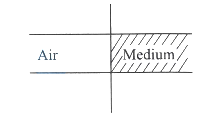
- The capacitance of a parallel plate capacitor is \(2.5 \mu \mathrm{F}\). When it is half filled with a dielectric as shown in figure, its capacitance becomes \(5 \mu \mathrm{F}\). The dielectric constant of the dielectric is
 MHT CET 2023 Medium