


MHT CET · Maths · Application of Derivatives
If slope of the tangent to the curve \(x y+a x+b y=0\) at the point \((1,1)\) on it is 2 , then the value of \(3 a+b\) is
- A 3
- B 1
- C 2
- D \(-1\)
Answer & Solution
Correct Answer
(B) 1
Step-by-step Solution
Detailed explanation
\(x y+a x+b y=0\)
Differentiating w.r.t. \(x\), we get
\(\frac{x \mathrm{~d} y}{\mathrm{~d} x}+y+\mathrm{a}+\mathrm{b} \frac{\mathrm{d} y}{\mathrm{~d} x}=0\)
\(\begin{aligned} & \Rightarrow \frac{\mathrm{d} y}{\mathrm{~d} x}=-\frac{\mathrm{a}+y}{\mathrm{~b}+x} \\ & \Rightarrow\left(\frac{\mathrm{d} y}{\mathrm{~d} x}\right)_{(\mathrm{b}, 1)}=-\frac{\mathrm{a}+1}{\mathrm{~b}+1} \\ & \Rightarrow 2=-\frac{\mathrm{a}+1}{\mathrm{~b}+1}\end{aligned}\)
\(\Rightarrow a+2 b=-3\) ...(i)
Also, the point \((1,1)\) lies on the curve
\(x y+a x+b y=0\).
\(\therefore \quad 1+a+b=0\)
\(\Rightarrow a+b=-1\) ...(ii)
Solving (i) and (ii), we get \(a=1, b=-2\)
\(\therefore \quad 3 a+b=1\)
Differentiating w.r.t. \(x\), we get
\(\frac{x \mathrm{~d} y}{\mathrm{~d} x}+y+\mathrm{a}+\mathrm{b} \frac{\mathrm{d} y}{\mathrm{~d} x}=0\)
\(\begin{aligned} & \Rightarrow \frac{\mathrm{d} y}{\mathrm{~d} x}=-\frac{\mathrm{a}+y}{\mathrm{~b}+x} \\ & \Rightarrow\left(\frac{\mathrm{d} y}{\mathrm{~d} x}\right)_{(\mathrm{b}, 1)}=-\frac{\mathrm{a}+1}{\mathrm{~b}+1} \\ & \Rightarrow 2=-\frac{\mathrm{a}+1}{\mathrm{~b}+1}\end{aligned}\)
\(\Rightarrow a+2 b=-3\) ...(i)
Also, the point \((1,1)\) lies on the curve
\(x y+a x+b y=0\).
\(\therefore \quad 1+a+b=0\)
\(\Rightarrow a+b=-1\) ...(ii)
Solving (i) and (ii), we get \(a=1, b=-2\)
\(\therefore \quad 3 a+b=1\)
See the Complete Solution
Get step-by-step explanations for this and 2.5 Lakh+ more JEE, NEET & CET questions.
- Unlock all solutions
- Practice the full chapter
- Track accuracy across PYQs
4.8 rated on Google Play · 14,000+ reviews
More questions from Maths
- The value of \(\operatorname{cosec}^{-1}(\sqrt{2})+\cos ^{-1}\left(\frac{-1}{2}\right)-\sec ^{-1}\left(\frac{2}{\sqrt{3}}\right)\) is equal toMHT CET 2022 Easy
- The particular solution of the differential equation, \(x y \frac{\mathrm{~d} y}{\mathrm{~d} x}=x^2+2 y^2\) when \(y(1)=0\) isMHT CET 2024 Hard
- A man \(P\) has 7 friends, 4 of them are ladies and 3 are men, His wife \(Q\) also has 7 friends, 3 of them are ladies and 4 are men. Assume \(P\) and \(Q\) have no common friends. Then the total number of ways in which \(P\) and \(Q\) together can throw a party inviting 3 ladies and 3 men, so that 3 friends of each of \(P\) and \(Q\) are in this party, is __________.MHT CET 2022 Hard
- If \(x=3 \sin \theta, y=3 \cos \theta \cos \phi, z=3 \cos \theta \sin \emptyset\), then \(x^{2}+y^{2}+z^{2}=\)MHT CET 2020 Easy
- The points \((1,3)\) and \((5,1)\) are two opposite vertices of a rectangle. The other two vertices are lie on the line \(\mathrm{y}=2 x+\mathrm{c}\) where c is the constant, then co-ordinates of other two vertices areMHT CET 2025 Medium
- The velocity of a particle at time \(t\) is given by the relation \(v=6 \mathrm{t}-\frac{\mathrm{t}^2}{6}\). Its displacement \(\mathrm{S}\) is zero at \(\mathrm{t}=0\), then the distance travelled in \(3 \mathrm{sec}\) isMHT CET 2021 Easy
More PYQs from MHT CET
- A simple pendulum is oscillating with frequency ' \(F\) ' on the surface of the earth. It is taken to a depth \(\frac{R}{3}\) below the surface of earth. ( \(R=\) radius of earth). The frequency of oscillation at depth \(R / 3\) isMHT CET 2023 Medium
- The half-life of a radioactive substance is 30 minutes. The time taken between \(40 \%\) decay and \(85 \%\) decay of the same radioactive substance isMHT CET 2021 Easy
- Identify biodegradable polymer from following.MHT CET 2023 Easy
- Two identical ideal diodes are connected to an ammeter and a d.c source (1 volt) as shown. In which one of the following circuits, ammeter will not show any defection?
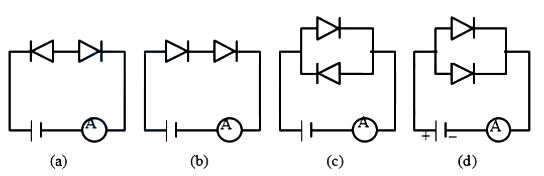 MHT CET 2021 Hard
 - The derivative of \(f(\tan x)\) w.r.t. \(g(\sec x)\) at \(x=\frac{\pi}{4}\), where \(f^{\prime}(1)=2\) and \(g^{\prime}(\sqrt{2})=4\) isMHT CET 2020 Easy
- A unit vector in the direction of resultant vector of \(\vec{A}=-2 \hat{i}+3 \hat{j}+\hat{k}\) and \(\vec{B}=\hat{i}+2 \hat{j}-4 \hat{k}\) isMHT CET 2025 Easy