


MHT CET · Maths · Indefinite Integration
If \(\mathrm{I}=\int \sin (\log (x)) \mathrm{d} x\), then \(\mathrm{I}\) is given by
- A \(-\frac{x}{2}(\sin (\log x)-\cos (\log x))+\mathrm{c}\), where \(\mathrm{c}\) is a constant of integration.
- B \(\frac{x}{2}(\sin (\log x)-\cos (\log x))+\mathrm{c}, \text { where } \mathrm{c}\)
is a constant of integration. - C \(\frac{x}{2}(\sin (\log x)+\cos (\log x))+\mathrm{c}\), where \(\mathrm{c}\) is a constant of 'integration.
- D \(-\frac{x}{2}(\sin (\log x)+\cos (\log x))+\mathrm{c}\), where c is a constant of integration.
Answer & Solution
Correct Answer
(B) \(\frac{x}{2}(\sin (\log x)-\cos (\log x))+\mathrm{c}, \text { where } \mathrm{c}\)
is a constant of integration.
Step-by-step Solution
Detailed explanation
Let \(\log x=\mathrm{t} \Rightarrow x=\mathrm{e}^{\mathrm{t}}\) Differentiating w.r.t. t, we get \(\mathrm{d} x=\mathrm{e}^{\mathrm{t}} \mathrm{dt}\)
\(\begin{aligned}
\therefore \quad \mathrm{I} & =\int \sin (\mathrm{t}) \mathrm{e}^{\mathrm{t}} \mathrm{dt} \\
& =\sin \mathrm{t} \mathrm{e}^{\mathrm{t}}-\int \cos \mathrm{t} \mathrm{e}^{\mathrm{t}} \mathrm{dt} \\
& =\sin \mathrm{t} \mathrm{e}^{\mathrm{t}}-\left[\cos \mathrm{t} \mathrm{e}^{\mathrm{t}}+\int \sin \mathrm{t} \mathrm{e}^{\mathrm{t}} \mathrm{dt}\right] \\
& =\sin \mathrm{t} \mathrm{e}^{\mathrm{t}}-\cos \mathrm{t} \mathrm{e}^{\mathrm{t}}-\mathrm{I}
\end{aligned}\)
\(\begin{array}{ll}\therefore & 2 \mathrm{I}=x \sin (\log x)-x \cos (\log x)+\mathrm{c} \\ \therefore \quad & \mathrm{I}=\frac{x}{2}(\sin (\log x)-\cos (\log x))+\mathrm{c}\end{array}\)
\(\begin{aligned}
\therefore \quad \mathrm{I} & =\int \sin (\mathrm{t}) \mathrm{e}^{\mathrm{t}} \mathrm{dt} \\
& =\sin \mathrm{t} \mathrm{e}^{\mathrm{t}}-\int \cos \mathrm{t} \mathrm{e}^{\mathrm{t}} \mathrm{dt} \\
& =\sin \mathrm{t} \mathrm{e}^{\mathrm{t}}-\left[\cos \mathrm{t} \mathrm{e}^{\mathrm{t}}+\int \sin \mathrm{t} \mathrm{e}^{\mathrm{t}} \mathrm{dt}\right] \\
& =\sin \mathrm{t} \mathrm{e}^{\mathrm{t}}-\cos \mathrm{t} \mathrm{e}^{\mathrm{t}}-\mathrm{I}
\end{aligned}\)
\(\begin{array}{ll}\therefore & 2 \mathrm{I}=x \sin (\log x)-x \cos (\log x)+\mathrm{c} \\ \therefore \quad & \mathrm{I}=\frac{x}{2}(\sin (\log x)-\cos (\log x))+\mathrm{c}\end{array}\)
See the Complete Solution
Get step-by-step explanations for this and 2.5 Lakh+ more JEE, NEET & CET questions.
- Unlock all solutions
- Practice the full chapter
- Track accuracy across PYQs
4.8 rated on Google Play · 14,000+ reviews
More questions from Maths
- The lines \(\frac{x-0}{1}=\frac{y-2}{2}=\frac{z+3}{\lambda}\) and \(\frac{x-2}{2}=\frac{y-6}{3}=\frac{z-3}{\lambda}\) are coplanar and \(p\) is the plane containing these lines, then which of following point lie on the plane for all values of (\(\lambda\)).MHT CET 2025 Medium
- \(\int_{-5}^{5} \log \left(\frac{7-x}{7+x}\right) d x=\)MHT CET 2020 Easy
- Values of \(\mathrm{c}\) as per Rolle's theorem for \(f(x)=\sin x+\cos x+6\) on \([0,2 \pi]\) areMHT CET 2023 Easy
- Water is running in a hemispherical bowl of radius \(180 \mathrm{~cm}\) at the rate of 108 cubic decimetres per minute. How fast the water level is rising when depth of the water level in the bowl is \(120 \mathrm{~cm}\) ?
\((1\) decimeter \(=10 \mathrm{~cm})\)MHT CET 2023 Medium - The following statement \((\mathrm{p} \rightarrow \mathrm{q}) \rightarrow((\sim \mathrm{p} \rightarrow \mathrm{q}) \rightarrow \mathrm{q})\) isMHT CET 2024 Medium
- The derivative of \(\tan ^{-1}\left(\frac{\sqrt{1+x^2}-1}{x}\right)\) w.r.t. \(\tan ^{-1}\left(\frac{2 x \sqrt{1-x^2}}{1-2 x^2}\right)\) at \(x=0\) isMHT CET 2025 Medium
More PYQs from MHT CET
- Given below are two statements.
Statement I - According to Darwin, the gradual, inheritable variations over a long period of time lead to speciation.
Statement II - According to Hugo de Vries, mutations are the cause of variations.
In the light of above statements, select the correct option given below:MHT CET 2025 Hard - A monobasic acid is \(5 \%\) dissociated in its 0.02 M solution. Calculate the dissociation constant of acid.MHT CET 2024 Easy
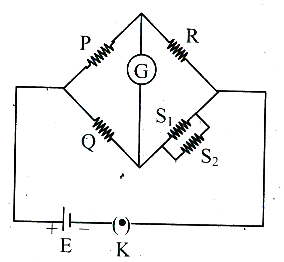
- In a Wheatstone's bridge, the resistances in four arms are as shown in the figure. The balancing condition of the bridge is
 MHT CET 2024 Easy
 - For detecting light intensity we useMHT CET 2024 Easy
- \(\int \frac{\mathrm{d} x}{\cos x(1+\cos x)}=\)MHT CET 2025 Medium
- Water flows through a horizontal pipe of varying cross-section at the rate of \(\pi \times 10^{-1} \mathrm{~m} / \mathrm{s}\). The velocity of water at a point where the radius of the pipe is 10 cm is \((\pi=3 \cdot 14)\)MHT CET 2025 Easy