


MHT CET · Maths · Indefinite Integration
If \(\mathrm{f}(x)=\frac{\sin ^2 \pi x}{1+\pi^x}\), then
\(\int(\mathrm{f}(x)+\mathrm{f}(-x)) \mathrm{d} x\) is equal to
- A \(\frac{x}{2}-\frac{\sin \pi x}{2 \pi}+\mathrm{c}\), (where c is a constant of integration)
- B \(\frac{1}{2} x-\frac{\sin 2 \pi x}{4 \pi}+\mathrm{c}\), (where c is a constant of integration)
- C \(\frac{x}{2}-\frac{\cos \pi x}{2 \pi}+\mathrm{c}\), (where c is a constant of integration)
- D \(\frac{1}{1+\pi^x}+\frac{\cos ^2 \pi x}{2 \pi}+\mathrm{c}\), (where c is a constant of integration)
Answer & Solution
Correct Answer
(B) \(\frac{1}{2} x-\frac{\sin 2 \pi x}{4 \pi}+\mathrm{c}\), (where c is a constant of integration)
Step-by-step Solution
Detailed explanation
\(\begin{aligned} & \int(\mathrm{f}(x)+\mathrm{f}(-x)) \mathrm{d} x \\ & =\int\left[\frac{\sin ^2 \pi x}{1+\pi^x}+\frac{\sin ^2(-\pi x)}{1+\pi^{-x}}\right] \mathrm{d} x \\ & =\int\left(\frac{\sin ^2 \pi x}{1+\pi^x}+\frac{\pi^x \sin ^2 \pi x}{\pi^x+1}\right) \mathrm{d} x\end{aligned}\)
\(\begin{aligned} & =\int \sin ^2 \pi x\left(\frac{1+\pi^x}{1+\pi^x}\right) d x \\ & =\int \sin ^2 \pi x \mathrm{~d} x \\ & =\int\left(\frac{1-\cos 2 \pi x}{2}\right) \mathrm{d} x \\ & =\frac{x}{2}-\frac{1}{2} \cdot \frac{\sin 2 \pi x}{2 \pi}+c=\frac{x}{2}-\frac{\sin 2 \pi x}{4 \pi}+c\end{aligned}\)
\(\begin{aligned} & =\int \sin ^2 \pi x\left(\frac{1+\pi^x}{1+\pi^x}\right) d x \\ & =\int \sin ^2 \pi x \mathrm{~d} x \\ & =\int\left(\frac{1-\cos 2 \pi x}{2}\right) \mathrm{d} x \\ & =\frac{x}{2}-\frac{1}{2} \cdot \frac{\sin 2 \pi x}{2 \pi}+c=\frac{x}{2}-\frac{\sin 2 \pi x}{4 \pi}+c\end{aligned}\)
See the Complete Solution
Get step-by-step explanations for this and 2.5 Lakh+ more JEE, NEET & CET questions.
- Unlock all solutions
- Practice the full chapter
- Track accuracy across PYQs
4.8 rated on Google Play · 14,000+ reviews
More questions from Maths
- The order of the differential equation whose general solution is given by \(\mathrm{y}=\left(\mathrm{C}_1+\mathrm{C}_2\right) \sin \left(\mathrm{x}+\mathrm{C}_3\right)-\mathrm{C}_4 \mathrm{e}^{x+\mathrm{C}_5}\) is (where \(\mathrm{C}_1, \mathrm{C}_2, \mathrm{C}_3, \mathrm{C}_4, \mathrm{C}_5\) are arbitrary constants)MHT CET 2025 Medium
- If sum of two numbers is 3 , then the maximum value of the product of first number and square of the second number isMHT CET 2024 Easy
- ________MHT CET 2019 Medium
- The function \(\mathrm{f}(\mathrm{t})=\frac{1}{\mathrm{t}^2+\mathrm{t}-2}\) where \(\mathrm{t}=\frac{1}{x-1}\) is discontinuous atMHT CET 2023 Medium
- A fair coin is tossed for a fixed number of times. If probability of getting 7 heads is equal to probability of getting 9 heads, then probability of getting 2 heads isMHT CET 2021 Medium
- If the sum of the deviations of 50 observations from 30 is 50 , then the mean of these observations isMHT CET 2024 Easy
More PYQs from MHT CET
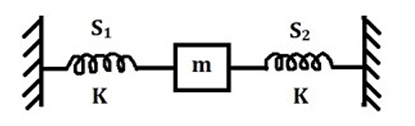
- As shown in the figure, \(S_1\) and \(S_2\) are identical springs with spring constant \(K\) each. The oscillation frequency of the mass ' \(m\) ' is ' \(f\) '. If the spring \(S_2\) is removed, the oscillation frequency will become
 MHT CET 2025 Medium
 - \(\int_{0}^{a}(a-x)^{\frac{3}{2}} \cdot x^{2} d x=\)MHT CET 2020 Medium
- Which of the following is \(\underline{\text { NOT }}\) a dihydric phenol?MHT CET 2020 Easy
- A single slit diffraction pattern is formed with light of wavelength \(6195 Å\). The second secondary maximum for this wavelength coincides with the third secondary maximum in the pattern for light of wavelength ' \(\lambda_0\) '. The value of ' \(\lambda_0\) ' isMHT CET 2024 Easy
- The number of regions in the structure of a typical root are __________.MHT CET 2021 Easy
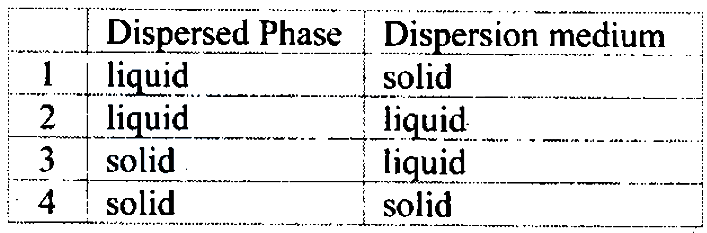
- Identify dispersed phase and dispersion medium in cheese.
 MHT CET 2024 Easy