


MHT CET · Maths · Indefinite Integration
If \(\mathrm{f}(x)=1+x ; \mathrm{g}(x)=\log x\), then \(\int \mathrm{g}(\mathrm{f}(x)) \mathrm{d} x\) is equal to
- A \((1+x) \log (1+x)-x+\mathrm{c}\), (where c is a constant of integration)
- B \((1+x) \log x-x+\mathrm{c}\), (where c is a constant of integration)
- C \(x \log (1+x)+\mathrm{c}\), (where c is a constant of integration)
- D \((1+x) \log (1+x)+x+\mathrm{c}\), (where c is a constant of integration)
Answer & Solution
Correct Answer
(A) \((1+x) \log (1+x)-x+\mathrm{c}\), (where c is a constant of integration)
Step-by-step Solution
Detailed explanation
\(\begin{aligned} & \int \mathrm{g}(\mathrm{f}(x)) \mathrm{d} x \\ & =\int 1 \times \log (1+x) \mathrm{d} x\end{aligned}\)
\(\begin{aligned} & =x \log (1+x)-\int x \times \frac{1}{(1+x)} \mathrm{d} x+\mathrm{c} \\ & =x \log (1+x)-\left[\int \frac{1+x}{1+x} \mathrm{~d} x-\int \frac{1}{1+x} \mathrm{~d} x\right]+\mathrm{c} \\ & =x \log (1+x)-x+\log (1+x)+\mathrm{c} \\ & =(1+x) \log (1+x)-x+\mathrm{c}\end{aligned}\)
\(\begin{aligned} & =x \log (1+x)-\int x \times \frac{1}{(1+x)} \mathrm{d} x+\mathrm{c} \\ & =x \log (1+x)-\left[\int \frac{1+x}{1+x} \mathrm{~d} x-\int \frac{1}{1+x} \mathrm{~d} x\right]+\mathrm{c} \\ & =x \log (1+x)-x+\log (1+x)+\mathrm{c} \\ & =(1+x) \log (1+x)-x+\mathrm{c}\end{aligned}\)
See the Complete Solution
Get step-by-step explanations for this and 2.5 Lakh+ more JEE, NEET & CET questions.
- Unlock all solutions
- Practice the full chapter
- Track accuracy across PYQs
4.8 rated on Google Play · 14,000+ reviews
More questions from Maths
- If one of the lines of the pair \(a x^{2}+2 h x y+b y^{2}=0\) bisects the angle between positive direction of the axes, then \(a, b\) and \(h\) satisfy the relationMHT CET 2011 Medium
- If the sum of slopes of the pair of lines given by \(4 x^{2}+2 \mathrm{~h} x y-7 y^{2}=0\) is equal to the product of the slopes, then \(\mathrm{h}\) isMHT CET 2020 Easy
- For a real number \(x,[x]\) denotes the greatest integer less than or equal to \(x\). Then the value of
\(\left[\frac{1}{2}\right]+\left[\frac{1}{2}+\frac{1}{100}\right]+\left[\frac{1}{2}+\frac{2}{100}\right]+\left[\frac{1}{2}+\frac{3}{100}\right]+\ldots \ldots \ldots \ldots .+\left[\frac{1}{2}+\frac{99}{100}\right]=\)MHT CET 2025 Medium - The value of \(\tan ^{-1}\left(\frac{1}{3}\right)+\tan ^{-1}\left(\frac{1}{5}\right)+\tan ^{-1}\left(\frac{1}{7}\right)+\tan ^{-1}\left(\frac{1}{8}\right)\) isMHT CET 2022 Easy
- The function \(\mathrm{f}(\mathrm{x})\) is defined by \(\mathrm{f}(\mathrm{x})=(\mathrm{x}+2) \mathrm{e}^{-\mathrm{x}}\) isMHT CET 2022 Hard
- If the error involved in making a certain measurement is continuous random variable \(\mathrm{X}\) with probability density function \(f(x)=k\left(4-x^{2}\right)\) if \(-2 \leq x \leq 2\)
\(=0 \quad\), otherwise
then, \(\mathrm{P}[-1 < \mathrm{X} < 1]=\)MHT CET 2020 Medium
More PYQs from MHT CET
- Equation of simple harmonic progressive wave is given by \(y=\frac{1}{\sqrt{a}} \sin \omega t \pm \frac{1}{\sqrt{b}} \cos \omega t\) then the resultant amplitude of the wave is \(\left(\cos 90^{\circ}=0\right)\)MHT CET 2023 Hard
- I - V characteristics of photodiode for different illumination intensities \(\mathrm{I}_1, \mathrm{I}_2, \mathrm{I}_3\) and \(\mathrm{I}_4\) are drawn as follows. Then the maximum intensity among them is
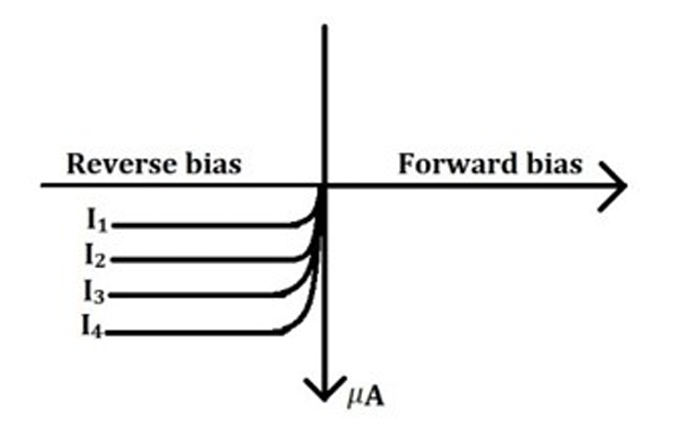 MHT CET 2025 Easy
 - Calculate amount of methane formed by liberation of \(149.6 \mathrm{~kJ}\) of heat using following equation.
\( \mathrm{C}_{(\mathrm{s})}+2 \mathrm{H}_{2(\mathrm{~g})} \longrightarrow \mathrm{CH}_{4(\mathrm{~g})} \quad \Delta \mathrm{H}\) \(=-74.8 \mathrm{~kJ} / \mathrm{mol} \)MHT CET 2023 Medium - What is the value of \(\Delta \mathrm{H}^{\circ}\) for the formation of ethanol from ethene gas and liquid water from following data?
(i) \(\mathrm{C}_{2} \mathrm{H}_{5} \mathrm{OH}_{(1)}+3 \mathrm{O}_{2(\mathrm{~g})} \longrightarrow 2 \mathrm{CO}_{2(\mathrm{~g})}+3 \mathrm{H}_{2} \mathrm{O}_{(\mathrm{l})}\) \(\Delta \mathrm{H}^{\circ}=-1368 \mathrm{~kJ}\)
(ii) \(\mathrm{C}_{2} \mathrm{H}_{4(\mathrm{~g})}+3 \mathrm{O}_{2(\mathrm{~g})} \longrightarrow 2 \mathrm{CO}_{2(\mathrm{~g})}+2 \mathrm{H}_{2} \mathrm{O}_{(\mathrm{l})}\) \(\Delta \mathrm{H}^{\circ}=1410 \mathrm{~kJ}\)MHT CET 2020 Medium - If the angle between the planes and is thenMHT CET 2017 Easy
- A body cools according to Newton's law from \(100^{\circ} \mathrm{C}\) to \(60^{\circ} \mathrm{C}\) in 20 minutes. The
temperature of the surrounding being \(20^{\circ} \mathrm{C}\) then the temperature of the body after
one hour isMHT CET 2020 Medium