


MHT CET · Maths · Three Dimensional Geometry
If \(\triangle \mathrm{ABC}\) is right angled at \(\mathrm{A}\), where \(\mathrm{A} \equiv(4,2, x), \mathrm{B} \equiv(3,1,8)\) and \(\mathrm{C} \equiv(2,-1,2)\), then the value of \(x\) is
- A \(4\)
- B \(2\)
- C \(3\)
- D \(1\)
Answer & Solution
Correct Answer
(D) \(1\)
Step-by-step Solution
Detailed explanation
Since \(\triangle \mathrm{ABC}\) is right angled at \(\mathrm{A}\),
\(\overline{\mathrm{AB}} \cdot \overline{\mathrm{AC}}=0\)
\(\Rightarrow[-\hat{\mathrm{i}}-\hat{\mathrm{j}}+(8-x) \hat{\mathrm{k}}] \cdot(-2 \hat{\mathrm{i}}-3 \hat{\mathrm{j}}+(2-x) \hat{\mathrm{k}})=0\)
\(\Rightarrow 2+3+(8-x)(2-x)=0\)
\(\Rightarrow x^2-10 x+21=0\)
\(\Rightarrow(x-3)(x-7)=0\)
\(\Rightarrow x=3 \text { or} x=7\)
\(\overline{\mathrm{AB}} \cdot \overline{\mathrm{AC}}=0\)
\(\Rightarrow[-\hat{\mathrm{i}}-\hat{\mathrm{j}}+(8-x) \hat{\mathrm{k}}] \cdot(-2 \hat{\mathrm{i}}-3 \hat{\mathrm{j}}+(2-x) \hat{\mathrm{k}})=0\)
\(\Rightarrow 2+3+(8-x)(2-x)=0\)
\(\Rightarrow x^2-10 x+21=0\)
\(\Rightarrow(x-3)(x-7)=0\)
\(\Rightarrow x=3 \text { or} x=7\)
See the Complete Solution
Get step-by-step explanations for this and 2.5 Lakh+ more JEE, NEET & CET questions.
- Unlock all solutions
- Practice the full chapter
- Track accuracy across PYQs
4.8 rated on Google Play · 14,000+ reviews
More questions from Maths
- Let \(A \equiv(0,0), B(3,0), C(0,-4)\) are vertices of \(\triangle A B C\) then the co-ordinates of incentre of \(\triangle A B C\) isMHT CET 2025 Medium
- \(\int \frac{\sin 2 x \cos 2 x}{\sqrt{4-\cos ^4 2 x}} \mathrm{~d} x=\)MHT CET 2025 Medium
- If \(2 a+b+3 c=0\), then the line \(a x+b y+c=0\) passes through the fixed point that isMHT CET 2012 Easy
- A random variable \(\mathrm{X}\) takes the values \(0,1,2\). Its mean is \(1 \cdot 2 .\) If \(\mathrm{P}(\mathrm{X}=0)=0.3\),
then \(\mathrm{P}(\mathrm{X}=1)=\)MHT CET 2020 Easy - The line \(L\) given by \(\frac{x}{5}+\frac{y}{b} \doteq 1\) passes through the point \((13,32)\). The line K is parallel to line L and has the equation \(\frac{x}{c}+\frac{y}{3}=1\). Then the distance between L and K is \(\qquad\) units.MHT CET 2024 Easy
- Let \(\overline{\mathrm{a}}, \overline{\mathrm{b}}\) and \(\overline{\mathrm{c}}\) be three unit vectors such that \(\overline{\mathrm{a}} \times(\overline{\mathrm{b}} \times \overline{\mathrm{c}})=\frac{\sqrt{3}}{2}(\overline{\mathrm{b}}+\overline{\mathrm{c}})\). If \(\overline{\mathrm{b}}\) is not parallel to \(\overline{\mathrm{c}}\), then the angle between \(\bar{a}\) and \(\bar{b}\) isMHT CET 2023 Medium
More PYQs from MHT CET
- The equation of the normal to the curve \(x=\theta+\sin \theta, y=1+\cos \theta\) at \(\theta=\frac{\pi}{2}\) isMHT CET 2024 Hard
- The ratio of work done by an ideal rigid diatomic gas to the heat supplied by the gas in an isobaric process isMHT CET 2024 Easy
- Human placenta is called haemochorial because _________ .MHT CET 2024 Hard
- A black body radiates maximum energy at wavelength \(^{\prime} \lambda^{\prime}\) and its emissive power is \({ }^{\prime} \mathrm{E}^{\prime}\). Now, due to change in temperature of that body, it radiates maximum energy at wavelength \(\frac{2 \lambda}{3}\). At that temperature, emissive power isMHT CET 2020 Easy
- In the given circuit, current flowing through it is
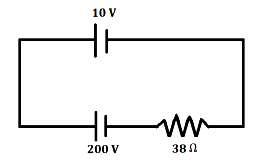 MHT CET 2020 Easy
 - For ideal non-rigid diatomic gas, the value of \(\frac{R}{C_V}\) is nearly \(\left(\gamma=\frac{C_P}{C_V}=\frac{9}{7}\right)\)MHT CET 2025 Easy