


MHT CET · Maths · Vector Algebra
If \(\bar{a}, \bar{b}\) and \(\bar{c}\) are any three non-zero vectors, then \((\bar{a}+2 \bar{b}+\bar{c}) \cdot[(\bar{a}-\bar{b}) \times(\bar{a}-\bar{b}-\bar{c})]=\)
- A \(\left[\begin{array}{lll}\bar{a} & \bar{b} & \bar{c}\end{array}\right]\)
- B \(2\left[\begin{array}{lll}-\bar{a} & \bar{b} & \bar{c}\end{array}\right]\)
- C \(3\left[\begin{array}{lll}\bar{a} & \bar{b} & \bar{c}\end{array}\right]\)
- D \(4\left[\begin{array}{lll}\vec{a} & \bar{b} & \bar{c}\end{array}\right]\)
Answer & Solution
Correct Answer
(C) \(3\left[\begin{array}{lll}\bar{a} & \bar{b} & \bar{c}\end{array}\right]\)
Step-by-step Solution
Detailed explanation
\((\bar{a}+2 \bar{b}+\bar{c}) \cdot[(\bar{a}-\bar{b}) \times(\bar{a}-\bar{b}-\bar{c})] \)
\( =(\bar{a}+2 \bar{b}+\bar{c}) \cdot(\bar{a} \times \bar{a}-\bar{a} \times \bar{b}-\bar{a} \times \bar{c}-\bar{b} \times \bar{a}+\bar{b}\) \(\times~ \bar{b}+\bar{b} \times \bar{c}) \)
\( =(\bar{a}+2 \bar{b}+\bar{c}) \cdot(\overline{0}-\bar{a} \times \bar{b}-\bar{a} \times \bar{c}+\bar{a} \times \bar{b}+\overline{0}+\bar{b} \times \bar{c}) \)
\( =(\overline{\mathrm{a}}+2 \overline{\mathrm{b}}+\overline{\mathrm{c}}) \cdot(\overline{\mathrm{c}} \times \overline{\mathrm{a}}+\overline{\mathrm{b}} \times \overline{\mathrm{c}}) \)
\( =\bar{a} \cdot(\bar{c} \times \bar{a})+\bar{a} \cdot(\bar{b} \times \bar{c})+2 \bar{b} \cdot(\bar{c} \times \bar{a})+2 \bar{b} \cdot(\bar{b} \times \bar{c}) \) \( +\overline{\mathrm{c}} \cdot(\overline{\mathrm{c}} \times \overline{\mathrm{a}})+\overline{\mathrm{c}} \cdot(\overline{\mathrm{b}} \times \overline{\mathrm{c}}) \)
\( =\overline{0}+\bar{a} \cdot(\bar{b} \times \bar{c})+2 \bar{b} \cdot(\bar{c} \times \bar{a})+2 \times 0-0-0 \)
\(=\left[\begin{array}{lll}\overline{ a } & \overline{ b } & \overline{ c }\end{array}\right]+2\left[\begin{array}{lll}\overline{ b } & \overline{ c } & \overline{ a }\end{array}\right]\)
\(=\left[\begin{array}{lll}\overline{ a } & \overline{ b } & \overline{ c }\end{array}\right]+2\left[\begin{array}{lll}\overline{ a } & \overline{ b } & \overline{ c }\end{array}\right]\)
\(=3\left[\begin{array}{lll}\overline{ a } & \overline{ b } & \overline{ c }\end{array}\right]\)
\( =(\bar{a}+2 \bar{b}+\bar{c}) \cdot(\bar{a} \times \bar{a}-\bar{a} \times \bar{b}-\bar{a} \times \bar{c}-\bar{b} \times \bar{a}+\bar{b}\) \(\times~ \bar{b}+\bar{b} \times \bar{c}) \)
\( =(\bar{a}+2 \bar{b}+\bar{c}) \cdot(\overline{0}-\bar{a} \times \bar{b}-\bar{a} \times \bar{c}+\bar{a} \times \bar{b}+\overline{0}+\bar{b} \times \bar{c}) \)
\( =(\overline{\mathrm{a}}+2 \overline{\mathrm{b}}+\overline{\mathrm{c}}) \cdot(\overline{\mathrm{c}} \times \overline{\mathrm{a}}+\overline{\mathrm{b}} \times \overline{\mathrm{c}}) \)
\( =\bar{a} \cdot(\bar{c} \times \bar{a})+\bar{a} \cdot(\bar{b} \times \bar{c})+2 \bar{b} \cdot(\bar{c} \times \bar{a})+2 \bar{b} \cdot(\bar{b} \times \bar{c}) \) \( +\overline{\mathrm{c}} \cdot(\overline{\mathrm{c}} \times \overline{\mathrm{a}})+\overline{\mathrm{c}} \cdot(\overline{\mathrm{b}} \times \overline{\mathrm{c}}) \)
\( =\overline{0}+\bar{a} \cdot(\bar{b} \times \bar{c})+2 \bar{b} \cdot(\bar{c} \times \bar{a})+2 \times 0-0-0 \)
\(=\left[\begin{array}{lll}\overline{ a } & \overline{ b } & \overline{ c }\end{array}\right]+2\left[\begin{array}{lll}\overline{ b } & \overline{ c } & \overline{ a }\end{array}\right]\)
\(=\left[\begin{array}{lll}\overline{ a } & \overline{ b } & \overline{ c }\end{array}\right]+2\left[\begin{array}{lll}\overline{ a } & \overline{ b } & \overline{ c }\end{array}\right]\)
\(=3\left[\begin{array}{lll}\overline{ a } & \overline{ b } & \overline{ c }\end{array}\right]\)
See the Complete Solution
Get step-by-step explanations for this and 2.5 Lakh+ more JEE, NEET & CET questions.
- Unlock all solutions
- Practice the full chapter
- Track accuracy across PYQs
4.8 rated on Google Play · 14,000+ reviews
More questions from Maths
- The area (in sq. units) bounded by the curves \(y=\sqrt{x}, 2 y-x+3=0\), \(\mathrm{X}\)-axis and lying in the first quadrant, isMHT CET 2022 Easy
- If \(\sin x+\operatorname{cosec} x=3\), then value of \(\sin ^{4} x+\operatorname{cosec}^{4} x\) isMHT CET 2020 Easy
- If the direction cosines of a line are \(\frac{1}{c}, \frac{1}{c}, \frac{1}{c}\) thenMHT CET 2020 Easy
- The differential equation \(\cos (x+y) \mathrm{d} y=\mathrm{d} x\) has the general solution given byMHT CET 2023 Medium
- \(\int_3^5 \frac{\sqrt{x} d x}{\sqrt{8-x}+\sqrt{x}}=\)MHT CET 2025 Medium
- The general solution of the differential equation \(\frac{d y}{d x}=\frac{x+2 y-1}{x+2 y+1}\) isMHT CET 2021 Hard
More PYQs from MHT CET
- The locus of a point of intersection of two lines \(x \sqrt{3}-y=k \sqrt{3}\) and
\(\sqrt{3} k x+k y=\sqrt{3}, k \in R\), describesMHT CET 2020 Easy - In the given figure of growth curve identify the phase marked as 'X'.
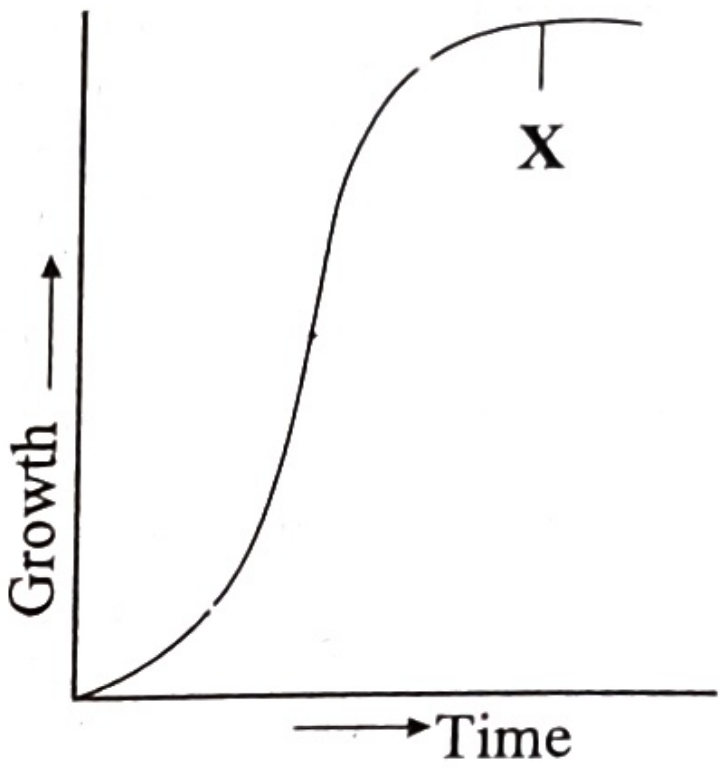 MHT CET 2022 Hard
 - The magnetic flux through a coil is \(4 \times 10^{-4} \mathrm{~Wb}\) at time \(\mathrm{t}=0\). It reduces to \(30 \%\) of its original value in time \(t\) second. If e.m.f. induced in the coil is 0.56 mV then the value of \(t\) isMHT CET 2025 Medium
- Seven identical discs each of mass \(M\) and radius \(\mathrm{R}\) are arranged in a hexagonal plane pattern so as to touch each neighbour disc as shown in the figure. The moment of inertia of the system of seven discs about an axis passing through the centre of central disc and normal to the plane of all discs is
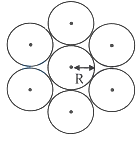 MHT CET 2023 Medium
 - The load versus elongation graph for four wires of the same materials shown in the figure. The thinnest wire is represented by the line
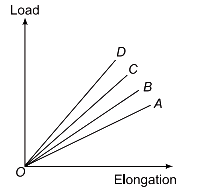 MHT CET 2011 Medium
 - Two cells \(\mathrm{E}_1\) and \(\mathrm{E}_2\) having equal \(\mathrm{EMF}\) ' \(\mathrm{E}\) ' and internal resistances \(r_1\) and \(r_2\left(r_1>r_2\right)\) respectively are connected in series. This combination is connected to an external resistance ' \(R\) '. It is observed that the potential difference across the cell \(E_1\) becomes zero. The value of ' \(R\) ' will beMHT CET 2023 Medium