


MHT CET · Maths · Matrices
If \(A=\left[\begin{array}{cc}\lambda & i \\ i & -\lambda\end{array}\right]\) and \(A^{-1}\) does not exist, then \(\lambda=(\) where \(I=\sqrt{-1})\)
- A \(\pm 2\)
- B \(\pm 1\)
- C 0
- D \(\pm 3\)
Answer & Solution
Correct Answer
(B) \(\pm 1\)
Step-by-step Solution
Detailed explanation
\(A=\left[\begin{array}{cc}
\lambda & \mathrm{i} \\
\mathrm{i} & -\lambda
\end{array}\right] \Rightarrow|\mathrm{A}|=\left|\begin{array}{cc}
\lambda & \mathrm{i} \\
\mathrm{i} & -\lambda
\end{array}\right|\)
Since \(\mathrm{A}^{-1}\) does not exist, we write \(|\mathrm{A}|=0\)
\(\therefore\left(-\lambda^2\right)-\left(\mathrm{i}^2\right)=0 \quad \Rightarrow \lambda^2=1 \Rightarrow \lambda= \pm 1\)
\lambda & \mathrm{i} \\
\mathrm{i} & -\lambda
\end{array}\right] \Rightarrow|\mathrm{A}|=\left|\begin{array}{cc}
\lambda & \mathrm{i} \\
\mathrm{i} & -\lambda
\end{array}\right|\)
Since \(\mathrm{A}^{-1}\) does not exist, we write \(|\mathrm{A}|=0\)
\(\therefore\left(-\lambda^2\right)-\left(\mathrm{i}^2\right)=0 \quad \Rightarrow \lambda^2=1 \Rightarrow \lambda= \pm 1\)
See the Complete Solution
Get step-by-step explanations for this and 2.5 Lakh+ more JEE, NEET & CET questions.
- Unlock all solutions
- Practice the full chapter
- Track accuracy across PYQs
4.8 rated on Google Play · 14,000+ reviews
More questions from Maths
- A tetrahedron has vertices at \(\mathrm{P}(2,1,3)\), \(\mathrm{Q}(-1,1,2), \mathrm{R}(1,2,1)\) and \(\mathrm{O}(0,0,0)\), then angle between the faces OPQ and PQR isMHT CET 2023 Medium
- The integrating factor of the differential equation \(\frac{d y}{d x}(x \log x)+y=2 \log x\) is given byMHT CET 2011 Easy
- If \(3 \sin 2 \theta=2 \sin 3 \theta\) and \(0 < \theta < \pi\), then the value of \(\sin \theta\) is equal toMHT CET 2025 Medium
- The slope of the normal to the curve \(x=\sqrt{t}\) and \(y=\mathrm{t}-\frac{1}{\sqrt{\mathrm{t}}}\) at \(\mathrm{t}=4\) isMHT CET 2023 Medium
- Let \(O\) be the origin and let \(P Q R\) be an arbitrary triangle. The point \(S\) \(\overline{O P} \cdot \overline{O Q}+\overline{O R} \cdot \overline{O S}=\overline{O R} \cdot \overline{O P}+\overline{O Q} \cdot \overline{O S}=\) \(\overline{O Q} \overline{O Q} \cdot \overline{O R}+\overline{O P} \cdot \overline{O S}\) that \(\overline{O P} \cdot \overline{O Q}+\overline{O R} \cdot \overline{O S}=\overline{O R} \cdot \overline{O P}+\overline{O Q} \cdot \overline{O S}=\) \(\overline{O Q} \cdot \overline{O R}+\overline{O P} \cdot \overline{O S}\), then the triangle \(P Q R\) has \(S\) as itsMHT CET 2022 Medium
- If \(2 \sin ^{2} x+7 \cos x=5\), then permissible value of \(\cos x\) isMHT CET 2020 Easy
More PYQs from MHT CET
- Identify the compound \(\mathrm{A}\) in the following reaction.
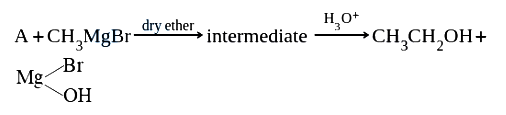 MHT CET 2022 Medium
 - The negation of the statement pattern \(\sim \mathrm{p} \vee(\mathrm{q} \rightarrow \sim \mathrm{r})\) isMHT CET 2020 Easy
- The cartesian co-ordinates of the point whose polar co-ordinates are \(\left(\frac{1}{2}, 120^{\circ}\right) \text { are }
\)MHT CET 2020 Easy - In a \(\Delta \mathrm{ABC}\) if \(2 \cos \mathrm{C}=\operatorname{Sin} \mathrm{B} .\) CosecA, thenMHT CET 2020 Easy
- A body of mass \(2 \mathrm{~kg}\) is acted upon by two forces each of magnitude \(1 \mathrm{~N}\) and inclined at \(60^{\circ}\) with each other. The acceleration of the body in \(\frac{\mathrm{m}}{\mathrm{s}}\) is \(\left[\cos 60^{\circ}=0.5\right]\)MHT CET 2020 Easy
- Two wavelengths of sodium light \(590 \mathrm{~nm}\) and \(596 \mathrm{~nm}\) are used one after another to study diffraction due to single slit of aperture \(2 \times 10^{-6} \mathrm{~m}\). The distance between the slit and the screen is \(1.5 \mathrm{~m}\). The separation between the positions of first maximum of the diffraction pattern obtained in the two cases isMHT CET 2023 Medium