


MHT CET · Maths · Differential Equations
General solution of the differential equation \(\cos x(1+\cos y) \mathrm{d} x-\sin y(1+\sin x) \mathrm{d} y=0\) is
- A \((1+\cos x)(1+\sin y)=\mathrm{c}\), where \(\mathrm{c}\) is a constant of integration.
- B \(1+\sin x+\cos y=\mathrm{c}\), where \(\mathrm{c}\) is a constant of integration.
- C \((1+\sin x)(1+\cos y)=\mathrm{c}\), where \(\mathrm{c}\) is a constant of integration.
- D \(1+\sin x \cos y=\mathrm{c}\), where \(\mathrm{c}\) is a constant of integration.
Answer & Solution
Correct Answer
(C) \((1+\sin x)(1+\cos y)=\mathrm{c}\), where \(\mathrm{c}\) is a constant of integration.
Step-by-step Solution
Detailed explanation
\(
\begin{aligned}
& \cos x(1+\cos y) \mathrm{d} x-\sin y(1+\sin x) \mathrm{d} y=0 \\
& \Rightarrow \frac{\cos x}{1+\sin x} \mathrm{~d} x-\frac{\sin y}{1+\cos y} \mathrm{~d} y=0
\end{aligned}
\)
Integrating on both sides, we get
\(
\begin{aligned}
& \log |1+\sin x|+\log |1+\cos y|=\log |c| \\
& \Rightarrow \log |(1+\sin x)(1+\cos y)|=\log |c| \\
& \Rightarrow(1+\sin x)(1+\cos y)=c
\end{aligned}
\)
\begin{aligned}
& \cos x(1+\cos y) \mathrm{d} x-\sin y(1+\sin x) \mathrm{d} y=0 \\
& \Rightarrow \frac{\cos x}{1+\sin x} \mathrm{~d} x-\frac{\sin y}{1+\cos y} \mathrm{~d} y=0
\end{aligned}
\)
Integrating on both sides, we get
\(
\begin{aligned}
& \log |1+\sin x|+\log |1+\cos y|=\log |c| \\
& \Rightarrow \log |(1+\sin x)(1+\cos y)|=\log |c| \\
& \Rightarrow(1+\sin x)(1+\cos y)=c
\end{aligned}
\)
See the Complete Solution
Get step-by-step explanations for this and 2.5 Lakh+ more JEE, NEET & CET questions.
- Unlock all solutions
- Practice the full chapter
- Track accuracy across PYQs
4.8 rated on Google Play · 14,000+ reviews
More questions from Maths
- \(\lim _{x \rightarrow 2}\left[\frac{1}{x-2}-\frac{2}{x^3-3 x^2+2 x}\right]\) is equal toMHT CET 2023 Easy
- \(\int_0^\pi \frac{\mathrm{d} x}{4+3 \cos x}=\)MHT CET 2023 Hard
- The area of the region bounded by the curve \(\mathrm{y}=|x-2|\) between \(x=1, x=3\) and X -axis is ......MHT CET 2025 Easy
- The plane \(2 x+3 y+4 z=1\) meets \(X\)-axis in \(A\), Y -axis in B and Z -axis in C . Then the centroid of \(\triangle A B C\) isMHT CET 2024 Easy
- The length of the perpendicular from the point \(\mathrm{A}(1,-2,-3)\) on the line \(\frac{x-1}{2}=\frac{y+3}{-1}=\frac{z+1}{-2}\) isMHT CET 2024 Hard
- The function \(\mathrm{f}(\mathrm{x})=\log (1+\mathrm{x})-\frac{2 \mathrm{x}}{2+\mathrm{x}}\) is increasing onMHT CET 2021 Easy
More PYQs from MHT CET
- A body of mass 1 kg starts from rest and moves with uniform acceleration. In 2 seconds, its velocity is \(10 \mathrm{~m} / \mathrm{s}\). The power exerted on the body in one second isMHT CET 2024 Medium
- If the plane \(2 x+3 y+5 z=1\) intersects the co-ordinate axes at the points \(A, B, C\), then the centroid of \(\triangle \mathrm{ABC}\) isMHT CET 2020 Easy
- When three capacitors of equal capacities are connected in parallel and one of the same capacity, capacitor is connected in series with the combination. The resultant capacity is \(4.5 \mu \mathrm{~F}\). The capacity of each capacitor isMHT CET 2024 Easy
- The equation of the plane containing the line \(\frac{x+1}{2}=\frac{y+2}{1}=\frac{z-2}{3}\) and the point \((1,-1,3)\) isMHT CET 2025 Medium
- The sum of two nonzero numbers is 4 . The minimum value of the sum of their reciprocals isMHT CET 2025 Medium
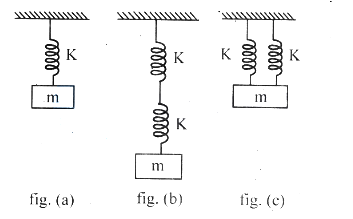
- All the springs in fig. (a), (b) and (c) are identical, each having force constant K. Mass attached to each system is ' \(m\) '. If \(T_a, T_b\) and \(T_c\) are the time periods of oscillations of the three systems respectively, then
 MHT CET 2024 Medium