


MHT CET · Maths · Probability
For \(\mathrm{k}=1,2,3\) the box \(\mathrm{B}_{\mathrm{k}}\) contains k red balls and \((\mathrm{k}+1)\) white balls. Let \(\mathrm{P}\left(\mathrm{B}_1\right)=\frac{1}{2}, \mathrm{P}\left(\mathrm{B}_2\right)=\frac{1}{3}\) and \(\mathrm{P}\left(\mathrm{B}_3\right)=\frac{1}{6}\). A box is selected at random and a ball is drawn from it. If a red ball is drawn from it, then the probability that it comes from box \(B_2\) is
- A \(\frac{35}{78}\)
- B \(\frac{14}{39}\)
- C \(\frac{10}{13}\)
- D \(\frac{12}{13}\)
Answer & Solution
Correct Answer
(B) \(\frac{14}{39}\)
Step-by-step Solution
Detailed explanation
\(\mathrm{P}\left(\mathrm{R} \mid \mathrm{B}_{\mathrm{k}}\right)=\frac{\mathrm{k}}{2 \mathrm{k}+1}\) \(\mathrm{P}\left(\mathrm{R} \mid \mathrm{B}_1\right)=\frac{1}{3}, \mathrm{P}\left(\mathrm{R} \mid \mathrm{B}_2\right)=\frac{2}{5}, \mathrm{P}\left(\mathrm{R} \mid \mathrm{B}_3\right)=\frac{3}{7}\)
See the Complete Solution
Get step-by-step explanations for this and 2.5 Lakh+ more JEE, NEET & CET questions.
- Unlock all solutions
- Practice the full chapter
- Track accuracy across PYQs
4.8 rated on Google Play · 14,000+ reviews
More questions from Maths
- \(\int_{0}^{\frac{\pi}{2}} \log \left[\sqrt{\frac{1-\cos 2 x}{1+\cos 2 x}}\right] d x=\)MHT CET 2020 Medium
- If \(\tan u=\sqrt{\frac{1-x}{1+x}}, \cos v=4 x^{3}-3 x\), then \(\frac{d u}{d v}=\)MHT CET 2020 Medium
- If \(\alpha\) and \(\beta\) are roots of the equation \(x^2+5|x|-6=0\) then the value of \(\left|\tan ^{-1} \alpha-\tan ^{-1} \beta\right|\) isMHT CET 2017 Easy
- If \(\mathrm{f}(x)=x^3-6 x^2+9 x+3\) is monotonically decreasing function, then \(x\) lies inMHT CET 2024 Easy
- Derivative of \(\tan ^{-1} \sqrt{\frac{1-x}{1+x}}\) w.r.t. \(\cos ^{-1}\left(4 x^3-3 x\right)\) isMHT CET 2024 Hard
-
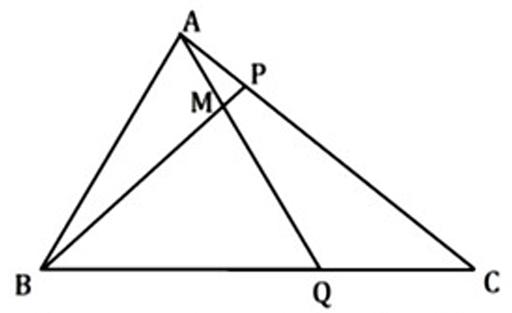
In the above figure, P divides AC in the ratio 3:4 and Q divides BC in the ratio \(4: 3\). Then \(M\) divides \(A Q\) in the ratioMHT CET 2025 Easy
More PYQs from MHT CET
- The parametric equations of the curve \(x^2+y^2+a x+b y=0\) areMHT CET 2023 Hard
- Half life of a first order reaction is 1 hour. What fraction of it will remain after 3 hour?MHT CET 2024 Easy
- Identify the angle \(\mathrm{O}-\mathrm{S}-\mathrm{O}\) in \(\mathrm{SO}_2\) molecule.MHT CET 2024 Medium
- The surface energy of a liquid drop is ' \(U\) '. It splits up into 512 equal droplets. The surface energy becomesMHT CET 2021 Medium
- Calculate the wavenumber of the photon emitted during transition from the orbit of \(\mathrm{n}=2\) to \(\mathrm{n}=1\) in hydrogen atom. \(\left[R_H=109677 \mathrm{~cm}^{-1}\right]\)MHT CET 2023 Medium
- A seconds pendulum is placed in a space laboratory orbiting round the earth at a height ' \(3 R\) ' from the earth's surface. The time period of the pendulum will be \((\mathrm{R}=\) radius of earth \()\)MHT CET 2023 Medium