


MHT CET · Maths · Probability
For an entry to a certain course, a candidate is given twenty problems to solve. If the probability that the candidate can solve any problem is \(\frac{3}{7}\), then the probability that he is unable to solve at most two problem is
- A \(\frac{256}{49}\left(\frac{4}{7}\right)^{18}\)
- B \(\frac{1966}{49}\left(\frac{4}{7}\right)^{18}\)
- C \(\frac{1710}{49}\left(\frac{4}{7}\right)^{18}\)
- D \(\frac{1726}{49}\left(\frac{4}{7}\right)^{18}\)
Answer & Solution
Correct Answer
(B) \(\frac{1966}{49}\left(\frac{4}{7}\right)^{18}\)
Step-by-step Solution
Detailed explanation
\(\mathrm{q}=\) probability that the candidate can solve the problem \(=\frac{3}{7}\)
\(\therefore \quad \mathrm{p}=1-\frac{3}{7}=\frac{4}{7}\)
Also, \(\mathrm{n}=20\).
\(\therefore \text { Required probability } \)
\( =\mathrm{P}(\mathrm{X} \leq 2) \)
\( =\mathrm{P}(\mathrm{X}=0)+\mathrm{P}(\mathrm{X}=1)+\mathrm{P}(\mathrm{X}=2) \)
\( ={ }^{20} \mathrm{C}_0 \mathrm{p}^{20} \mathrm{q}^0+{ }^{20} \mathrm{C}_1 \mathrm{p}^{19} \mathrm{q}+{ }^{20} \mathrm{C}_2 \mathrm{p}^{18} \mathrm{q}^2 \)
\( =1 \times\left(\frac{4}{7}\right)^{20} \times\left(\frac{3}{7}\right)^0+20 \times\left(\frac{4}{7}\right)^{19} \times\left(\frac{3}{7}\right)\) \(+~190\left(\frac{4}{7}\right)^{18} \times\left(\frac{3}{7}\right)^2 \)
\( =\left(\frac{4}{7}\right)^{18}\left[\frac{16}{49}+\frac{240}{49}+\frac{1710}{49}\right] \)
\( =\left(\frac{4}{7}\right)^{18} \cdot \frac{1966}{49}\)
\(\therefore \quad \mathrm{p}=1-\frac{3}{7}=\frac{4}{7}\)
Also, \(\mathrm{n}=20\).
\(\therefore \text { Required probability } \)
\( =\mathrm{P}(\mathrm{X} \leq 2) \)
\( =\mathrm{P}(\mathrm{X}=0)+\mathrm{P}(\mathrm{X}=1)+\mathrm{P}(\mathrm{X}=2) \)
\( ={ }^{20} \mathrm{C}_0 \mathrm{p}^{20} \mathrm{q}^0+{ }^{20} \mathrm{C}_1 \mathrm{p}^{19} \mathrm{q}+{ }^{20} \mathrm{C}_2 \mathrm{p}^{18} \mathrm{q}^2 \)
\( =1 \times\left(\frac{4}{7}\right)^{20} \times\left(\frac{3}{7}\right)^0+20 \times\left(\frac{4}{7}\right)^{19} \times\left(\frac{3}{7}\right)\) \(+~190\left(\frac{4}{7}\right)^{18} \times\left(\frac{3}{7}\right)^2 \)
\( =\left(\frac{4}{7}\right)^{18}\left[\frac{16}{49}+\frac{240}{49}+\frac{1710}{49}\right] \)
\( =\left(\frac{4}{7}\right)^{18} \cdot \frac{1966}{49}\)
See the Complete Solution
Get step-by-step explanations for this and 2.5 Lakh+ more JEE, NEET & CET questions.
- Unlock all solutions
- Practice the full chapter
- Track accuracy across PYQs
4.8 rated on Google Play · 14,000+ reviews
More questions from Maths
- The value of \(\int \mathrm{e}^x\left(\frac{1-\sin x}{1-\cos x}\right) \mathrm{dx}\) is equal toMHT CET 2024 Easy
- If the line joining two points \(\mathrm{A}(2,0)\) and \(\mathrm{B}(3,1)\) is rotated about \(\mathrm{A}\) in anticlockwise direction through an angle of \(15^{\circ}\), then the equation of the line in new position isMHT CET 2021 Medium
- On which of the following lines lies the point of intersection of the line, \(\frac{x-4}{2}=\frac{y-5}{2}=\frac{z-3}{1}\) and the plane \(x+y+z=2\) ?MHT CET 2024 Easy
- If a discrete random variable \(X\) takes values \(0,1,2,3, \ldots \ldots .\). with probability \(\mathrm{P}(\mathrm{X}=x)=\mathrm{k}(x+1) 5^{-x}\), where k is a constant, then \(\mathrm{P}(\mathrm{X}=0)\) isMHT CET 2024 Hard
- The shortest distance between the lines \(1+x=2 y=-12 z\) and
\(x=y+2=6 z-6\) isMHT CET 2020 Easy - \(\int_{0}^{\frac{\pi}{4}} \frac{\sin x+\cos x}{9+16 \sin 2 x} d x=k \log 3\), then \(k=\)MHT CET 2020 Hard
More PYQs from MHT CET
- The equivalent capacitance between plates 'A' and 'B' (A-area of each plate, d-separation between plates) ( \(\epsilon_0\) - permittivity of free space) is
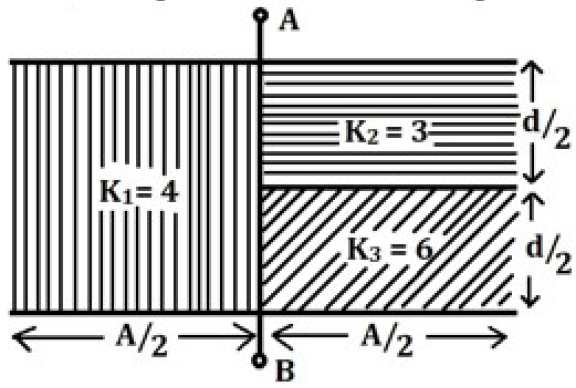 MHT CET 2025 Medium
 - During sewage treatment the activated sludge is present in _________.MHT CET 2020 Hard
- Two periodic waves of intensities \(I_{1}\) and \(I_{2}\) pass through a region at the same time in the same direction. The sum of the maximum and minimum intensities isMHT CET 2008 Medium
- A vector \(v\) is equally inclined to the \(x\) -axis, \(y\) -axis and \(z\) -axis respectively, its direction cosines areMHT CET 2011 Easy
- Which from following elements has completely filled 4 f orbital at expected ground state configuration?MHT CET 2024 Hard
- Students of class XII were given a list of following characters such as clawed toes, curved beak, feathers, pneumatic bones, wings and fur. In this list, how many are volant adaptations?MHT CET 2020 Medium