


MHT CET · Maths · Indefinite Integration
For \(-\frac{\pi}{2} < x <\frac{\pi}{2}, \int \tan ^{-1}\left(\sqrt{\frac{1-\sin x}{1+\sin x}}\right) d x=\)
(Where \(\mathrm{C}\) is a constant of integration)
- A \(\frac{\pi}{4} x+\frac{x^2}{2}+C\)
- B \(\frac{\pi}{4}-\frac{x^2}{2}+C\)
- C \(\frac{\pi}{4}+\frac{x^2}{2}+C\)
- D \(\frac{\pi}{4} x-\frac{x^2}{4}+C\)
Answer & Solution
Correct Answer
(D) \(\frac{\pi}{4} x-\frac{x^2}{4}+C\)
Step-by-step Solution
Detailed explanation
\(\int \tan ^{-1}\left(\sqrt{\frac{1-\sin x}{1+\sin x}}\right) d x=\int \tan ^{-1} \sqrt{\frac{\left(\cos \frac{x}{2}-\sin \frac{x}{2}\right)^2}{\left(\cos \frac{x}{2}+\sin \frac{x}{2}\right)^2}} d x \)
\( =\int \tan ^{-1}\left(\frac{\cos \frac{x}{2}-\sin \frac{x}{2}}{\cos \frac{x}{2}+\sin \frac{x}{2}}\right) d x=\int \tan ^{-1}\left(\frac{1-\tan \frac{x}{2}}{1+\tan \frac{x}{2}}\right) d x \)
\( =\int \tan ^{-1} \tan \left(\frac{\pi}{4}-\frac{x}{2}\right) d x=\int\left(\frac{\pi}{4}-\frac{x}{2}\right) d x \)
\( =\frac{\pi}{2} x-\frac{x^2}{4}+C\)
\( =\int \tan ^{-1}\left(\frac{\cos \frac{x}{2}-\sin \frac{x}{2}}{\cos \frac{x}{2}+\sin \frac{x}{2}}\right) d x=\int \tan ^{-1}\left(\frac{1-\tan \frac{x}{2}}{1+\tan \frac{x}{2}}\right) d x \)
\( =\int \tan ^{-1} \tan \left(\frac{\pi}{4}-\frac{x}{2}\right) d x=\int\left(\frac{\pi}{4}-\frac{x}{2}\right) d x \)
\( =\frac{\pi}{2} x-\frac{x^2}{4}+C\)
See the Complete Solution
Get step-by-step explanations for this and 2.5 Lakh+ more JEE, NEET & CET questions.
- Unlock all solutions
- Practice the full chapter
- Track accuracy across PYQs
4.8 rated on Google Play · 14,000+ reviews
More questions from Maths
- In \(\triangle \mathrm{ABC}\), with usual notations, if \(\frac{1}{b+c}+\frac{1}{c+a}=\frac{3}{a+b+c}\), then \(m \angle C\) is equal toMHT CET 2024 Medium
- If the slopes of the lines \(\mathrm{Kx}^2-4 \mathrm{xy}+5 \mathrm{y}^2=0\) differ by 2 , then \(\mathrm{K}=\)MHT CET 2022 Easy
- The correct constraints for the given feasible region are ....
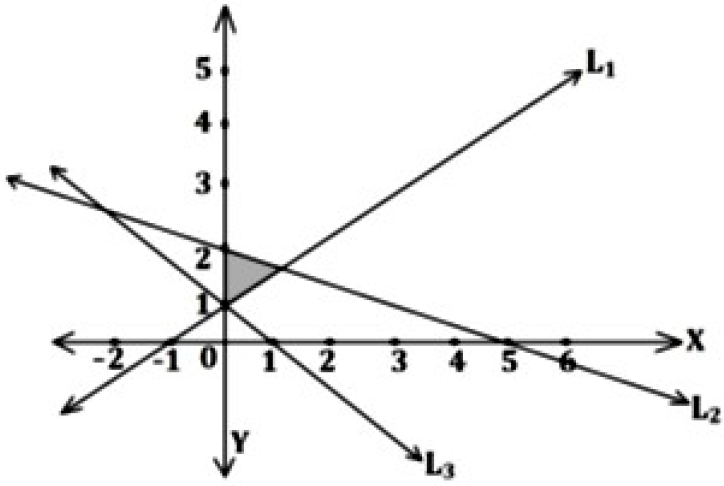 MHT CET 2025 Medium
 - The distance of the point \(\mathrm{P}(3,4,4)\) from the point of intersection of the line joining the points \(\mathrm{Q}(3,-4,-5), \mathrm{R}(2,-3,1)\) and the plane \(2 x+y+z=7\) isMHT CET 2025 Medium
- If \(\vec{a}=\hat{i}+\hat{j}+\hat{k}, \vec{c}=\hat{j}-\hat{k}, \vec{a} \times \vec{b}=\vec{c}\) and \(\vec{a} \cdot \vec{b}=1\), then \(\vec{b}\)MHT CET 2021 Medium
- If the vectors \(\overline{\mathrm{AB}}=3 \hat{\mathrm{i}}+4 \hat{\mathrm{k}}\) and \(\overline{\mathrm{AC}}=5 \hat{\mathrm{i}}-2 \hat{\mathrm{j}}+4 \hat{\mathrm{k}}\) are the sides of the triangle \(A B C\), then the length of the median through A isMHT CET 2024 Medium
More PYQs from MHT CET
- A straight horizontal conducting rod of length ' \(\mathrm{L}\) ' and mass 'M' is suspended by two vertical wires at its ends. If 'I' is the current passing through the rod, then in order that tension in the wire is zero, the magnetic field set up normal to the conductor is
(Neglect the mass of wire, \(\mathrm{g}=\) acceleration due to gravity)MHT CET 2020 Medium - Given below are two statements:
Statement I: In suspension culture and callus culture technique, subculturing is necessary.
Statement II: Subculturing is needed only in suspension culture technique.
In the light of above statements, select the correct option given below:MHT CET 2024 Easy - A monobasic weak acid dissociates to \(1.2 \%\) in its 0.01 M solution at 298 K . Calculate dissociation constant of it.MHT CET 2025 Medium
- Consider two SHMs along the same straight line \(x_1=A_1 \sin \left(\omega t+\phi_1\right)\), \(x_2=A_2 \sin \left(\omega t+\phi_2\right)\), where \(A_1\) and \(A_2\) are their amplitudes and \(\phi_1\) and \(\phi_2\) are their initial phase angle. If the two SHMs meet simultaneously and \(R\) is the resultant amplitude, match column I with column II.MHT CET 2022 Hard
- A body slides down a smooth inclined plane having angle ' \(\theta\) ' and reaches the bottom with velocity 'v'. If a body is a sphere then its linear velocity at the bottom of the plane isMHT CET 2020 Medium
- Three particles each of mass ' \(\mathrm{m}_{1}\) ' are placed at the corners of an equilateral triangle of side \(\frac{\mathrm{L}}{3}\) '. A particle of mass 'm \(_{2}\) ' is placed at the mid point of any one side of triangle. Due to the system of particles the force acting on ' \(\mathrm{m}_{2}\) ' is (G = Universal constant of gravitation)MHT CET 2020 Medium