


MHT CET · Maths · Mathematical Reasoning
Consider the statement " \(\mathrm{P}(n): n^2-n+37\) is prime." then, which one of the following is true?
- A \(\mathrm{P}(3)\) is false, but \(\mathrm{P}(5)\) is true.
- B \(P(5)\) is false, but \(P(3)\) is true.
- C Both \(\mathrm{P}(3)\) and \(\mathrm{P}(5)\) are true.
- D Both \(\mathrm{P}(3)\) and \(\mathrm{P}(5)\) are false.
Answer & Solution
Correct Answer
(B) \(P(5)\) is false, but \(P(3)\) is true.
Step-by-step Solution
Detailed explanation
"p \((n): n^2-n+37\) is prime"
Now, \(\mathrm{p}(3)=3^2-3+37=43\) (which is prime)
and \(p(5)=5^2-5+37=57\) (which is not prime)
Hence, \(\mathrm{p}(3)\) is true but \(\mathrm{p}(5)\) is false
In the question write ' \(n\) ' ' in place of ' \(n_2\) '
Now, \(\mathrm{p}(3)=3^2-3+37=43\) (which is prime)
and \(p(5)=5^2-5+37=57\) (which is not prime)
Hence, \(\mathrm{p}(3)\) is true but \(\mathrm{p}(5)\) is false
In the question write ' \(n\) ' ' in place of ' \(n_2\) '
See the Complete Solution
Get step-by-step explanations for this and 2.5 Lakh+ more JEE, NEET & CET questions.
- Unlock all solutions
- Practice the full chapter
- Track accuracy across PYQs
4.8 rated on Google Play · 14,000+ reviews
More questions from Maths
- The negation of \(\mathrm{p} \wedge(\mathrm{q} \rightarrow \mathrm{r})\) isMHT CET 2021 Easy
- The line coincides with one of the lines given by then the value of isMHT CET 2018 Hard
- Let \(B \equiv(0,3)\) and \(C \equiv(4,0)\). The point \(A\) is moving on the line \(y=2 x\) at the rate of 2 units/second. The area of \(\triangle \mathrm{ABC}\) is increasing at the rate ofMHT CET 2023 Medium
- Let \(\overline{\mathrm{a}}=3 \hat{\mathrm{i}}-\alpha \hat{\mathrm{j}}+\hat{\mathrm{k}}\) and \(\overline{\mathrm{b}}=\hat{\mathrm{i}}+\alpha \hat{\mathrm{j}}+3 \hat{\mathrm{k}}\). If the area of the parallelogram whose adjacent sides are represented by the vectors \(\bar{a}\) and \(\bar{b}\), is \(8 \sqrt{3}\) sq. units, then \(\overline{\mathrm{a}} \cdot \overline{\mathrm{b}}\) is equal toMHT CET 2024 Easy
- The locus of a point of intersection of two lines \(x \sqrt{3}-y=k \sqrt{3}\) and
\(\sqrt{3} k x+k y=\sqrt{3}, k \in R\), describesMHT CET 2020 Easy - The point on the curve \(y^2=2(x-3)\) at which the normal is parallel to the line \(y-2 x+1=0\) isMHT CET 2021 Easy
More PYQs from MHT CET
- The number of words that can be formed by using the letters of the word CALCULATE such that each word starts and ends with a consonant, areMHT CET 2023 Medium
- An AC voltage source of variable angular frequency \(\omega\) and fixed amplitude \(V_0\) is connected in series with a capacitance \(C\) and an electric bulb of resistance \(R\) (inductance zero). When \(\omega\) is increasedMHT CET 2022 Medium
- Identify the isomerism exhibited by methoxyethane and propan-1-ol.MHT CET 2021 Easy
- If \(\mathrm{p}:\) Seema is fat. \(\mathrm{q}:\) She is happy, then the logical equivalent statement of 'If Seema is fat, then she is happy' isMHT CET 2020 Easy
- A cylinder contains water upto a height 'H'. It has three orifices \(\mathrm{O}_1, \mathrm{O}_2, \mathrm{O}_3\) as shown in the figure. Let \(V_1, V_2, V_3\) be the speed of efflux of water from the three orifices. Then
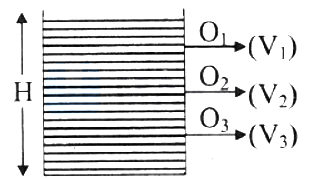 MHT CET 2024 Easy
 - The ratio of energies of photons produced due to transition of electron of hydrogen atom from its (i) second to first energy level and (ii) highest energy level to \(2^{\text {nd }}\) level is respectivelyMHT CET 2020 Easy