


MHT CET · Maths · Three Dimensional Geometry
A vector parallel to the line of intersection of the planes \(\bar{r} \cdot(3 \hat{i}-\hat{j}+\hat{k})=1\) and \(\overline{\mathrm{r}} \cdot(\hat{\mathrm{i}}+4 \hat{\mathrm{j}}-2 \hat{\mathrm{k}})=2\) is
- A \(-2 \hat{i}+7 \hat{j}+13 \hat{k}\)
- B \(2 \hat{i}-7 \hat{j}+13 \hat{k}\)
- C \(-\hat{\mathrm{i}}+4 \hat{\mathrm{j}}+7 \hat{\mathrm{k}}\)
- D \(\hat{\mathrm{i}}-4 \hat{\mathrm{j}}+7 \hat{\mathrm{k}}\)
Answer & Solution
Correct Answer
(A) \(-2 \hat{i}+7 \hat{j}+13 \hat{k}\)
Step-by-step Solution
Detailed explanation
The line of intersection of the planes \(\overline{\mathrm{r}} \cdot(3 \hat{\mathrm{i}}-\hat{\mathrm{j}}+\hat{\mathrm{k}})=1\) and \(\overline{\mathrm{r}} \cdot(\hat{\mathrm{i}}+4 \hat{\mathrm{j}}-2 \hat{\mathrm{k}})=2\) is perpendicular to each of the normal vectors \(\overline{n_1}=3 \hat{i}-\hat{j}+\hat{k}\) and \(\overline{n_2}=\hat{i}+4 \hat{j}-2 \hat{k}\).
\(\therefore \quad\) The line is parallel to the vector \(\overline{\mathrm{n}}_1 \times \overline{\mathrm{n}}_2\)
\(\begin{aligned}
\therefore \quad \overline{\mathrm{n}}_1 \times \overline{\mathrm{n}}_2 & =\left|\begin{array}{ccc}
\hat{\mathrm{i}} & \hat{\mathrm{j}} & \hat{\mathrm{k}} \\
3 & -1 & 1 \\
1 & 4 & -2
\end{array}\right| \\
& =-2 \hat{\mathrm{i}}+7 \hat{\mathrm{j}}+13 \hat{\mathrm{k}}
\end{aligned}\)
\(\therefore \quad\) The line is parallel to the vector \(\overline{\mathrm{n}}_1 \times \overline{\mathrm{n}}_2\)
\(\begin{aligned}
\therefore \quad \overline{\mathrm{n}}_1 \times \overline{\mathrm{n}}_2 & =\left|\begin{array}{ccc}
\hat{\mathrm{i}} & \hat{\mathrm{j}} & \hat{\mathrm{k}} \\
3 & -1 & 1 \\
1 & 4 & -2
\end{array}\right| \\
& =-2 \hat{\mathrm{i}}+7 \hat{\mathrm{j}}+13 \hat{\mathrm{k}}
\end{aligned}\)
See the Complete Solution
Get step-by-step explanations for this and 2.5 Lakh+ more JEE, NEET & CET questions.
- Unlock all solutions
- Practice the full chapter
- Track accuracy across PYQs
4.8 rated on Google Play · 14,000+ reviews
More questions from Maths
- A problem in statistics is given to three students \(\mathrm{P}, \mathrm{Q}\) and \(\mathrm{R}\). Their chances of solving
the problem are \(\frac{1}{2}, \frac{1}{3}, \frac{1}{4}\) respectively. If all of them try independently, then the
probability that the problem is solved, isMHT CET 2020 Easy - If the standard deviation of the random variable X is and mean is 3p thenMHT CET 2019 Medium
- The value of \(\int \frac{\sec x \cdot \tan x}{9-16 \tan ^2 x} \mathrm{~d} x\) is equal toMHT CET 2024 Hard
- If \(\mathrm{y}=x^x+x^{\frac{1}{x}}\), then \(\frac{\mathrm{dy}}{\mathrm{d} x}\) is equal toMHT CET 2025 Medium
- \(\int_{0}^{\frac{\pi}{2}} \log \left[\sqrt{\frac{1-\cos 2 x}{1+\cos 2 x}}\right] d x=\)MHT CET 2020 Medium
- An open metallic tank is to be constructed, with a square base and vertical sides, having volume 500 cubic meter. Then the dimensions of the tank, for minimum area of the sheet metal used in its construction, areMHT CET 2023 Easy
More PYQs from MHT CET
- If a star emitting yellow light is accelerated towards earth, them to an observer on earth it will appearMHT CET 2019 Easy
- Which from following is an example of an intensive property of the system?MHT CET 2025 Easy
- For the following shaded area, the linear constraints except \(x, y \geq 0\) are
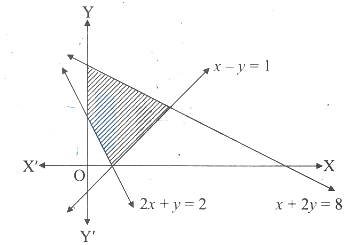 MHT CET 2023 Easy
 - A \(500 \mathrm{~kg}\) car takes a round turn of radius \(50 \mathrm{~m}\) with a velocity of \(36 \mathrm{~km} / \mathrm{h}\). The centripetal force isMHT CET 2007 Hard
- The bacteria increases at the rate proportional to the number of bacteria present. If the original number 'N' doubles in 4 hours, then the number of bacteria in 12 hours will beMHT CET 2020 Easy
- Identify the cells and their function.
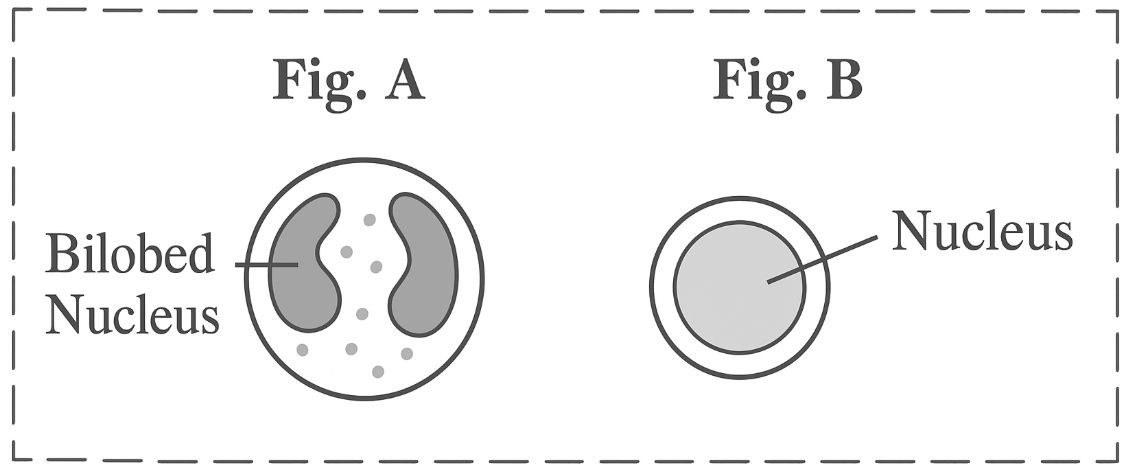
(a) Fig. A - Megakaryocyte - formation of platelets
(b) Fig. B - Lymphocyte - synthesis of antibodies
(c) Fig. A - Eosinophil - secrete antihistamine
(d) Fig. A - Neutrophil - secrete heparinMHT CET 2020 Hard