


MHT CET · Maths · Application of Derivatives
A spherical raindrop evaporates at a rate proportional to its surface area. If its radius originally is \(3 \mathrm{~mm}\). and 1 hour later has been reduced to \(2 \mathrm{~mm}\), then the expression of radius \(\mathrm{r}\) of the raindrop at any time \(t\) is (where \(0 \leq t < 3\) )
- A \(\mathrm{r}=\mathrm{t}+5\)
- B \(r=t-5\)
- C \(\mathrm{r}=3-\mathrm{t}\)
- D \(r=t+3\)
Answer & Solution
Correct Answer
(C) \(\mathrm{r}=3-\mathrm{t}\)
Step-by-step Solution
Detailed explanation
We have \(\frac{\mathrm{dv}}{\mathrm{dt}} \propto-\left(4 \pi \mathrm{r}^2\right)\)
We know that \(\mathrm{v}=\frac{4}{3} \pi \mathrm{r}^2 \Rightarrow \frac{\mathrm{dv}}{\mathrm{dt}}=4 \pi \mathrm{r}^2 \frac{\mathrm{dr}}{\mathrm{dt}}\)
\(
\begin{aligned}
& \therefore 4 \pi \mathrm{r}^2 \frac{\mathrm{dr}}{\mathrm{dt}} \propto-\left(4 \pi \mathrm{r}^2\right) \\
& \therefore 4 \pi \mathrm{r}^2 \frac{\mathrm{dr}}{\mathrm{dt}}=\left(-4 \mathrm{k} \pi \mathrm{r}^2\right) \Rightarrow \frac{\mathrm{dr}}{\mathrm{dt}}=-\mathrm{k}
\end{aligned}
\)
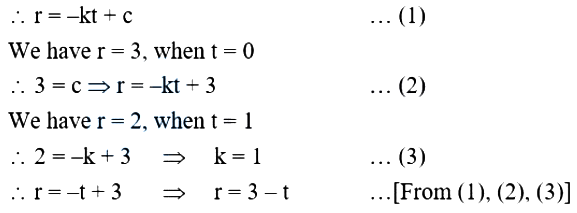
We know that \(\mathrm{v}=\frac{4}{3} \pi \mathrm{r}^2 \Rightarrow \frac{\mathrm{dv}}{\mathrm{dt}}=4 \pi \mathrm{r}^2 \frac{\mathrm{dr}}{\mathrm{dt}}\)
\(
\begin{aligned}
& \therefore 4 \pi \mathrm{r}^2 \frac{\mathrm{dr}}{\mathrm{dt}} \propto-\left(4 \pi \mathrm{r}^2\right) \\
& \therefore 4 \pi \mathrm{r}^2 \frac{\mathrm{dr}}{\mathrm{dt}}=\left(-4 \mathrm{k} \pi \mathrm{r}^2\right) \Rightarrow \frac{\mathrm{dr}}{\mathrm{dt}}=-\mathrm{k}
\end{aligned}
\)
See the Complete Solution
Get step-by-step explanations for this and 2.5 Lakh+ more JEE, NEET & CET questions.
- Unlock all solutions
- Practice the full chapter
- Track accuracy across PYQs
4.8 rated on Google Play · 14,000+ reviews
More questions from Maths
- If then x = …..MHT CET 2019 Medium
- The line \(L\) is passing through \((1,2,3)\). The distance of any point on the line \(L\) from the line \(\bar{r}=(3 \lambda-1) \hat{i}+(-2 \lambda+3) \hat{j}+(4+\lambda) \hat{k}\) is constant. Then the line \(L\) does not pass through the pointMHT CET 2025 Hard
- If \(A^{-1}=\left[\begin{array}{cc}2 & -3 \\ -1 & 2\end{array}\right]\) and \(B^{-1}=\left[\begin{array}{cc}1 & 0 \\ -3 & 1\end{array}\right]\), then \((A B)^{-1}=\)MHT CET 2021 Medium
- With usual notations, the perimeter of a triangle ABC is 6 times the arithmetic mean of sine of its angles. If \(a=1\), then \(\angle \mathrm{A}=\)MHT CET 2025 Medium
- A fair coin is tossed 100 times. The chance of getting a head even number of times isMHT CET 2025 Medium
- If \(\bar{a}\) is perpendicular to \(\bar{b}\) and \(\bar{c},|\vec{a}|=2\), \(|\bar{b}|=3,|\bar{c}|=4\) and the angle between \(\bar{b}\) and \(\bar{c}\) is \(\frac{\pi}{3}\), then \(\left[\begin{array}{lll}\overline{\mathrm{a}} & \overline{\mathrm{b}} & \overline{\mathrm{c}}\end{array}\right]=\)MHT CET 2024 Easy
More PYQs from MHT CET
- What is the conductivity of 0.02 M AgNO 3 solution having cell constant \(1.1 \mathrm{~cm}^{-1}\) and resistance is 94.5 ohms?MHT CET 2024 Medium
- A bicycle wheel of radius ' \(R\) ' has ' \(n\) ' spokes. It is rotating at the rate of ' \(F\) ' r.p.m. perpendicular to the horizontal component of earth's magnetic field \(\vec{B}\). The e.m.f. induced between the rim and the centre of the wheel isMHT CET 2024 Medium
- For \(N \in \mathbb{N}\),
\(\frac{\mathrm{d}^{\mathrm{n}}}{\mathrm{~d} x^{\mathrm{n}}}(\log x)=\)MHT CET 2025 Medium - At certain temperature, \(\operatorname{rod} \mathrm{A}\) and \(\operatorname{rod} \mathrm{B}\) of different materials have lengths \(L_A\) and \(L_B\) respectively: Their coefficients of linear expansion are \(\alpha_A\) and \(\alpha_B\) respectively. It is observed that the difference between their length's remains constant at all temperatures. The ratio \(\mathrm{L}_{\mathrm{A}}: \mathrm{L}_{\mathrm{B}}\) is given byMHT CET 2024 Easy
- The resonant frequency of an \(L-C\) circuit isMHT CET 2012 Medium
- What is IUPAC name of 3 - chloropropyl ethyl ether?MHT CET 2020 Medium