


MHT CET · Maths · Probability
A random variable \(\mathrm{X}\) assumes value \(1,2,3, \ldots \ldots . n\) with equal probabilities. If the ratio of variance of \(=\sum p_i x_i^2-\left(\sum p_i x_i\right)^2\) to expected value of \(\mathrm{X}\) is equal to 4 , then the value of \(n\) is
- A 35
- B 50
- C 30
- D 25
Answer & Solution
Correct Answer
(D) 25
Step-by-step Solution
Detailed explanation
\(\text { Variance }=\sum p_i X_i^2-\left(\sum p_i X_i\right)^2 \)
\( =\frac{1}{n} \times \frac{n(n+1)(2 n+1)}{6}-\left\{\frac{1}{n} \times \frac{n(n+1)}{2}\right\}^2 \)
\(=\frac{n(n+1)}{2 n}\left\{\frac{2 n+1}{3}-\frac{n(n+1)}{2 n}\right\} \)
\( \text {Expected value }=\sum p_i x_i=\frac{1}{n} \cdot \frac{n(n+1)}{2}=\) \(\frac{n(n+1)}{2 n} \)
\( \text {Ratio }=\frac{2 n+1}{3}-\frac{n(n+1)}{2 n}\)
\(\Rightarrow n^2-25 n=0\)
\(\Rightarrow n(n-25)=0\)
\(\Rightarrow n=0\) or \(n=25\)
\(\Rightarrow n=25\) as \(n=0\) is not possible
\( =\frac{1}{n} \times \frac{n(n+1)(2 n+1)}{6}-\left\{\frac{1}{n} \times \frac{n(n+1)}{2}\right\}^2 \)
\(=\frac{n(n+1)}{2 n}\left\{\frac{2 n+1}{3}-\frac{n(n+1)}{2 n}\right\} \)
\( \text {Expected value }=\sum p_i x_i=\frac{1}{n} \cdot \frac{n(n+1)}{2}=\) \(\frac{n(n+1)}{2 n} \)
\( \text {Ratio }=\frac{2 n+1}{3}-\frac{n(n+1)}{2 n}\)
\(\Rightarrow n^2-25 n=0\)
\(\Rightarrow n(n-25)=0\)
\(\Rightarrow n=0\) or \(n=25\)
\(\Rightarrow n=25\) as \(n=0\) is not possible
See the Complete Solution
Get step-by-step explanations for this and 2.5 Lakh+ more JEE, NEET & CET questions.
- Unlock all solutions
- Practice the full chapter
- Track accuracy across PYQs
4.8 rated on Google Play · 14,000+ reviews
More questions from Maths
- If is non-singular matrix and thenMHT CET 2019 Easy
- Consider the probability distribution
\(\begin{array}{|r|c|c|c|c|c|} \hline \mathrm{X}=x & 1 & 2 & 3 & 4 & 5 \\ \hline \mathrm{P}(\mathrm{X}=x) & \mathrm{K} & 2 \mathrm{K} & \mathrm{K}^2 & 2 \mathrm{K} & 5 \mathrm{K}^2 \\ \hline \end{array}\)
Then the value of \(\mathrm{P}(\mathrm{X} > 2)\) isMHT CET 2025 Easy - If \(e_{1}\) is the eccentricity of the ellipse \(\frac{x^{2}}{a^{2}}+\frac{y^{2}}{b^{2}}=1, a>b\) and \(e_{2}\) is the eccentricity
of the hyperbola \(\frac{x^{2}}{a^{2}}-\frac{y^{2}}{b^{2}}=1\), then \(e_{1}^{2}+e_{2}^{2}=\)MHT CET 2020 Easy - If vectors \(\bar{a}=2 \hat{i}+2 \hat{j}+3 \hat{k}, \bar{b}=-\hat{i}+2 \hat{j}+\hat{k}\) and \(\bar{c}=-3 \hat{i}+\hat{j}+2 \hat{k}\) are such that, \(\overline{\mathrm{a}}+\lambda \overline{\mathrm{b}}\) is perpendicular to \(\overline{\mathrm{c}}\), then \(\lambda=\)MHT CET 2021 Easy
- Let \(a, b, c\) be the lengths of sides of triangle \(\mathrm{ABC}\) such that \(\frac{\mathrm{a}+\mathrm{b}}{7}=\frac{\mathrm{b}+\mathrm{c}}{8}=\frac{\mathrm{c}+\mathrm{a}}{9}=\mathrm{k}\). Then \(\frac{(\mathrm{A}(\triangle \mathrm{ABC}))^2}{\mathrm{k}^4}=\)MHT CET 2023 Easy
- If \(\left[\begin{array}{ccc}1 & 1 & 1 \\ 1 & -2 & -2 \\ 1 & 3 & 1\end{array}\right]\left[\begin{array}{l}x \\ y \\ z\end{array}\right]=\left[\begin{array}{l}0 \\ 3 \\ 4\end{array}\right]\), then \(2 x-y+z=\)MHT CET 2022 Easy
More PYQs from MHT CET
- Which of the following is a simple ketone?MHT CET 2024 Hard
- Which of the following pair of compounds demonstrates the law of multiple proportions?MHT CET 2023 Easy
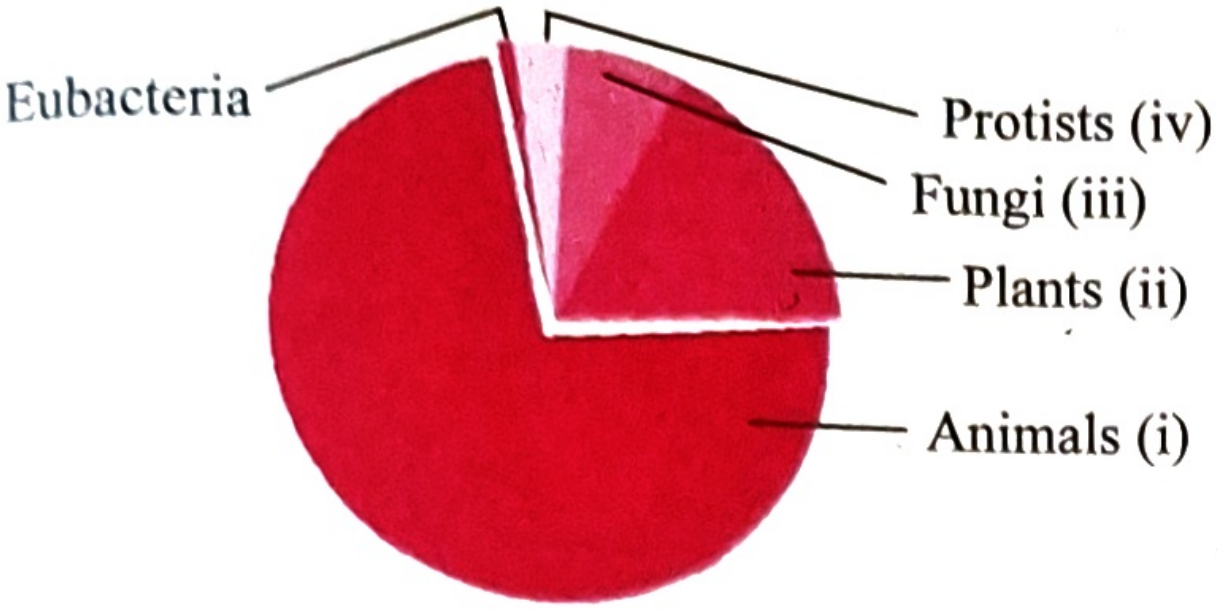
- Based on the given pie diagram, identify the correct expression with relation to the number of various groups of organism.
 MHT CET 2024 Medium
 - A woman has normal vision but some of her sons and daughters are colorblind. What will be the genotype of the woman and her husband?MHT CET 2023 Medium
- Site of fossil record of Neanderthal man was __________ .MHT CET 2024 Hard
- \( \int \frac{2 x^2-1}{x^4-x^2-20} d x= \)MHT CET 2021 Hard