


MHT CET · Maths · Sequences and Series
A radioactive substance, with initial mass \(m_0\), has a half-life of \(\mathrm{h}\) days. Then its initial decay rate is given by
- A \(\frac{\mathrm{m}_0}{\mathrm{~h}} \log 2\)
- B \(\mathrm{m}_0 \mathrm{~h} \log 2\)
- C \(-\frac{\mathrm{m}_0}{\mathrm{~h}} \log 2\)
- D \(-m_0 \mathrm{~h} \log 2\)
Answer & Solution
Correct Answer
(C) \(-\frac{\mathrm{m}_0}{\mathrm{~h}} \log 2\)
Step-by-step Solution
Detailed explanation
Let \(\mathrm{m}\) be the mass of substance at time \(\mathrm{t}\). Then,
\(\frac{\mathrm{dm}}{\mathrm{dt}}=-\mathrm{km} \text {, where } \mathrm{k}>0 \)
\( \Rightarrow \frac{\mathrm{dm}}{\mathrm{m}}=-\mathrm{kdt}\)
Integrating on both sides, we get
\(\log m=-k t+c\)
When \(\mathrm{t}=0, \mathrm{~m}=\mathrm{m}_0\)
\(\therefore \log \mathrm{m}_0=0+\mathrm{c}\)
\(\Rightarrow \mathrm{c}=\log \mathrm{m}_0\)
\(\therefore \log m=-k t+\log m_0\)
\(\Rightarrow \log \frac{\mathrm{m}}{\mathrm{m}_0}=-\mathrm{kt}\)
When \(\mathrm{t}=\mathrm{h}, \mathrm{m}=\frac{1}{2} \mathrm{~m}_0\)
\(\therefore \log \left(\frac{\frac{1}{2} m_0}{m_0}\right)=-k h\)
\(\Rightarrow \log \frac{1}{2}=-\mathrm{kh}\)
\(\Rightarrow \log 2=\mathrm{kh}\)
\(\Rightarrow \mathrm{k}=\frac{\log 2}{\mathrm{~h}}\) ...(i)
Initial decay rate,
\(\frac{\mathrm{dm}}{\mathrm{dt}}=-\mathrm{km}_0\)
\(=\frac{-\mathrm{m}_0}{\mathrm{~h}} \log 2\) ...[From (i)]
\(\frac{\mathrm{dm}}{\mathrm{dt}}=-\mathrm{km} \text {, where } \mathrm{k}>0 \)
\( \Rightarrow \frac{\mathrm{dm}}{\mathrm{m}}=-\mathrm{kdt}\)
Integrating on both sides, we get
\(\log m=-k t+c\)
When \(\mathrm{t}=0, \mathrm{~m}=\mathrm{m}_0\)
\(\therefore \log \mathrm{m}_0=0+\mathrm{c}\)
\(\Rightarrow \mathrm{c}=\log \mathrm{m}_0\)
\(\therefore \log m=-k t+\log m_0\)
\(\Rightarrow \log \frac{\mathrm{m}}{\mathrm{m}_0}=-\mathrm{kt}\)
When \(\mathrm{t}=\mathrm{h}, \mathrm{m}=\frac{1}{2} \mathrm{~m}_0\)
\(\therefore \log \left(\frac{\frac{1}{2} m_0}{m_0}\right)=-k h\)
\(\Rightarrow \log \frac{1}{2}=-\mathrm{kh}\)
\(\Rightarrow \log 2=\mathrm{kh}\)
\(\Rightarrow \mathrm{k}=\frac{\log 2}{\mathrm{~h}}\) ...(i)
Initial decay rate,
\(\frac{\mathrm{dm}}{\mathrm{dt}}=-\mathrm{km}_0\)
\(=\frac{-\mathrm{m}_0}{\mathrm{~h}} \log 2\) ...[From (i)]
See the Complete Solution
Get step-by-step explanations for this and 2.5 Lakh+ more JEE, NEET & CET questions.
- Unlock all solutions
- Practice the full chapter
- Track accuracy across PYQs
4.8 rated on Google Play · 14,000+ reviews
More questions from Maths
- If \(h(x)=\sqrt{4 f(x)+3 g(x)}, f(1)=4, g(1)=3, f^{\prime}(1)=4\), then \(\mathrm{h}(1)=\)MHT CET 2021 Medium
- The area of the triangle formed by the co-ordinate axes and a tangent to the curve \(x \mathrm{y}=a^2\) at the point \(\left(x_1, \mathrm{y}_1\right)\) is ________ sq.units (where \(a, x_1\) and \(y_1\) are non zero)MHT CET 2025 Medium
- If \(\cot (A+B)=0\), then \(\sin (A+2 B)\) is equal toMHT CET 2022 Easy
- The value of \(m\), such that \(\frac{x-4}{1}=\frac{y-2}{1}=\frac{2 z-m}{3}\) lies in the plane \(2 x-5 y+2 z=7\), isMHT CET 2024 Easy
- Let X be the number of successes in ‘n’ independent Bernoulli trials with probability of success . The least value of ‘n’ so that is….MHT CET 2019 Hard
- \(y=m x+\frac{2}{m}\) is the general solution ofMHT CET 2020 Easy
More PYQs from MHT CET
- \(\int \frac{2 x^2-1}{\left(x^2+4\right)\left(x^2-3\right)} d x=\)MHT CET 2024 Medium
- The sum of the cofactors of the elements of second row of the matrix \(\left[\begin{array}{ccc}1 & 3 & 2 \\ -2 & 0 & 1 \\ 5 & 2 &1\end{array}\right]\) isMHT CET 2020 Easy
- Which following statement is true for vinylic halide?MHT CET 2021 Medium
- Which from following is NOT a globular protein?MHT CET 2024 Medium
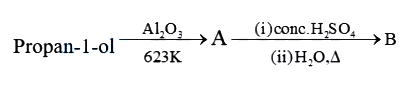
- Identify the product B in the following sequence of reactions?
 MHT CET 2021 Easy
 - Which of the following equations gives combined relationship of Boyle's law and Charle's law?MHT CET 2024 Easy