


MHT CET · Maths · Differentiation
A particle moves along a straight line according to the law \(s=16-2 t+3 t^{3}\), where \(s\) metres is the distance of the particle from a fixed point at the end of \(t\) second. The acceleration of the particle at the end of \(2 \mathrm{~s}\) is
- A \(3.6 \mathrm{~m} / \mathrm{s}^{2}\)
- B \(36 \mathrm{~m} / \mathrm{s}^{2}\)
- C \(36 \mathrm{~km} / \mathrm{s}^{2}\)
- D \(360 \mathrm{~m} / \mathrm{s}^{2}\)
Answer & Solution
Correct Answer
(B) \(36 \mathrm{~m} / \mathrm{s}^{2}\)
Step-by-step Solution
Detailed explanation
Given, \(s=16-2 t+3 t^{3}\)
\(
\begin{array}{lc}
\Rightarrow \frac{d s}{d t}=-2+9 t^{2} \\
\Rightarrow \frac{d^{2} s}{d t^{2}}=18 t
\end{array}
\)
Now, the acceleration of the particle at the end of \(t=2 \mathrm{~s}\) is
\(f=\frac{d^{2} s}{d t^{2}}=18 \times 2\)
\(=36 \mathrm{~m} / \mathrm{s}^{2}\)
\(
\begin{array}{lc}
\Rightarrow \frac{d s}{d t}=-2+9 t^{2} \\
\Rightarrow \frac{d^{2} s}{d t^{2}}=18 t
\end{array}
\)
Now, the acceleration of the particle at the end of \(t=2 \mathrm{~s}\) is
\(f=\frac{d^{2} s}{d t^{2}}=18 \times 2\)
\(=36 \mathrm{~m} / \mathrm{s}^{2}\)
See the Complete Solution
Get step-by-step explanations for this and 2.5 Lakh+ more JEE, NEET & CET questions.
- Unlock all solutions
- Practice the full chapter
- Track accuracy across PYQs
4.8 rated on Google Play · 14,000+ reviews
More questions from Maths
- The equation of tangent at \(\mathrm{P}(-4,-4)\) on the curve \(x^{2}=-4 y\) isMHT CET 2020 Easy
- Tangent to the ellipse \(\frac{x^{2}}{32}+\frac{y^{2}}{18}=1\) having slope \(-\frac{3}{4}\) meet the coordinate axes in \(A\) and \(B\). Find the area of the \(\Delta A O B\), where \(O\) is the origin.MHT CET 2009 Medium
- The means of 5 observations is 4.4 and variance is 8.24 . If three of the five observations are 1,2 and 6 , then the values of other two observations areMHT CET 2022 Easy
- The area of a parallelogram whose diagonals are the vectors \(2 \bar{a}-\bar{b}\) and \(4 \bar{a}-5 \bar{b}\), where \(\bar{a}\) and \(\overline{\mathrm{b}}\) are unit vectors forming an angle of \(45^{\circ}\) isMHT CET 2025 Medium
- If thenMHT CET 2017 Medium
- If \(x^{2} y^{2}=\sin ^{-1} \sqrt{x^{2}+y^{2}}+\cos ^{-1} \sqrt{x^{2}+y^{2}}\), then \(\frac{d y}{d x}=\)MHT CET 2020 Easy
More PYQs from MHT CET
- \(\int \frac{\mathrm{d} x}{2+\cos x}=\) (Where \(C\) is a constant of integration.)MHT CET 2022 Medium
- If p : The total prime numbers between 2 to 100 are 26 .
q : Zero is a complex number.
r : Least common multiple (L.C.M.) of 6 and 7 is 6 .
Then which of the following is correct?MHT CET 2024 Easy - Five capacitors, each of capacitance 'C' are connected as shown in the figure. The ratio of equivalent capacitance between \(P\) and \(R\) and the equivalent capacitance between \(P\) and \(Q\) is
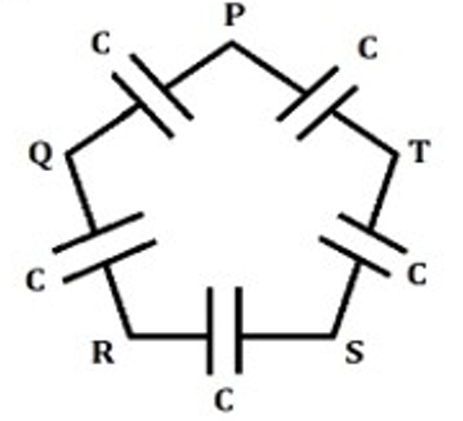 MHT CET 2025 Medium
 - A potentiometer wire of length \(4 \mathrm{~m}\) and resistance \(5 \Omega\) is connected in series with a resistance of \(992 \Omega\) and a cell of e.m.f. \(4 \mathrm{~V}\) with internal resistance \(3 \Omega\). The length of \(0.75 \mathrm{~m}\) on potentiometer wire balances the e.m.f. ofMHT CET 2023 Hard
- Which of the following cannot be considered as application of electrochemical series?MHT CET 2022 Medium
- A planet is moving around the sun in an elliptical orbit at different positions A, B, C, D. The maximum rotational kinetic energy of a planet is at postion.
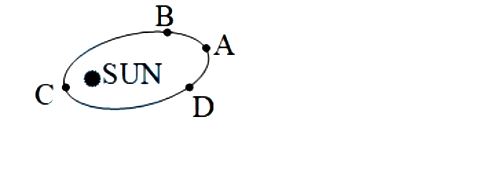 MHT CET 2022 Medium