


MHT CET · Maths · Application of Derivatives
A particle is moving on a straight line. The distance \(\mathrm{S}\) travelled in time \(t\) is given by \(S=a t^2+b t+6\). If the particle comes to rest after 4 seconds at a distance of \(16 \mathrm{~m}\). from the starting point, then the acceleration of the particle is.
- A \(\frac{-3}{4} \mathrm{~m} / \mathrm{sec}^2\)
- B \(\frac{-1}{2} \mathrm{~m} / \mathrm{sec}^2\)
- C \(-1 \mathrm{~m} / \mathrm{sec}^2\)
- D \(\frac{-5}{4} \mathrm{~m} / \mathrm{sec}^2\)
Answer & Solution
Correct Answer
(D) \(\frac{-5}{4} \mathrm{~m} / \mathrm{sec}^2\)
Step-by-step Solution
Detailed explanation
\(
\begin{aligned}
& \mathrm{S}=\mathrm{at} \mathrm{t}^2+\mathrm{bt}+6 \\
& \therefore \mathrm{V}=\frac{\mathrm{dS}}{\mathrm{dt}}=2 \mathrm{at}+\mathrm{b} \text { and } \mathrm{A}=\frac{\mathrm{d}^2 \mathrm{~S}}{\mathrm{dt}^2}=2 \mathrm{a}
\end{aligned}
\)
When particle comes to rest,
\(
\begin{aligned}
& S=16, \mathrm{t}=4, \mathrm{~V}=0 \\
& \therefore 16=\mathrm{a}(4)^2+\mathrm{b}(4)+6 \\
& \Rightarrow 16 \mathrm{a}+4 \mathrm{~b}=10 \ldots(1)
\end{aligned}
\)
Also \(0=2 \mathrm{a}(1)(2)+4\)
\(
\Rightarrow \mathrm{b}=-8 \mathrm{a}
\)
From (1) and (2), we get
\(
16 a+4(8 a)=10 \Rightarrow-16=10 \Rightarrow a=\frac{-5}{9}
\)
We have acceleration \(\mathrm{A}=2 \mathrm{a}=2\left(\frac{-5}{8}\right)=\frac{-5}{4} \mathrm{~m} / \mathrm{sec}^2\)
\begin{aligned}
& \mathrm{S}=\mathrm{at} \mathrm{t}^2+\mathrm{bt}+6 \\
& \therefore \mathrm{V}=\frac{\mathrm{dS}}{\mathrm{dt}}=2 \mathrm{at}+\mathrm{b} \text { and } \mathrm{A}=\frac{\mathrm{d}^2 \mathrm{~S}}{\mathrm{dt}^2}=2 \mathrm{a}
\end{aligned}
\)
When particle comes to rest,
\(
\begin{aligned}
& S=16, \mathrm{t}=4, \mathrm{~V}=0 \\
& \therefore 16=\mathrm{a}(4)^2+\mathrm{b}(4)+6 \\
& \Rightarrow 16 \mathrm{a}+4 \mathrm{~b}=10 \ldots(1)
\end{aligned}
\)
Also \(0=2 \mathrm{a}(1)(2)+4\)
\(
\Rightarrow \mathrm{b}=-8 \mathrm{a}
\)
From (1) and (2), we get
\(
16 a+4(8 a)=10 \Rightarrow-16=10 \Rightarrow a=\frac{-5}{9}
\)
We have acceleration \(\mathrm{A}=2 \mathrm{a}=2\left(\frac{-5}{8}\right)=\frac{-5}{4} \mathrm{~m} / \mathrm{sec}^2\)
See the Complete Solution
Get step-by-step explanations for this and 2.5 Lakh+ more JEE, NEET & CET questions.
- Unlock all solutions
- Practice the full chapter
- Track accuracy across PYQs
4.8 rated on Google Play · 14,000+ reviews
More questions from Maths
- The equation of the plane through the line of intersection of \(\overline{\mathrm{r}} \cdot(2 \hat{i}-3 \hat{\mathrm{j}}+4 \hat{\mathrm{k}})=1\) and \(\overline{\mathrm{r}} \cdot(\hat{i}-\hat{\mathrm{j}})+4=0\) and perpandicular to \(\bar{r} \cdot(2 \hat{i}-\hat{j}+\hat{k})+8=0\) is \(\bar{r} \cdot(-5 \hat{i}+2 \hat{j}+12 \hat{k})=\mu\). Then \(\mu=\)MHT CET 2025 Medium
- \(\int_{0}^{1} \tan ^{-1}\left[\frac{2 x-1}{1+x-x^{2}}\right] d x=\)MHT CET 2020 Hard
- A plane passes through \((2,1,2)\) and \((1,2,1)\) and parallel to the line \(2 x=3 y\) and \(\mathrm{z}=1\), then the plane also passes through the point.MHT CET 2025 Medium
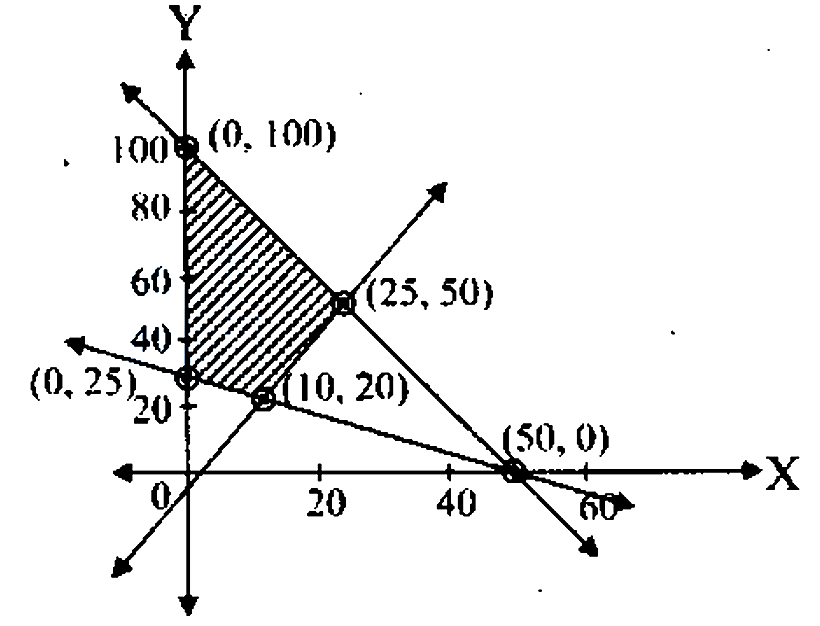
- The shaded region in the following figure is the solution set of the inequations
 MHT CET 2024 Easy
 - The sum to 10 terms of the series \(1 \times 3^{2}+2 \times 5^{2}+3 \times 7^{2}+\ldots \ldots \ldots \ldots . .\) isMHT CET 2020 Medium
- If \(X \sim B(35, p)\) such that \(7 P(X=0)=P(X=1)\) then the value of \(\frac{\mathrm{P}(\mathrm{X}=15)}{\mathrm{P}(\mathrm{X}=20)}\) is equal toMHT CET 2025 Medium
More PYQs from MHT CET
- The instantaneous value of current in an a.c. circuit is \(I=3 \sin\) \(\left(50 \pi t+\frac{\pi}{4}\right) \mathrm{A}\). The current will be maximum for the first time atMHT CET 2025 Easy
- \(\int_0^1 \cos ^{-1} x d x=\)MHT CET 2023 Medium
- Two, point charges \(+3 \mu \mathrm{C}\) and \(+8 \mu \mathrm{C}\) repel each other with a force of \(40 \mathrm{~N}\). If a charge of \(-5 \mu \mathrm{C}\) is added to each of them, then force between them will becomeMHT CET 2021 Easy
- MHT CET 2016 Easy
- Which among the following solids is a non-polar solid?MHT CET 2016 Easy
- Which from following electrolytes, molar conductivity is determined using Kohlrausch theory?MHT CET 2021 Medium