


MHT CET · Maths · Application of Derivatives
A normal is drawn at a point \(\mathrm{P}(x, y)\) of a curve \(\mathrm{y}=\mathrm{f}(x)\). The normal meets the X axis at \(\mathrm{Q} . l(\mathrm{PQ})=\mathrm{k} .(\mathrm{k}\) is a constant \()\)
Then equation of the curve through \((0, \mathrm{k})\) is
- A \(x^2+\mathrm{y}^2=\mathrm{k}^2\)
- B \((1+\mathrm{k}) x^2+\mathrm{y}^2=\mathrm{k}^2\)
- C \(x^2+\left(1+\mathrm{k}^2\right) \mathrm{y}^2=\mathrm{k}^2\)
- D \(x^2+2 \mathrm{y}^2=2 \mathrm{k}^2\)
Answer & Solution
Correct Answer
(A) \(x^2+\mathrm{y}^2=\mathrm{k}^2\)
Step-by-step Solution
Detailed explanation
\(\text{Slope of normal, } m_N = -\frac{1}{dy/dx} = -\frac{dx}{dy}\) \(\text{Equation of normal: } Y - y = -\frac{dx}{dy}(X - x)\)
See the Complete Solution
Get step-by-step explanations for this and 2.5 Lakh+ more JEE, NEET & CET questions.
- Unlock all solutions
- Practice the full chapter
- Track accuracy across PYQs
4.8 rated on Google Play · 14,000+ reviews
More questions from Maths
- Total number of 3-digit numbers, whose g.c.d with 36 is 2 , isMHT CET 2025 Medium
- The distance ' \(s\) ' in meters covered by a body in \(t\) seconds is given by \(s=3 t^2-8 t+5\). The body will stop afterMHT CET 2024 Easy
- The value of \(\tan \frac{\pi}{3}+2 \tan \frac{2 \pi}{3}+4 \tan \frac{4 \pi}{3}+8 \tan \frac{8 \pi}{3}\) is equal toMHT CET 2025 Medium
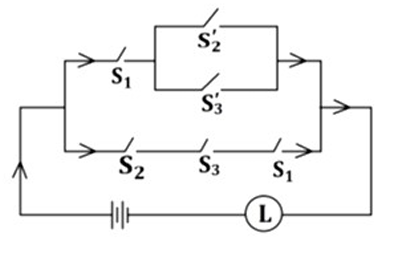
- Number of switches in alternative equivalent simple circuit for the circuit is (are)
 MHT CET 2025 Medium
 - \(\int \frac{\mathrm{d} x}{3-2 \cos 2 x}=\frac{\tan ^{-1}(\mathrm{f}(x))}{\sqrt{5}}+\mathrm{c}\), (where c is constant of integration), then \(f(\pi / 4)\) has the valueMHT CET 2024 Medium
- If \(\overline{\mathrm{a}}=\frac{1}{\sqrt{10}}(3 \hat{i}+\hat{\mathrm{k}})\) and \(\overline{\mathrm{b}}=\frac{1}{7}(2 \hat{i}+3 \hat{\mathrm{j}}-6 \hat{\mathrm{k}})\) then the value of \((2 \bar{a}-\bar{b}) \cdot[(\bar{a} \times \bar{b}) \times(\bar{a}+2 \bar{b})]=\)MHT CET 2025 Medium
More PYQs from MHT CET
- \(\int \sin ^{-1} x d x=\)MHT CET 2020 Medium
- 15 coins are tossed, then the probability of getting 10 heads will beMHT CET 2012 Easy
- Identify the product ' B ' in the following sequence of reactions.
Propanone \(\xrightarrow{\mathrm{Ba}(\mathrm{OH})_2} \mathrm{~A} \xrightarrow[-\mathrm{H}_2 \mathrm{O}]{\Delta} \mathrm{B}\)MHT CET 2024 Medium - The magnetic susceptibility of a material of a rod is 349 and permeability of vacuum \(\mu_0\) is \(4 \pi \times 10^{-7} \mathrm{SI}\) units. Absolute permeability of the material of the rod in SI unitsMHT CET 2022 Easy
- Let \(\bar{a}=\hat{i}+\hat{\mathrm{j}}+\hat{\mathrm{k}}, \overline{\mathrm{b}}\) and \(\overline{\mathrm{c}}=\hat{\mathrm{j}}-\hat{\mathrm{k}}\) be three vectors such that \(\bar{a} \times \overline{\mathrm{b}}=\overline{\mathrm{c}}\) and \(\bar{a} \cdot \bar{c}=0\). If the length of projection vector of the vector \(\overline{\mathrm{b}}\) on the vector \(\bar{a} \times \overline{\mathrm{c}}\) is \(l\), then the value of \(3 l^2\) isMHT CET 2025 Hard
- A solid cylinder of mass 'M' and radius 'R' rolls down a smooth inclined plane about its own axis and reaches the bottom with velocity ' \(\mathrm{v}^{\prime}\). The height of the inclined plane
is \((\mathrm{g}=\) acceleration due to gravity \()\)MHT CET 2020 Medium