


MHT CET · Maths · Three Dimensional Geometry
A line with positive direction cosines passes through the point \(\mathrm{P}(2,1,2)\) and makes equal angles with the coordinate axes. The line meets the plane \(2 x+y+\mathrm{z}=9\) at point Q . The length of the line segment PQ equals \(\qquad\) units.
- A \(\frac{5}{\sqrt{3}}\)
- B \(2 \sqrt{3}\)
- C \(\frac{4}{\sqrt{3}}\)
- D \(4 \sqrt{3}\)
Answer & Solution
Correct Answer
(B) \(2 \sqrt{3}\)
Step-by-step Solution
Detailed explanation
1. Direction Cosines: If a line makes equal angles with coordinate axes, its direction ratios are proportional to \((1,1,1)\).
2. Equation of the Line: Parametric form is:
\(\frac{x-2}{1}=\frac{y-1}{1}=\frac{z-2}{1}=t\)
or,
\(x=2+t, y=1+t, z=2+t\)
3. Point of Intersection with Plane: Substituting \(x=2+t, y=1+t, z=2+t\) into \(2 x+\) \(y+z=9\) :
\(\begin{gathered}
2(2+t)+(1+t)+(2+t)=9 \\
4+2 t+1+t+2+t=9 \quad \Rightarrow \quad 4 t+7=9 \\
t=\frac{2}{4}=\frac{1}{2}
\end{gathered}\)
Substituting \(t=\frac{1}{2}\) back, the coordinates of Q are:
\(Q=\left(2+\frac{1}{2}, 1+\frac{1}{2}, 2+\frac{1}{2}\right)=\left(\frac{5}{2}, \frac{3}{2}, \frac{5}{2}\right)\)
4. Length of PQ: Using the distance formula:
\(P Q=\sqrt{\left(\frac{5}{2}-2\right)^2+\left(\frac{3}{2}-1\right)^2+\left(\frac{5}{2}-2\right)^2} \)
\( P Q=\sqrt{\left(\frac{1}{2}\right)^2+\left(\frac{1}{2}\right)^2+\left(\frac{1}{2}\right)^2}=\sqrt{3 \cdot\left(\frac{1}{2}\right)^2}=\) \(\sqrt{\frac{3}{4}}=\frac{\sqrt{3}}{2}\)
Answer: \(2 \sqrt{3}\), Option 2.
2. Equation of the Line: Parametric form is:
\(\frac{x-2}{1}=\frac{y-1}{1}=\frac{z-2}{1}=t\)
or,
\(x=2+t, y=1+t, z=2+t\)
3. Point of Intersection with Plane: Substituting \(x=2+t, y=1+t, z=2+t\) into \(2 x+\) \(y+z=9\) :
\(\begin{gathered}
2(2+t)+(1+t)+(2+t)=9 \\
4+2 t+1+t+2+t=9 \quad \Rightarrow \quad 4 t+7=9 \\
t=\frac{2}{4}=\frac{1}{2}
\end{gathered}\)
Substituting \(t=\frac{1}{2}\) back, the coordinates of Q are:
\(Q=\left(2+\frac{1}{2}, 1+\frac{1}{2}, 2+\frac{1}{2}\right)=\left(\frac{5}{2}, \frac{3}{2}, \frac{5}{2}\right)\)
4. Length of PQ: Using the distance formula:
\(P Q=\sqrt{\left(\frac{5}{2}-2\right)^2+\left(\frac{3}{2}-1\right)^2+\left(\frac{5}{2}-2\right)^2} \)
\( P Q=\sqrt{\left(\frac{1}{2}\right)^2+\left(\frac{1}{2}\right)^2+\left(\frac{1}{2}\right)^2}=\sqrt{3 \cdot\left(\frac{1}{2}\right)^2}=\) \(\sqrt{\frac{3}{4}}=\frac{\sqrt{3}}{2}\)
Answer: \(2 \sqrt{3}\), Option 2.
See the Complete Solution
Get step-by-step explanations for this and 2.5 Lakh+ more JEE, NEET & CET questions.
- Unlock all solutions
- Practice the full chapter
- Track accuracy across PYQs
4.8 rated on Google Play · 14,000+ reviews
More questions from Maths
- If \(p \rightarrow(q \vee r)\) is false, then the truth values of \(\mathrm{p}, \mathrm{q}, \mathrm{r}\) are respectivelyMHT CET 2024 Easy
- If and are non-zero, non-coplanar vectors, then ________MHT CET 2019 Medium
- If the straight-line \(x=b\) divides the area enclosed by \(y=(1-x)_{-}^2\) \(y=0\) and \(x=0\) in two parts \(R_1(0 \leq x \leq b)\) and \(R_2(b \leq x \leq 1)\) such that \(R_1-R_2=\frac{1}{4}\). Then \(\mathrm{b}\) equalsMHT CET 2022 Hard
- The value of \(\cos ^{-1}\left(\cos \left(\frac{7 \pi}{6}\right)\right)\) isMHT CET 2020 Easy
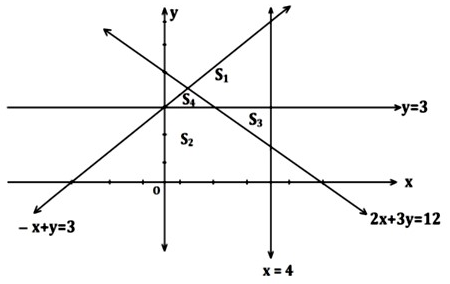
- The feasible region represented by the given constraints \(2 x+3 \mathrm{y} \geqslant 12,-x+\mathrm{y} \leqslant 3, x \leqslant 4, \mathrm{y} \geqslant 3\) is denoted by
 MHT CET 2025 Medium
 - If
\(f(x)=\left\{\begin{array}{cc}(1+|\sin x|)^{\frac{a}{|\sin x|}}, & -\pi / 6 < x < 0 \ b \end{array}\right.\) \(x=0 \ \frac{\tan 2 x}{e^{\tan 3 x}},0 < x < \pi / 6\)
is continuous at \(x=0\), find the values of \(a\) and \(b\).MHT CET 2011 Hard
More PYQs from MHT CET
- The integrating factor of the differential equation \(\frac{d y}{d x}(x \log x)+y=2 \log x\) is given byMHT CET 2011 Easy
- Which of the following property does not correspond to the order \(\mathrm{HI} < \mathrm{HBr} < \mathrm{HCl} < \mathrm{HF} ?\)MHT CET 2011 Easy
- Given \(P(A)=0.5, P(B)=0.4, P(A \cap B)=0.3\),
then \(P\left(A^{\prime} / B^{\prime}\right)\) is equal toMHT CET 2009 Medium - If \(\bar{a}=\hat{i}+\hat{j}+\hat{k}, \bar{b}=4 \hat{i}+3 \hat{j}+4 \hat{k}\) and \(\bar{c}=\hat{i}+\alpha \hat{j}+\beta \hat{k}\) are linearly dependent vectors and \(|\overline{\mathrm{c}}|=\sqrt{3}\), then the values of \(\alpha\) and \(\beta\) are respectively.MHT CET 2023 Easy
- An ammeter of resistance \(20 \Omega\) gives full scale deflection when \(1 \mathrm{~mA}\) current flows through it. What is the maximum current that can be measured by connecting 4 resistors each of \(16 \Omega\) in parallel with the meter?MHT CET 2020 Medium
- Which from following alloys is used for ultra-high speed flight?MHT CET 2022 Medium