


MHT CET · Maths · Three Dimensional Geometry
A line \(\mathrm{L}_1\) passes through the point, whose p. v. (position vector) \(3 \hat{\mathrm{i}}\), is parallel to the vector \(-\hat{\mathrm{i}}+\hat{\mathrm{j}}+\hat{\mathrm{k}}\). Another line \(\mathrm{L}_2\) passes through the point having p.v. \(\hat{i}+\hat{j}\) is parallel to vector \(\hat{i}+\hat{k}\), then the point of intersection of lines \(L_1\) and \(L_2\) has p.v.
- A \(2 \hat{i}+2 \hat{j}+\hat{k}\)
- B \(2 \hat{i}+\hat{j}+\hat{k}\)
- C \(2 \hat{\mathrm{i}}-\hat{\mathrm{j}}-\hat{\mathrm{k}}\)
- D \(2 \hat{i}-2 \hat{j}+\hat{k}\)
Answer & Solution
Correct Answer
(B) \(2 \hat{i}+\hat{j}+\hat{k}\)
Step-by-step Solution
Detailed explanation
Equation of line \(\mathrm{L}_1\) is \(\overline{\mathrm{r}}=3 \hat{\mathrm{i}}+\lambda(-\hat{\mathrm{i}}+\hat{\mathrm{j}}+\hat{\mathrm{k}})\)
Equation of line \(L_2\) is \(\overline{r^{\prime}}=\hat{i}+\hat{j}+\lambda^{\prime}(\hat{i}+\hat{k})\)
The point of intersection of \(\mathrm{L}_1\) and \(\mathrm{L}_2\) will satisfy \(\overline{\mathrm{r}}=\overline{\mathrm{r}^{\prime}}\)
\(
\begin{aligned}
& \Rightarrow 3 \hat{\mathrm{i}}+\lambda(-\hat{\mathrm{i}}+\hat{\mathrm{j}}+\hat{\mathrm{k}})=\hat{\mathrm{i}}+\hat{\mathrm{j}}+\lambda^{\prime}(\hat{\mathrm{i}}+\hat{\mathrm{k}}) \\
& \Rightarrow(3-\lambda) \hat{\mathrm{i}}+\lambda \hat{\mathrm{j}}+\lambda \hat{\mathrm{k}}=\left(1+\lambda^{\prime}\right) \hat{\mathrm{i}}+\hat{\mathrm{j}}+\lambda^{\prime} \hat{\mathrm{k}} \\
& \Rightarrow 3-\lambda=1+\lambda^{\prime} \text { and } \lambda=1 \\
& \Rightarrow \lambda=1 \text { and } \lambda^{\prime}=1
\end{aligned}
\)
Substituting the value of \(\lambda\) in (i), we get the point of intersection.
\(\therefore\) The point of intersection of lines \(\mathrm{L}_1\) and \(\mathrm{L}_2\) has p.v. \(2 \hat{\mathrm{i}}+\hat{\mathrm{j}}+\hat{\mathrm{k}}\).
Equation of line \(L_2\) is \(\overline{r^{\prime}}=\hat{i}+\hat{j}+\lambda^{\prime}(\hat{i}+\hat{k})\)
The point of intersection of \(\mathrm{L}_1\) and \(\mathrm{L}_2\) will satisfy \(\overline{\mathrm{r}}=\overline{\mathrm{r}^{\prime}}\)
\(
\begin{aligned}
& \Rightarrow 3 \hat{\mathrm{i}}+\lambda(-\hat{\mathrm{i}}+\hat{\mathrm{j}}+\hat{\mathrm{k}})=\hat{\mathrm{i}}+\hat{\mathrm{j}}+\lambda^{\prime}(\hat{\mathrm{i}}+\hat{\mathrm{k}}) \\
& \Rightarrow(3-\lambda) \hat{\mathrm{i}}+\lambda \hat{\mathrm{j}}+\lambda \hat{\mathrm{k}}=\left(1+\lambda^{\prime}\right) \hat{\mathrm{i}}+\hat{\mathrm{j}}+\lambda^{\prime} \hat{\mathrm{k}} \\
& \Rightarrow 3-\lambda=1+\lambda^{\prime} \text { and } \lambda=1 \\
& \Rightarrow \lambda=1 \text { and } \lambda^{\prime}=1
\end{aligned}
\)
Substituting the value of \(\lambda\) in (i), we get the point of intersection.
\(\therefore\) The point of intersection of lines \(\mathrm{L}_1\) and \(\mathrm{L}_2\) has p.v. \(2 \hat{\mathrm{i}}+\hat{\mathrm{j}}+\hat{\mathrm{k}}\).
See the Complete Solution
Get step-by-step explanations for this and 2.5 Lakh+ more JEE, NEET & CET questions.
- Unlock all solutions
- Practice the full chapter
- Track accuracy across PYQs
4.8 rated on Google Play · 14,000+ reviews
More questions from Maths
- The shaded part of given figure indicates the feasible region
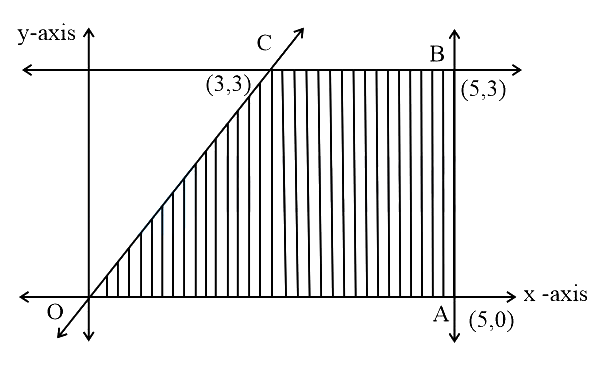
Then the constrants areMHT CET 2016 Medium - The differential equation \(y^{\prime}=\frac{y}{x+\sqrt{x y}}\) has general solution given by (Where \(C\) is a constant of integration.)MHT CET 2022 Medium
- In the usual notation the value of \(\Delta \nabla\) is equal toMHT CET 2007 Easy
- A tangent to the curve \(x=a t^{2}, y=2 a t\) is perpendicular to \(X\) axis, then the point
of contact isMHT CET 2020 Easy - The function \(\mathrm{f}(\mathrm{x})=\log (1+\mathrm{x})-\frac{2 \mathrm{x}}{2+\mathrm{x}}\) is increasing onMHT CET 2021 Easy
- If where , then A (adj A) = ….MHT CET 2019 Easy
More PYQs from MHT CET
- A solution of nonvolatile solute is obtained by dissolving \(1 \mathrm{~g}\) in \(100 \mathrm{~g}\) solvent, decreases its freezing point by \(0.3 \mathrm{~K}\). Calculate cryoscopic constant of solvent if molar mass of solute is \(60 \mathrm{~g} \mathrm{~mol}^{-1}\).MHT CET 2023 Medium
- A mass x gram is suspended from a light spring. It is pulled in downward direction and released so that mass performs S.H.M. of period T. If mass is increased by \(Y\) gram, the period becomes \(4 T / 3\). The ratio of \(\mathrm{Y} / \mathrm{x}\) isMHT CET 2025 Medium
- If \(\mathrm{y}=\mathrm{y}(x)\) and \(\left(\frac{2+\sin x}{\mathrm{y}+1}\right) \frac{\mathrm{dy}}{\mathrm{d} x}=-\cos x\), \(y(0)=1\), then \(y\left(\frac{\pi}{2}\right)=\)MHT CET 2025 Medium
- If \(|\overline{\mathrm{a}}|=3 ;|\overline{\mathrm{b}}|=5 ; \overline{\mathrm{b}} \cdot \overline{\mathrm{c}}=10\), angle between \(\overline{\mathrm{b}}\) and \(\overline{\mathrm{c}}\) is \(\frac{\pi}{3}, \overline{\mathrm{a}}\) is perpendicular to \(\overline{\mathrm{b}} \times \overline{\mathrm{c}}\). Then the value of \(|\overline{\mathrm{a}} \times(\overline{\mathrm{b}} \times \overline{\mathrm{c}})|\) isMHT CET 2023 Medium
- Which among the following compounds is NOT used for the preparation of aromatic carboxylic acids from alkyl benzene?MHT CET 2022 Medium
- In LCR series circuit if the frequency is increased, the impedance of the circuitMHT CET 2024 Medium