


MHT CET · Maths · Application of Derivatives
A ladder of length \(17 \mathrm{~m}\) rests with one end against a vertical wall and the other on the level ground. If the lower end slips away at the rate of \(1 \mathrm{~m} / \mathrm{sec}\)., then when it is \(8 \mathrm{~m}\) away from the wall, its upper end is coming down at the rate of
- A \(\frac{5}{8} \mathrm{~m} / \mathrm{sec}\).
- B \(\frac{8}{15} \mathrm{~m} / \mathrm{sec}\).
- C \(\frac{-8}{15} \mathrm{~m} / \mathrm{sec}\).
- D \(\frac{15}{8} \mathrm{~m} / \mathrm{sec}\).
Answer & Solution
Correct Answer
(B) \(\frac{8}{15} \mathrm{~m} / \mathrm{sec}\).
Step-by-step Solution
Detailed explanation
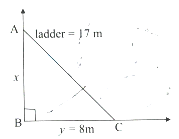
In \(\triangle \mathrm{ABC}, \mathrm{AC}\) represents ladder
\(\mathrm{AB} \rightarrow\) vertical wall
Let \(\mathrm{AB}=x, \mathrm{BC}=y\)
\(\therefore \quad \angle \mathrm{ABC}=90^{\circ}\)
By Pythagoras theorem,
\(\begin{aligned}
& \mathrm{AB}^2+\mathrm{BC}^2=\mathrm{AC}^2 \\
& \Rightarrow x^2+y^2=17^2 \\
& \Rightarrow x^2=289-y^2 ... (i)\\
& \Rightarrow x^2=289-64 \\
& \Rightarrow x^2=225 \\
& \Rightarrow x=15 \mathrm{~m}
\end{aligned}\)
Consider equation (i),
\(x^2=289-y^2\)
Differentiating w.r.t. t, we get
\(\begin{aligned}
& 2 x \frac{\mathrm{d} x}{\mathrm{dt}}=-2 y \frac{\mathrm{d} y}{\mathrm{dt}} \\
& \Rightarrow 15 \frac{\mathrm{d} x}{\mathrm{dt}}=-8(1) \\
& \Rightarrow \frac{\mathrm{d} x}{\mathrm{dt}}=\frac{-8}{15} \mathrm{~m} / \mathrm{s}
\end{aligned}\)
Negative sign shows that the ladder is moving down. i.e., vertical length is decreasing
\(\therefore \quad\) Upper end is coming down at the rate of \(\frac{8}{15} \mathrm{~m} / \mathrm{s}\).
See the Complete Solution
Get step-by-step explanations for this and 2.5 Lakh+ more JEE, NEET & CET questions.
- Unlock all solutions
- Practice the full chapter
- Track accuracy across PYQs
4.8 rated on Google Play · 14,000+ reviews
More questions from Maths
- The slant height of a right circular cone is \(3 \mathrm{~cm}\). The height of the cone for maximum volume isMHT CET 2021 Hard
- The negation of the statement pattern \(p v(q \rightarrow \sim r)\) isMHT CET 2022 Easy
- In a triangle ABC , the sides \(a, \mathrm{~b}, \mathrm{c}\) are such that they are the roots of the equation \(x^3-11 x^2+38 x-40=0\) Then \(\frac{\cos \mathrm{A}}{a}+\frac{\cos \mathrm{B}}{\mathrm{b}}+\frac{\cos \mathrm{C}}{\mathrm{c}}=\)MHT CET 2025 Medium
- The maximum value of \(\frac{\log x}{x}\) isMHT CET 2024 Easy
- If \(A=\left[\begin{array}{ccc}1 & 2 & 3 \\ -1 & 1 & 2 \\ 1 & 2 & 4\end{array}\right]\), and \(A(\operatorname{adj} A)=k I\), then the value of \((k+1)^4\) isMHT CET 2021 Easy
- The area of the region bounded by the curves, \(y^{2}=8 x\) and \(y=x\) isMHT CET 2012 Easy
More PYQs from MHT CET
- The sum of three numbers is 6 . Thrice the third number when added to the first number given 7 . On adding three time first number to the sum of second and third number we get 12 . The product of these numbers isMHT CET 2021 Easy
- Two uniform wires of same material are vibrating under the same tension. If the \(1^{\text {st }}\) overtone of \(1^{\text {st }}\) wire is equal to the \(2^{\text {nd }}\) overtone of \(2^{\text {nd }}\) wire and radius of \(1^{\text {st }}\) wire is twice the radius of \(2^{\text {nd }}\) wire, the ratio of length of \(1^{\text {st }}\) wire to that \(2^{\text {nd }}\) wire isMHT CET 2025 Medium
- Which of the following can not be the direction cosines of a line?MHT CET 2019 Easy
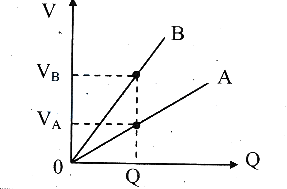
- The graph shows the variation of voltage ' V ' across the plates of two capacitors \(A\) and \(B\) versus increase in charge ' \(Q\) ' stored in them. Then
 MHT CET 2024 Easy
 - If \(\mathrm{f}(x)=3^x ; \mathrm{g}(x)=4^x\), then \(\frac{\mathrm{f}^{\prime}(0)-\mathrm{g}^{\prime}(0)}{1+\mathrm{f}^{\prime}(0) \mathrm{g}^{\prime}(0)}\) isMHT CET 2023 Easy
- \(\frac{\mathrm{d}}{\mathrm{d} x}\left(\cos ^{-1}\left(\frac{x-\frac{1}{x}}{x+\frac{1}{x}}\right)\right)=\)MHT CET 2024 Medium