


MHT CET · Maths · Probability
\(\mathrm{A}, \mathrm{B}, \mathrm{C}\) are three events, one of which must and only one can happen. The odds in favor of \(A\) are \(4: 6\), the odds against B are \(7: 3\). Thus, odds against \(\mathrm{C}\) are
- A \(7:3\)
- B \(4:6\)
- C \(6:4\)
- D \(3:7\)
Answer & Solution
Correct Answer
(A) \(7:3\)
Step-by-step Solution
Detailed explanation
Odd in favor of \(\mathrm{A}\) is \(4: 6\).
\(\therefore \mathrm{P}(\mathrm{A})=\frac{4}{10}\)
Odd against \(\mathrm{B}\) is \(7: 3\)
\(\therefore \mathrm{P}(\mathrm{B})=\frac{3}{10}\)
Since only one of the events A, B and C can happen, we get
\(\mathrm{P}(\mathrm{A})+\mathrm{P}(\mathrm{B})+\mathrm{P}(\mathrm{C})=1 \)
\( \therefore \frac{4}{10}+\frac{3}{10}+\mathrm{P}(\mathrm{C})=1 \)
\( \therefore \mathrm{P}(\mathrm{C})=\frac{3}{10} \)
\( \therefore \mathrm{P}\left(\mathrm{C}^{\prime}\right)=\frac{7}{10}\)
\(\therefore\) odds against the event \(\mathrm{C}\) are \(\mathrm{P}\left(\mathrm{C}^{\prime}\right): \mathrm{P}(\mathrm{C})\)
\(=\frac{7}{10}: \frac{3}{10}\)
\(=7: 3\)
\(\therefore \mathrm{P}(\mathrm{A})=\frac{4}{10}\)
Odd against \(\mathrm{B}\) is \(7: 3\)
\(\therefore \mathrm{P}(\mathrm{B})=\frac{3}{10}\)
Since only one of the events A, B and C can happen, we get
\(\mathrm{P}(\mathrm{A})+\mathrm{P}(\mathrm{B})+\mathrm{P}(\mathrm{C})=1 \)
\( \therefore \frac{4}{10}+\frac{3}{10}+\mathrm{P}(\mathrm{C})=1 \)
\( \therefore \mathrm{P}(\mathrm{C})=\frac{3}{10} \)
\( \therefore \mathrm{P}\left(\mathrm{C}^{\prime}\right)=\frac{7}{10}\)
\(\therefore\) odds against the event \(\mathrm{C}\) are \(\mathrm{P}\left(\mathrm{C}^{\prime}\right): \mathrm{P}(\mathrm{C})\)
\(=\frac{7}{10}: \frac{3}{10}\)
\(=7: 3\)
See the Complete Solution
Get step-by-step explanations for this and 2.5 Lakh+ more JEE, NEET & CET questions.
- Unlock all solutions
- Practice the full chapter
- Track accuracy across PYQs
4.8 rated on Google Play · 14,000+ reviews
More questions from Maths
- If \(\omega\) is complex cube root of unity and \((1+\omega)^7=\mathrm{A}+\mathrm{B} \omega\), then values of A and B are, respectively.MHT CET 2021 Hard
- Let P be a plane passing through the points \((2,1,0),(4,1,1)\) and \((5,0,1)\) and \(R\) be the point \((2,1,6)\). Then image of \(R\) in the plane \(P\) isMHT CET 2024 Medium
- \(\int \frac{x d x}{(x-1)(x-2)}=\)MHT CET 2025 Easy
- \(\int_0^{\frac{\pi}{2}} \frac{300 \sin x+100 \cos x}{\sin x+\cos x} \mathrm{~d} x=\ldots\)MHT CET 2025 Medium
- Let \(\mathrm{f}(x)=\frac{x}{\sqrt{\mathrm{a}^2+x^2}}-\frac{\mathrm{d}-x}{\sqrt{\mathrm{~b}^2+(\mathrm{d}-x)^2}}, x \in \mathbb{R}\) where \(a, b, d\) are non-zero real constants. ThenMHT CET 2024 Hard
- The number of solutions of
\(\tan ^{-1}\left(x+\frac{2}{x}\right)-\tan ^{-1}\left(\frac{4}{x}\right)-\tan ^{-1}\left(x-\frac{2}{x}\right)=0\) areMHT CET 2025 Medium
More PYQs from MHT CET
- The wave number of first line in Lyman series of hydrogen atom is ( \(R\) is Rydberg's constant)MHT CET 2022 Easy
- The angle between particle velocity and wave velocity in a transverse wave isMHT CET 2008 Medium
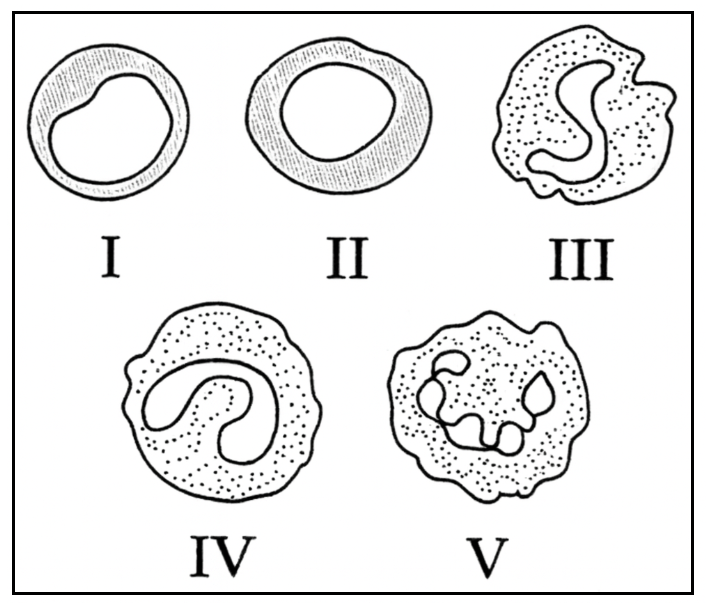
- Which are the phagocytic cells from given diagram?
 MHT CET 2015 Hard
 - Identify the instrument used to find crystal structure from following:MHT CET 2024 Easy
- During transcription, the DNA strand which acts as a template is called A strand and it has B polarity.MHT CET 2023 Medium
- The surface area of a spherical balloon is increasing at the rate \(2 \mathrm{~cm}^2 / \mathrm{sec}\). Then rate of increase in the volume of the balloon is , when the radius of the balloon is \(6 \mathrm{~cm}\).MHT CET 2021 Medium