


MHT CET · Maths · Trigonometric Ratios & Identities
\(\cos ^3\left(\frac{\pi}{8}\right) \cos \left(\frac{3 \pi}{8}\right)+\sin ^3\left(\frac{\pi}{8}\right) \sin \left(\frac{3 \pi}{8}\right)=\)
- A \(\frac{1}{2 \sqrt{2}}\)
- B \(\frac{1}{\sqrt{2}}\)
- C \(\frac{1}{2}\)
- D \(\frac{\sqrt{3}}{2}\)
Answer & Solution
Correct Answer
(A) \(\frac{1}{2 \sqrt{2}}\)
Step-by-step Solution
Detailed explanation
To solve the expression \(\cos ^3\left(\frac{\pi}{8}\right) \cos \left(\frac{3 \pi}{8}\right)+\sin ^3\left(\frac{\pi}{8}\right) \sin \left(\frac{3 \pi}{8}\right)\), we will follow these steps:
Step 1: Rewrite \(\cos \left(\frac{3 \pi}{8}\right)\) and \(\sin \left(\frac{3 \pi}{8}\right)\)
Using the identity \(\cos \left(\frac{3 \pi}{8}\right)=\sin \left(\frac{\pi}{2}-\frac{3 \pi}{8}\right)=\sin \left(\frac{\pi}{8}\right)\) and \(\sin \left(\frac{3 \pi}{8}\right)=\cos \left(\frac{\pi}{2}-\frac{3 \pi}{8}\right)=\cos \left(\frac{\pi}{8}\right)\), we can rewrite the expression:
\(\cos ^3\left(\frac{\pi}{8}\right) \sin \left(\frac{\pi}{8}\right)+\sin ^3\left(\frac{\pi}{8}\right) \cos \left(\frac{\pi}{8}\right)\)
Step 2: Factor the expression
Now we can factor out \(\cos \left(\frac{\pi}{8}\right) \sin \left(\frac{\pi}{8}\right)\) :
\(\cos \left(\frac{\pi}{8}\right) \sin \left(\frac{\pi}{8}\right)\left(\cos ^2\left(\frac{\pi}{8}\right)+\sin ^2\left(\frac{\pi}{8}\right)\right)\)
Step 3: Simplify using Pythagorean identity
Using the Pythagorean identity \(\cos ^2 A+\sin ^2 A=1\) :
Step 3: Simplify using Pythagorean identity
Using the Pythagorean identity \(\cos ^2 A+\sin ^2 A=1\) :
\(\cos \left(\frac{\pi}{8}\right) \sin \left(\frac{\pi}{8}\right) \cdot 1=\cos \left(\frac{\pi}{8}\right) \sin \left(\frac{\pi}{8}\right)\)
Step 4: Use the double angle formula
We can use the double angle formula for sine, which states that \(\sin (2 A)=2 \sin (A) \cos (A)\) :
\(\sin \left(\frac{\pi}{4}\right)=2 \sin \left(\frac{\pi}{8}\right) \cos \left(\frac{\pi}{8}\right)\)
Since \(\sin \left(\frac{\pi}{4}\right)=\frac{\sqrt{2}}{2}\) :
\(\cos \left(\frac{\pi}{8}\right) \sin \left(\frac{\pi}{8}\right)=\frac{1}{2} \sin \left(\frac{\pi}{4}\right)=\frac{1}{2} \cdot \frac{\sqrt{2}}{2}=\frac{\sqrt{2}}{4}\)
Final Answer
Thus, the value of the expression is:
\(\frac{\sqrt{2}}{4}\)
Step 1: Rewrite \(\cos \left(\frac{3 \pi}{8}\right)\) and \(\sin \left(\frac{3 \pi}{8}\right)\)
Using the identity \(\cos \left(\frac{3 \pi}{8}\right)=\sin \left(\frac{\pi}{2}-\frac{3 \pi}{8}\right)=\sin \left(\frac{\pi}{8}\right)\) and \(\sin \left(\frac{3 \pi}{8}\right)=\cos \left(\frac{\pi}{2}-\frac{3 \pi}{8}\right)=\cos \left(\frac{\pi}{8}\right)\), we can rewrite the expression:
\(\cos ^3\left(\frac{\pi}{8}\right) \sin \left(\frac{\pi}{8}\right)+\sin ^3\left(\frac{\pi}{8}\right) \cos \left(\frac{\pi}{8}\right)\)
Step 2: Factor the expression
Now we can factor out \(\cos \left(\frac{\pi}{8}\right) \sin \left(\frac{\pi}{8}\right)\) :
\(\cos \left(\frac{\pi}{8}\right) \sin \left(\frac{\pi}{8}\right)\left(\cos ^2\left(\frac{\pi}{8}\right)+\sin ^2\left(\frac{\pi}{8}\right)\right)\)
Step 3: Simplify using Pythagorean identity
Using the Pythagorean identity \(\cos ^2 A+\sin ^2 A=1\) :
Step 3: Simplify using Pythagorean identity
Using the Pythagorean identity \(\cos ^2 A+\sin ^2 A=1\) :
\(\cos \left(\frac{\pi}{8}\right) \sin \left(\frac{\pi}{8}\right) \cdot 1=\cos \left(\frac{\pi}{8}\right) \sin \left(\frac{\pi}{8}\right)\)
Step 4: Use the double angle formula
We can use the double angle formula for sine, which states that \(\sin (2 A)=2 \sin (A) \cos (A)\) :
\(\sin \left(\frac{\pi}{4}\right)=2 \sin \left(\frac{\pi}{8}\right) \cos \left(\frac{\pi}{8}\right)\)
Since \(\sin \left(\frac{\pi}{4}\right)=\frac{\sqrt{2}}{2}\) :
\(\cos \left(\frac{\pi}{8}\right) \sin \left(\frac{\pi}{8}\right)=\frac{1}{2} \sin \left(\frac{\pi}{4}\right)=\frac{1}{2} \cdot \frac{\sqrt{2}}{2}=\frac{\sqrt{2}}{4}\)
Final Answer
Thus, the value of the expression is:
\(\frac{\sqrt{2}}{4}\)
See the Complete Solution
Get step-by-step explanations for this and 2.5 Lakh+ more JEE, NEET & CET questions.
- Unlock all solutions
- Practice the full chapter
- Track accuracy across PYQs
4.8 rated on Google Play · 14,000+ reviews
More questions from Maths
- If \(x=a \sin 2 t(1+\cos 2 t), y=b \cos 2 t(1-\cos 2 t)\) then \(\frac{d y}{d x}\) is equal toMHT CET 2025 Medium
- If \(m\) and \(n\) are order and degree of the equation \(\left(\frac{d^{2} y}{d x^{2}}\right)^{5}+4 \cdot \frac{\left(\frac{d^{2} y}{d x^{2}}\right)^{3}}{\left(\frac{d^{3} y}{d x^{3}}\right)}+\left(\frac{d^{3} y}{d x^{3}}\right)=x^{2}-1\), thenMHT CET 2011 Easy
- The differential equation of the circles having their centres on the line \(\mathrm{y}=8\) and touching the \(\mathrm{X}\) -axis isMHT CET 2020 Medium
- The equation of a curve whose normal at any point has a slope which is the same as the ordinate and which passes through \((1,-1)\) is \(2 x=\mathrm{k}\left(3-\mathrm{y}^2\right)\). Then k isMHT CET 2025 Medium
- Let \(\mathrm{f}: \mathbb{R}-\{2\} \rightarrow \mathbb{R}-\{1\}\) defined by \(\mathrm{f}(x)=\frac{x-3}{x-2}\) and \(\mathrm{g}: \mathbb{R} \rightarrow \mathbb{R}\) defined by \(\mathrm{g}(x)=3 \mathrm{x}-2\), then sum of all values of \(x\) for which \(\mathrm{f}^{-1}(x)+\mathrm{g}^{-1}(x)=\frac{19}{6}\) isMHT CET 2025 Medium
- \(\int\left(1+x-\frac{1}{x}\right) \mathrm{e}^{x+\frac{1}{x}} \mathrm{~d} x\) equal toMHT CET 2024 Easy
More PYQs from MHT CET
- The graphical solution set of the system of inequations \(2 x+3 y \leq 6, x+4 y \geq 4, x \geq 0, y \geq 0\) is given by
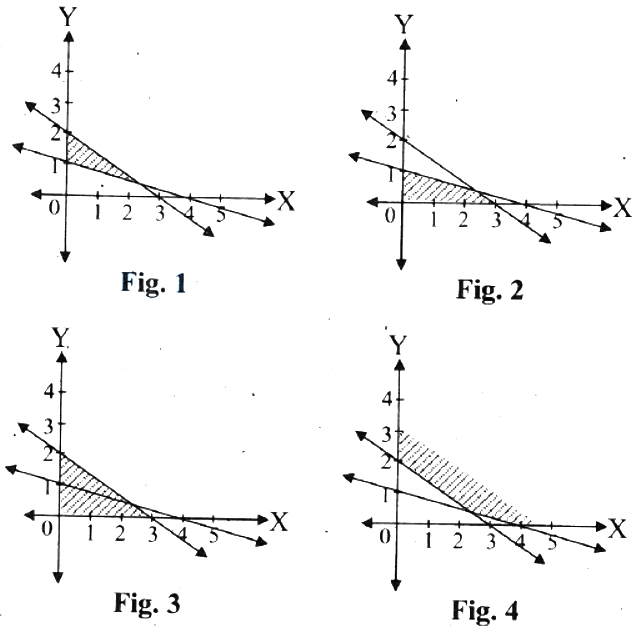 MHT CET 2024 Easy
 - The value of \(\cos \left(2 \cos ^{-1} x+\sin ^{-1} x\right)\) at \(x=\frac{1}{5}\), where \(0 \leq \cos ^{-1} x \leq \pi\) and \(-\frac{\pi}{2} \leq \sin ^{-1} x \leq \frac{\pi}{2}\), isMHT CET 2022 Medium
- When a light of wavelength \(300 \mathrm{~nm}\) fall on a photoelectric emitter, photo electrons are emitted. For another emitter light of wavelength \(600 \mathrm{~nm}\) is just sufficient for liberating photoelectrons. The ratio of the work function of the two emitters isMHT CET 2023 Medium
- What is carbon-carbon bond length in benzene?MHT CET 2022 Easy
- Which from following complexes, the central metal ion does NOT obey EAN rule? (Atomic number - \(\mathrm{Pt}=78, \mathrm{Cu}=29, \mathrm{Zn}=30, \mathrm{Fe}=26\) )MHT CET 2020 Medium
- The differential equation of the family of curves \(\mathrm{y}=e^{x}(\mathrm{~A} \cos x+\mathrm{B} \sin x)\), where
\(\mathrm{A}\) and \(\mathrm{B}\) are arbitrary constants isMHT CET 2020 Medium