


MHT CET · Maths · Definite Integration
\(\int_0^{\pi / 2} \frac{d x}{5+4 \sin x}=A \tan ^{-1} B\), then \(A+B=\)
- A \(\frac{2}{3}\)
- B 1
- C 2
- D \(\frac{1}{3}\)
Answer & Solution
Correct Answer
(B) 1
Step-by-step Solution
Detailed explanation
Let \(I=\int_0^{\pi / 2} \frac{d x}{5+4 \sin x}\)
Put \(\tan \frac{\mathrm{x}}{2}=\mathrm{t} \Rightarrow \sec ^2 \frac{\mathrm{x}}{2}\left(\frac{1}{2}\right) \mathrm{dx}=\mathrm{dt}\)
\(
\therefore \mathrm{dx}=\frac{2 \mathrm{dt}}{1+\mathrm{t}^2} \text { and } \sin \mathrm{x}=\frac{2 \mathrm{t}}{1+\mathrm{t}^2}
\)
When \(\mathrm{x}=0, \mathrm{t}=0\) and when \(\mathrm{x}=\frac{\pi}{2}, \mathrm{t}=1\)
\(\therefore=\int_0^1 \frac{1}{5+4\left(\frac{2 \mathrm{t}}{1+\mathrm{t}^2}\right)} \times \frac{2 \mathrm{dt}}{1+\mathrm{t}^2}=2 \int_0^1 \frac{\mathrm{dt}}{5+5 \mathrm{t}^2+8 \mathrm{t}}=\) \(\frac{2}{5} \int_0^1 \frac{\mathrm{dt}}{\mathrm{t}^2+\frac{8}{5} \mathrm{t}+1} \)
\( =\frac{2}{5} \int_0^1 \frac{\mathrm{dt}}{\mathrm{t}^2+\frac{8}{5} \mathrm{t}+\frac{16}{25}+\frac{9}{25}}=\frac{2}{5} \int_0^1 \frac{\mathrm{dt}}{\left(\mathrm{t}+\frac{4}{5}\right)^2+\left(\frac{3}{5}\right)^2}\)
\(\therefore I=\frac{2}{5} \times \frac{1}{\left(\frac{3}{5}\right)}\left[\tan ^{-1}\left[\frac{\mathrm{t}+\frac{4}{5}}{\left(\frac{3}{5}\right)}\right]\right]_0^1=\) \(\frac{2}{3}\left[\tan ^{-1}\left(\frac{5 \mathrm{t}+4}{3}\right)\right]_0^1 \)
\( =\frac{2}{3}\left[\tan ^{-1} 3-\tan ^{-1} \frac{4}{3}\right]=\frac{2}{3} \tan ^{-1}\left[\frac{3-\left(\frac{4}{3}\right)}{1+3\left(\frac{4}{3}\right)}\right] \)
\( =\frac{2}{3} \tan ^{-1}\left(\frac{5}{3} \times \frac{1}{5}\right)=\frac{2}{3} \tan ^{-1}\left(\frac{1}{3}\right)\)
Comparing with given data, we get
\(
\mathrm{A}=\frac{2}{3}, \mathrm{~B}=\frac{1}{3} \Rightarrow \mathrm{A}+\mathrm{B}=1
\)
Put \(\tan \frac{\mathrm{x}}{2}=\mathrm{t} \Rightarrow \sec ^2 \frac{\mathrm{x}}{2}\left(\frac{1}{2}\right) \mathrm{dx}=\mathrm{dt}\)
\(
\therefore \mathrm{dx}=\frac{2 \mathrm{dt}}{1+\mathrm{t}^2} \text { and } \sin \mathrm{x}=\frac{2 \mathrm{t}}{1+\mathrm{t}^2}
\)
When \(\mathrm{x}=0, \mathrm{t}=0\) and when \(\mathrm{x}=\frac{\pi}{2}, \mathrm{t}=1\)
\(\therefore=\int_0^1 \frac{1}{5+4\left(\frac{2 \mathrm{t}}{1+\mathrm{t}^2}\right)} \times \frac{2 \mathrm{dt}}{1+\mathrm{t}^2}=2 \int_0^1 \frac{\mathrm{dt}}{5+5 \mathrm{t}^2+8 \mathrm{t}}=\) \(\frac{2}{5} \int_0^1 \frac{\mathrm{dt}}{\mathrm{t}^2+\frac{8}{5} \mathrm{t}+1} \)
\( =\frac{2}{5} \int_0^1 \frac{\mathrm{dt}}{\mathrm{t}^2+\frac{8}{5} \mathrm{t}+\frac{16}{25}+\frac{9}{25}}=\frac{2}{5} \int_0^1 \frac{\mathrm{dt}}{\left(\mathrm{t}+\frac{4}{5}\right)^2+\left(\frac{3}{5}\right)^2}\)
\(\therefore I=\frac{2}{5} \times \frac{1}{\left(\frac{3}{5}\right)}\left[\tan ^{-1}\left[\frac{\mathrm{t}+\frac{4}{5}}{\left(\frac{3}{5}\right)}\right]\right]_0^1=\) \(\frac{2}{3}\left[\tan ^{-1}\left(\frac{5 \mathrm{t}+4}{3}\right)\right]_0^1 \)
\( =\frac{2}{3}\left[\tan ^{-1} 3-\tan ^{-1} \frac{4}{3}\right]=\frac{2}{3} \tan ^{-1}\left[\frac{3-\left(\frac{4}{3}\right)}{1+3\left(\frac{4}{3}\right)}\right] \)
\( =\frac{2}{3} \tan ^{-1}\left(\frac{5}{3} \times \frac{1}{5}\right)=\frac{2}{3} \tan ^{-1}\left(\frac{1}{3}\right)\)
Comparing with given data, we get
\(
\mathrm{A}=\frac{2}{3}, \mathrm{~B}=\frac{1}{3} \Rightarrow \mathrm{A}+\mathrm{B}=1
\)
See the Complete Solution
Get step-by-step explanations for this and 2.5 Lakh+ more JEE, NEET & CET questions.
- Unlock all solutions
- Practice the full chapter
- Track accuracy across PYQs
4.8 rated on Google Play · 14,000+ reviews
More questions from Maths
- If \(f(x)=\frac{x}{8}\), if \(0 < x < 4\)
\(=0\), otherwise is probability density function (p.d.f) of c.r.v. \(X\) and \(F(x)\) is c.d.f. associated with \(f(x)\), then \(\mathrm{F}(0 \cdot 5)=\)MHT CET 2020 Easy - The general solution of \(\frac{d y}{d x}=\frac{x+y}{x-y}\) isMHT CET 2021 Hard
- The maximum value of \(x y\) when \(x+2 y=8\) isMHT CET 2023 Easy
- If \(\overline{\mathrm{a}}, \overline{\mathrm{b}}, \overline{\mathrm{c}}\) are non-coplanar unit vectors such that \(\overline{\mathrm{a}} \times(\overline{\mathrm{b}} \times \overline{\mathrm{c}})=\frac{\overline{\mathrm{b}} \times \overline{\mathrm{c}}}{\sqrt{2}}\), then the angle between \(\overline{\mathrm{a}}\) and \(\overline{\mathrm{b}}\) isMHT CET 2023 Easy
- \(\int_0^1 \frac{8 \log (1+x)}{1+x^2} \mathrm{~d} x=\)MHT CET 2022 Easy
- The side of a square sheet of metal is increasing at the rate of \(3 \mathrm{~cm} / \mathrm{min}\). At what rate is the area increasing when the length of the side is \(6 \mathrm{~cm}\) long?MHT CET 2022 Easy
More PYQs from MHT CET
- Pollen grain develops from _________ of antherMHT CET 2015 Easy
- For the following distribution function \(F(x)\) of a random variable \(X\)

\(P(3 < X \leq 5)=\) _____________MHT CET 2017 Medium - If we add \(3 \mathrm{~kg}\) load to the hanger of sonometer, the fundamental frequency
becomes two times its initial value. The initial load must beMHT CET 2020 Easy - What is the percentage of formaldehyde in formalin?MHT CET 2020 Easy
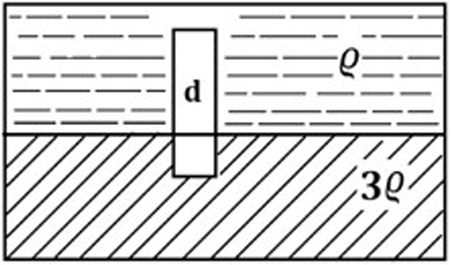
- A solid cylinder of length \(\ell\) and cross-sectional area \(\frac{\mathrm{a}}{5}\) is immersed such that it floats with its axis vertical at the liquid-liquid interface with length \(\ell / 4\) in the denser liquid as shown in figure. The lower density liquid \((\varrho)\) is open to atmosphere having pressure \(P_0\). The density d of solid cylinder is
 MHT CET 2025 Medium
 - Which one of the following is NOT a symptom of Typhoid?MHT CET 2025 Easy