


MHT CET · Chemistry · General Organic Chemistry
Which one of the following compounds is optically active?
- A 2-Chloropentane
- B 3-Chloropentane
- C 2-Chloropropane
- D 2-Chloro-2 methyl butane
Answer & Solution
Correct Answer
(A) 2-Chloropentane
Step-by-step Solution
Detailed explanation
See the Complete Solution
Get step-by-step explanations for this and 2.5 Lakh+ more JEE, NEET & CET questions.
- Unlock all solutions
- Practice the full chapter
- Track accuracy across PYQs
4.8 rated on Google Play · 14,000+ reviews
More questions from Chemistry
- What is the number of unpaired electrons present in \(\mathrm{f}\)-orbital at +3 oxidation state of \(\mathrm{Lu}(\mathrm{Z}=71)\) ?MHT CET 2022 Easy
- Which among the following reactions occurs at the zone of slag formation in extraction of iron by blast furnace?MHT CET 2020 Easy
- Which among the following is allylic secondary alcohol?MHT CET 2020 Easy
- Which of the following compounds does NOT react with sodium metal?MHT CET 2020 Medium
- Which of the following alloy contain Al, Cu, Mg and Mn?MHT CET 2020 Easy
- Which of the following element is used in photoelectric cell?MHT CET 2024 Medium
More PYQs from MHT CET
- In case of p-n junction diode, the width of depletion region isMHT CET 2019 Easy
- Identify the product obtained when isopropyl bromide is reacted with metallic sodium in dry ether.MHT CET 2023 Easy
- Two cells \(\mathrm{E}_1\) and \(\mathrm{E}_2\) having equal \(\mathrm{EMF}\) ' \(\mathrm{E}\) ' and internal resistances \(r_1\) and \(r_2\left(r_1>r_2\right)\) respectively are connected in series. This combination is connected to an external resistance ' \(R\) '. It is observed that the potential difference across the cell \(E_1\) becomes zero. The value of ' \(R\) ' will beMHT CET 2023 Medium
- Which of the following orbitals have same value of \((\mathrm{n}+l)\), as that of 3 d orbital?MHT CET 2024 Easy
- In the circuit shown, the potential difference across the \(4.5 \mu \mathrm{F}\) capacitor is
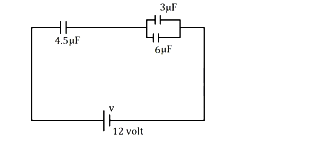 MHT CET 2020 Medium
 - The derivative of \(\tan ^{-1}\left(\frac{\sqrt{1+x^2}-1}{x}\right)\) w.r.t. \(\tan ^{-1}\left(\frac{2 x \sqrt{1-x^2}}{1-2 x^2}\right)\) at \(x=0\) isMHT CET 2025 Medium