


MHT CET · Chemistry · General Organic Chemistry
Which of the following molecule contain \(50 \%\) p character of hybrid orbital in C atom?
- A Propene
- B Acetylene
- C Methane
- D Ethane
Answer & Solution
Correct Answer
(B) Acetylene
Step-by-step Solution
Detailed explanation
Acetylene is a common name of Ethyne. Ethyne is the sp hhybridised for both C atoms, thus have 50% p character.
See the Complete Solution
Get step-by-step explanations for this and 2.5 Lakh+ more JEE, NEET & CET questions.
- Unlock all solutions
- Practice the full chapter
- Track accuracy across PYQs
4.8 rated on Google Play · 14,000+ reviews
More questions from Chemistry
- Which from following elements does not react with water?MHT CET 2022 Medium
- In acetylene molecule, \(\mathrm{C}-\mathrm{H}\) sigma bond is formed byMHT CET 2022 Medium
- Identify chiral molecule from the followingMHT CET 2022 Medium
- Identify the product in the following reaction.
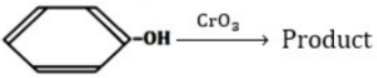 MHT CET 2025 Easy
 - Assuming complete ionisation, arrange the following solutions in order of increasing osmotic pressure.
a) \(0.5 \mathrm{~m} \mathrm{Li}_2 \mathrm{SO}_4\).
b) \(\quad 0.5 \mathrm{mKCl}\)
c) \(\quad 0.5 \mathrm{~m} \mathrm{Al}_2\left(\mathrm{SO}_4\right)_3\)
d) \(0.1 \mathrm{~m} \mathrm{BaCl}_2\)MHT CET 2024 Medium - What product is obtained by electrolysis of \(50 \%\) solution of sulfuric acid on further hydrolysis?MHT CET 2025 Medium
More PYQs from MHT CET
- What type of following solution is obtained from amalgam of mercury with sodium?MHT CET 2021 Easy
- \(\int_{0}^{\pi} \frac{x \cos x \cdot \sin x}{\cos ^{3} x+\cos x} d x=\)MHT CET 2020 Medium
- Which of the following elements exhibits oxidation states other than \(+3 ?\)MHT CET 2020 Easy
- A random variable \(X \sim B(n, p)\), if values of mean and variance of \(\mathrm{X}\) are 18,12 respectively, then \(\mathrm{n}=\)MHT CET 2021 Easy
- Calculate the total number of tetrahedral and octahedral voids formed in 0.6 mol of a compound if it forms hcp structure.MHT CET 2025 Medium
- If \(\mathrm{x}=\mathrm{e}^{\mathrm{t}}(\sin \mathrm{t}-\cos \mathrm{t})\) and \(\mathrm{y}=\mathrm{e}^{\mathrm{t}}(\sin \mathrm{t}+\cos \mathrm{t})\), then \(\frac{\mathrm{dy}}{\mathrm{dx}}\) at \(\mathrm{t}=\frac{\pi}{3}\) isMHT CET 2021 Medium