


MHT CET · Chemistry · General Organic Chemistry
Which of the following is NOT dihydric alcohol?
- A Catechol
- B Hydroquinone
- C Phloroglucinol
- D Resorcinol
Answer & Solution
Correct Answer
(C) Phloroglucinol
Step-by-step Solution
Detailed explanation
Phloroglucinol is not dihydric alcohol
See the Complete Solution
Get step-by-step explanations for this and 2.5 Lakh+ more JEE, NEET & CET questions.
- Unlock all solutions
- Practice the full chapter
- Track accuracy across PYQs
4.8 rated on Google Play · 14,000+ reviews
More questions from Chemistry
- What is the total number of unpaired electrons in an element placed at period-4 and group-12 either in excited or at ground state?MHT CET 2024 Medium
- What is molecular formula of undecane?MHT CET 2024 Medium
- Identify the amine that does not form alcohol by the action of \(\mathrm{NaNO}_2\) and \(\mathrm{HCl}\).MHT CET 2022 Easy
- Which from following complexes does NOT obey EAN rule?MHT CET 2025 Medium
- Which of the following is \(\underline{\text { NOT }}\) a dihydric phenol?MHT CET 2020 Easy
- The IUPAC name of following compound is
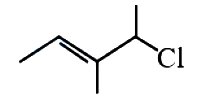 MHT CET 2021 Easy
More PYQs from MHT CET
- If \(P(\theta)\) lies on the hyperbola \(\frac{x^{2}}{a^{2}}-\frac{y^{2}}{b^{2}}=1\) and \(S\) and \(S^{\prime}\) are foci of the hyperbola, then \(S P . S^{\prime} P=\)MHT CET 2020 Medium
- A light travels through water in the beaker. The height of water column is 'h'.
Refractive index of water is ' \(\mu_{\mathrm{w}}^{\prime}\). If \(\mathrm{C}\) is velocity of light in air, the time taken by
light to travel through water will beMHT CET 2020 Easy - What is oxidation number of oxygen in \(\mathrm{OF}_2\) ?MHT CET 2022 Medium
- The first operation involved in a Carnot cycle isMHT CET 2024 Easy
- If the lines \(\frac{x-1}{2}=\frac{y+1}{3}=\frac{z-1}{4}\) and \(\frac{x-2}{1}=\frac{y+m}{2}=\frac{z-2}{1}\) intersect each other, then value of \(m\) isMHT CET 2021 Easy
- The graph of stopping potential ' \(\mathrm{V}_{\mathrm{s}}\) ' against frequency ' \(v\) ' of incident radiation is plotted for two different metals ' X ' and ' Y ' as shown in graph. ' \(\phi_{\mathrm{x}}\) ' and ' \(\phi_{\mathrm{y}}\) ' are work functions of ' x ' and ' \(Y\) ', respectively then
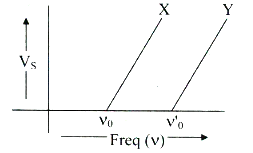 MHT CET 2024 Easy