


MHT CET · Chemistry · p Block Elements (Group 15, 16, 17 & 18)
Which of the following compounds contains chlorine in +5 oxidation state?
- A \(\mathrm{HClO}_4\)
- B \(\mathrm{HClO}_2\)
- C \(\mathrm{HClO}_3\)
- D HCl
Answer & Solution
Correct Answer
(C) \(\mathrm{HClO}_3\)
Step-by-step Solution
Detailed explanation
See the Complete Solution
Get step-by-step explanations for this and 2.5 Lakh+ more JEE, NEET & CET questions.
- Unlock all solutions
- Practice the full chapter
- Track accuracy across PYQs
4.8 rated on Google Play · 14,000+ reviews
More questions from Chemistry
- What are different possible oxidation states exhibited by scandium?MHT CET 2023 Easy
- Which of the following reactions represents Clemmensen reduction?MHT CET 2024 Easy
- The difference between enthalpy change and internal energy change for the combustion of one mole of ethyl alcohol isMHT CET 2022 Hard
- Which among the following pair of properties are intensive?MHT CET 2024 Easy
- Select the CORRECT increasing order of boiling points of alcohols, amines and carboxylic acids of comparable molar mass from the following.MHT CET 2023 Easy
- What is IUPAC name of following compound?
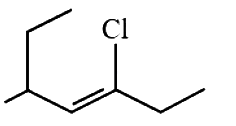 MHT CET 2021 Hard
More PYQs from MHT CET
- What is the mass percentage of carbon in urea? (mol. mass of urea \(=60 \mathrm{~g} \mathrm{~mol}^{-1}\) )MHT CET 2020 Easy
- Identify the product \((\mathrm{X})\) formed in the following reaction.
\(
\mathrm{C}_6 \mathrm{H}_5 \mathrm{OH}+\mathrm{CH}_3 \mathrm{COOH} \stackrel{\mathrm{H}^{+}}{\rightleftharpoons} \mathrm{X}
\)MHT CET 2021 Easy - When the observer moves towards a stationary source with velocity \(V_1\), the apparent frequency of emitted note is \(F_1\). When observer moves away from the source with velocity \(V_1\), the apparent frequency is \(F_2\). If \(V\) is the velocity of sound in air and \(F_1 / F_2=2\) then \(V / V_1\) is equal toMHT CET 2025 Medium
- Identify tertiary amine from following.MHT CET 2025 Easy
- Which from following polymers (trade name) is used to obtain paints?MHT CET 2024 Medium
- The frequencies for series limit of Balmer and Paschen series are ' \(v_1{ }^{\prime}\) and ' \(v_3\) ' respectively. If frequency of first line of Balmer series ' \(v_2\) ' then the relation between \(v_1, v_2\) and \(v_3\) isMHT CET 2025 Medium