


MHT CET · Chemistry · Coordination Compounds
What type of hybridization is present in \(\mathrm{Ni}\) of \(\left[\mathrm{Ni}(\mathrm{Cl})_4\right]^{2-}\) and \(\left[\mathrm{Ni}(\mathrm{CN})_4\right]^{2-}\) respectively?
- A \(\mathrm{dsp}^2\) and \(\mathrm{dsp}^2\)
- B \(\mathrm{sp}^3\) and \(\mathrm{dsp}^2\)
- C \(\mathrm{dsp}^2\) and \(\mathrm{sp}^3\)
- D \(\mathrm{sp}^3\) and \(\mathrm{sp}^3\)
Answer & Solution
Correct Answer
(B) \(\mathrm{sp}^3\) and \(\mathrm{dsp}^2\)
Step-by-step Solution
Detailed explanation
In \(\left[\mathrm{NiCl}_4\right]^{2-} \mathrm{Ni}\) is in +2 oxidation state \(\mathrm{Ni}^{+2} \rightarrow[\mathrm{Ar}] 3 \mathrm{~d}^8\)
Hybridization involved is \(\mathrm{sp}^3\) as participating orbitals are \(4 \mathrm{~S}\) \& \(4 \mathrm{P}\)
\(\mathrm{In}\left[\mathrm{NiCN}_4\right]^{2-} \mathrm{Ni}\) is in \(2+\) oxidation state. \(\mathrm{Ni}^{+2} \rightarrow[\mathrm{Ar}] 3 \mathrm{~d}^8\)
\(\mathrm{CN}^{-}\)is strong field ligand. It causes pairing of \(3 \mathrm{~d}\) electrons.
Hybridization
involved is \(\mathrm{dsp}^2\) as participating orbitals are \(3 \mathrm{~d}, 4 \mathrm{~S}\) and \(4 \mathrm{P}\).
Hybridization involved is \(\mathrm{sp}^3\) as participating orbitals are \(4 \mathrm{~S}\) \& \(4 \mathrm{P}\)
\(\mathrm{In}\left[\mathrm{NiCN}_4\right]^{2-} \mathrm{Ni}\) is in \(2+\) oxidation state. \(\mathrm{Ni}^{+2} \rightarrow[\mathrm{Ar}] 3 \mathrm{~d}^8\)
\(\mathrm{CN}^{-}\)is strong field ligand. It causes pairing of \(3 \mathrm{~d}\) electrons.
Hybridization
involved is \(\mathrm{dsp}^2\) as participating orbitals are \(3 \mathrm{~d}, 4 \mathrm{~S}\) and \(4 \mathrm{P}\).
See the Complete Solution
Get step-by-step explanations for this and 2.5 Lakh+ more JEE, NEET & CET questions.
- Unlock all solutions
- Practice the full chapter
- Track accuracy across PYQs
4.8 rated on Google Play · 14,000+ reviews
More questions from Chemistry
- If \(\mathrm{E}^{\circ}\left(\mathrm{Mg}_{(\mathrm{aq)})}^{+2} \mid \mathrm{Mg}_{(\mathrm{s})}\right)=-2 \cdot 37 \mathrm{~V}\).
What is potential for \(\mathrm{Mg}_{(\mathrm{s})} \rightarrow \mathrm{Mg}^{+2}(0.01 \mathrm{M})+2 \overline{\mathrm{e}}\) at 298 K ?MHT CET 2025 Medium - The reaction in which copper (I) salt is used to replace nitrogen in diazonium salt is called,MHT CET 2020 Easy
- Which among the following reactions occurs at the zone of slag formation in extraction of iron by blast furnace?MHT CET 2020 Easy
- Which of the following forms 2-Methylbut-2-ene on heating with concentrated sulphuric acid?MHT CET 2025 Medium
- Which of the following oxyacids of chlorine does not contain lone pair of electron on chlorine atom?MHT CET 2020 Medium
- Which among the following molecules exhibits strong London forces?MHT CET 2021 Medium
More PYQs from MHT CET
- The value of \(2 \tan ^{-1} \frac{1}{2}+\tan ^{-1} \frac{1}{7}\)MHT CET 2023 Medium
- A diatomic ideal gas is used in Carnot engine as a working substance. If during the adiabatic expansion part of the cycle, the volume of the gas increases from V to 32 V , the efficiency of the engine isMHT CET 2024 Medium
- The probability distribution of a random variable \(\mathrm{X}\) is
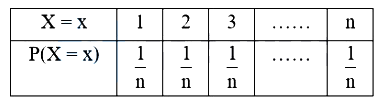
Then \(\operatorname{Var}(\mathrm{X})=\)MHT CET 2021 Medium - If \(x^{\mathrm{y}}+\mathrm{y}^x=\mathrm{a}^{\mathrm{b}}\), then \(\frac{\mathrm{dy}}{\mathrm{d} x}\) at \(x=1, \mathrm{y}=2\) isMHT CET 2025 Medium
- A body performs S.H.M. under the action of force ' \(F_1\) ' with period ' \(T_1\) ' second. If the force is changed to ' \(F_2\) ' it performs S.H.M with period ' \(T_2\) ' second. If both forces ' \(F_1\) ' and ' \(F_2\) ' act simultaneously in the same direction on the body, the period in second will beMHT CET 2021 Medium
- The refraction of light ray takes place from air to water, water to glass and again
glass to air. The ray emerges parallel to incident ray. The correct relation is
\(\left[\mathrm{n}_{\mathrm{a}}, \mathrm{n}_{\mathrm{w}}, \mathrm{n}_{\mathrm{g}}\right.\) represent refractive indices of air, water and glass respectively.MHT CET 2020 Easy