


MHT CET · Chemistry · Chemical Kinetics
The reaction \(2 \mathrm{~A}+\mathrm{B}+\mathrm{C} \longrightarrow \mathrm{D}+\mathrm{E}\) is found to. be first order in A , second order in B and zero order in C . What is the effect of increasing concentration of all reactants twice?
- A Rate of reaction increases 8 times.
- B Rate of reaction increases 24 times.
- C Rate of reaction increases 36 times.
- D Rate of reaction remains unaffected.
Answer & Solution
Correct Answer
(A) Rate of reaction increases 8 times.
Step-by-step Solution
Detailed explanation
\(\begin{aligned}
& \text { Rate }=\mathrm{k}[\mathrm{~A}][\mathrm{B}]^2[\mathrm{C}]^0 \\
& (\text { Rate })_1=\mathrm{k} \times[2 \mathrm{~A}] \times[2 \mathrm{~B}]^2 \times[2 \mathrm{C}]^0 \\
& =8 \mathrm{k}[\mathrm{~A}][\mathrm{B}]^2[\mathrm{C}]^0 \\
& \therefore \quad \frac{(\text { Rate })_1}{\text { Rate }}=\frac{8 \mathrm{k}[\mathrm{~A}][\mathrm{B}]^2[\mathrm{C}]^0}{\mathrm{k}[\mathrm{~A}][\mathrm{B}]^2[\mathrm{C}]^0}=8 \\
& \therefore \quad(\text { Rate })_1=8 \times \text { Rate }
\end{aligned}\)
i.e., rate of reaction increases 8 times.
& \text { Rate }=\mathrm{k}[\mathrm{~A}][\mathrm{B}]^2[\mathrm{C}]^0 \\
& (\text { Rate })_1=\mathrm{k} \times[2 \mathrm{~A}] \times[2 \mathrm{~B}]^2 \times[2 \mathrm{C}]^0 \\
& =8 \mathrm{k}[\mathrm{~A}][\mathrm{B}]^2[\mathrm{C}]^0 \\
& \therefore \quad \frac{(\text { Rate })_1}{\text { Rate }}=\frac{8 \mathrm{k}[\mathrm{~A}][\mathrm{B}]^2[\mathrm{C}]^0}{\mathrm{k}[\mathrm{~A}][\mathrm{B}]^2[\mathrm{C}]^0}=8 \\
& \therefore \quad(\text { Rate })_1=8 \times \text { Rate }
\end{aligned}\)
i.e., rate of reaction increases 8 times.
See the Complete Solution
Get step-by-step explanations for this and 2.5 Lakh+ more JEE, NEET & CET questions.
- Unlock all solutions
- Practice the full chapter
- Track accuracy across PYQs
4.8 rated on Google Play · 14,000+ reviews
More questions from Chemistry
- Identify the use of HDPE.MHT CET 2022 Easy
- Which from following is NOT a dicarboxylic acid?MHT CET 2024 Easy
- What type of peptide is the glycylalanine?MHT CET 2023 Easy
- In an ionic solid anions are arranged in hcp array and cations occupy \(\frac{2}{3}\) of octahedral voids. What is the formula of ionic compound? [ consider \(\mathrm{A}=\) cation ; \(\mathrm{B}=\) anion]MHT CET 2025 Medium
- Identify the correct statement for following reaction. \(3 \mathrm{Mg}+\mathrm{N}_2 \longrightarrow \mathrm{Mg}_3 \mathrm{~N}_2\)MHT CET 2024 Easy
- Calculate the work done if 1 mole of certain gas compressed isothermally and reversibly at 300 K from initial pressure \(x\) bar to final pressure \(2 x\) bar \(\left[\mathrm{R}=8 \cdot 314 \mathrm{~J} \mathrm{~K}^{-1} \mathrm{~mol}^{-1}\right]\)MHT CET 2025 Medium
More PYQs from MHT CET
- \(\int_0^{\pi / 2} \frac{d x}{5+4 \sin x}=A \tan ^{-1} B\), then \(A+B=\)MHT CET 2021 Hard
- MHT CET 2018 Easy
- The frequency at resonance for the circuit is
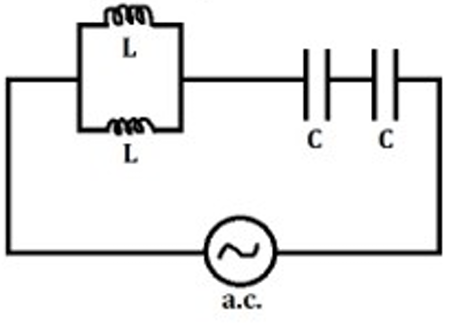 MHT CET 2025 Medium
 - A first order reaction is given as \(A \rightarrow\) products. Its integrated equation isMHT CET 2011 Medium
- What is the position of copper in long form of periodic table?MHT CET 2023 Easy
- The distance between two consecutive points with phase difference of \(60^{\circ}\) in wave of frequency 500 Hz is 0.6 m . The velocity with which wave is travelling isMHT CET 2024 Medium