


MHT CET · Chemistry · Chemical Kinetics
The highest peak in energy profile diagram for mechanism of alkaline hydrolysis of tertiary butyl bromide represents
- A transition state of \(1^{\text {st }}\) step
- B formation of carbocation
- C transition state of \(2^{\text {nd }}\) step
- D products
Answer & Solution
Correct Answer
(A) transition state of \(1^{\text {st }}\) step
Step-by-step Solution
Detailed explanation
The alkaline hydrolysis to tert-butyl bromide with aqueous alkali such as \(\mathrm{NaOH}\) or \(\mathrm{KOH}\) is as follows.

The rate of this reaction depends only on the concentration of the tert-butyl bromide and is independent of the concentration of alkali added.
Rate \(\alpha\left[\left(\mathrm{CH}_{3}\right)_{3} \mathrm{C}-\mathrm{Br}\right]\)
Rate \(=\mathrm{K}\left[\left(\mathrm{CH}_{3}\right)_{3} \mathrm{C}-\mathrm{Br}\right]\)
This is a first order reaction because rate of hydrolysis of \(\left(\mathrm{CH}_{3}\right)_{3}-\mathrm{Br}\) is independent of the concentration of alkali or \(\mathrm{OH}^{-}\)ions. This can be explained by two-step mechanism shown below. Each step is an elementary reaction with its own rate constant, step 1 proceeds much more slowly than step 2.

Rate of reaction \(=\mathrm{k}_{1}\left[\left(\mathrm{CH}_{3}\right)_{3} \mathrm{C}-\mathrm{Br}\right]\)
The first step consists of breaking of \(\mathrm{C}-\mathrm{Br}\) bond and it determines the rate of overall reaction. So, step 1 is called the rate-determining step. The rate determining step in this reaction involves only a single molecule, therefore, it is said to be unimolecular. Also, this type of mechanism is known as \(\mathrm{SN}^{1}\) mechanism(substitution, nucleophilic, unimolecular).
Rate of reaction \(=\mathrm{k}_{2}\left[\left(\mathrm{CH}_{3}\right)_{3} \mathrm{C}^{+}\right]\left[\mathrm{OH}^{-}\right]\)
The second step involves the attack of \(\mathrm{OH}^{-}\)ion. This is the fast step, since it is the bond formation step.
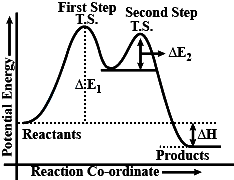
Energy profile diagram of \(\mathrm{SN}^{1}\) mechanism shows that rate of a reaction is independent of the concentration of nucleophile. The first step requires larger activation energy \(\left(\Delta \mathrm{E}_{1}\right)\) than the second step \(\left(\Delta \mathrm{E}_{2}\right)\). The first step to form carbocation determines the rate of overall reaction. The second step, which is the attack of nucleophile on carbocation is exothermic i.e., it is a lower energy transition state. The intermediate carbocation appears at a low point in the diagram. The conditions and reagents which favour the formation of carbocation will accelerate the \(\mathrm{SN}^{1}\) reaction. The energy difference between products and reactants is \(\Delta \mathrm{H}\), i.e., Heat of reaction.
The rate of this reaction depends only on the concentration of the tert-butyl bromide and is independent of the concentration of alkali added.
Rate \(\alpha\left[\left(\mathrm{CH}_{3}\right)_{3} \mathrm{C}-\mathrm{Br}\right]\)
Rate \(=\mathrm{K}\left[\left(\mathrm{CH}_{3}\right)_{3} \mathrm{C}-\mathrm{Br}\right]\)
This is a first order reaction because rate of hydrolysis of \(\left(\mathrm{CH}_{3}\right)_{3}-\mathrm{Br}\) is independent of the concentration of alkali or \(\mathrm{OH}^{-}\)ions. This can be explained by two-step mechanism shown below. Each step is an elementary reaction with its own rate constant, step 1 proceeds much more slowly than step 2.
Rate of reaction \(=\mathrm{k}_{1}\left[\left(\mathrm{CH}_{3}\right)_{3} \mathrm{C}-\mathrm{Br}\right]\)
The first step consists of breaking of \(\mathrm{C}-\mathrm{Br}\) bond and it determines the rate of overall reaction. So, step 1 is called the rate-determining step. The rate determining step in this reaction involves only a single molecule, therefore, it is said to be unimolecular. Also, this type of mechanism is known as \(\mathrm{SN}^{1}\) mechanism(substitution, nucleophilic, unimolecular).
Rate of reaction \(=\mathrm{k}_{2}\left[\left(\mathrm{CH}_{3}\right)_{3} \mathrm{C}^{+}\right]\left[\mathrm{OH}^{-}\right]\)
The second step involves the attack of \(\mathrm{OH}^{-}\)ion. This is the fast step, since it is the bond formation step.
Energy profile diagram of \(\mathrm{SN}^{1}\) mechanism shows that rate of a reaction is independent of the concentration of nucleophile. The first step requires larger activation energy \(\left(\Delta \mathrm{E}_{1}\right)\) than the second step \(\left(\Delta \mathrm{E}_{2}\right)\). The first step to form carbocation determines the rate of overall reaction. The second step, which is the attack of nucleophile on carbocation is exothermic i.e., it is a lower energy transition state. The intermediate carbocation appears at a low point in the diagram. The conditions and reagents which favour the formation of carbocation will accelerate the \(\mathrm{SN}^{1}\) reaction. The energy difference between products and reactants is \(\Delta \mathrm{H}\), i.e., Heat of reaction.
See the Complete Solution
Get step-by-step explanations for this and 2.5 Lakh+ more JEE, NEET & CET questions.
- Unlock all solutions
- Practice the full chapter
- Track accuracy across PYQs
4.8 rated on Google Play · 14,000+ reviews
More questions from Chemistry
- A gas absorbs \(150 \mathrm{~J}\) heat and expands by \(300 \mathrm{~cm}^3\) against a constant external pressure \(2 \times 10^5 \mathrm{~N} \mathrm{~m}^{-2}\), What is \(\Delta \mathrm{U}\) of the system?MHT CET 2023 Medium
- Which of the following alkenes on oxidation by \(\mathrm{KMnO}_4\) in dil. \(\mathrm{H}_2 \mathrm{SO}_4\) forms adipic acid?MHT CET 2021 Medium
- Calculate the molar mass of an element having density \(7.8 \mathrm{~g} \mathrm{~cm}^{-3}\) that forms bec unit cell. \(\left[\mathrm{a}^3 \cdot \mathrm{N}_{\mathrm{A}}=16.2 \mathrm{~cm}^3 \mathrm{~mol}^{-1}\right]\)MHT CET 2023 Medium
- Identify correct statement for reaction stated below.
\(\mathrm{Ag}_2 \mathrm{O}+\mathrm{H}_2 \mathrm{O}+2 \overline{\mathrm{e}} \rightarrow 2 \mathrm{Ag}+2 \mathrm{OH}^{-}\)MHT CET 2025 Medium - What is the packing efficiency of silver metal in its unit cell?MHT CET 2023 Easy
- The laughing gas isMHT CET 2012 Easy
More PYQs from MHT CET
- The reactance of capacitor at \(50 \mathrm{~Hz}\) is \(5 \Omega\). If the frequency is increased to \(100 \mathrm{~Hz}\), the new reactance isMHT CET 2023 Medium
- A particle connected to the end of a spring executes S.H.M. with period ' \(\mathrm{T}_1\) '. While the corresponding period for another spring is ' \(T_2\) '. If the period of oscillation with two springs in series is ' \(T\) ', thenMHT CET 2021 Medium
- Which of the following reactions exhibits decrease in entropy?MHT CET 2025 Medium
- The differential equation of all parabolas whose axis is y-axis, isMHT CET 2021 Hard
- ' \(N\) ' molecules of gas \(A\), each having mass ' \(m\) ' and ' 2 N ' molecules of gas B , each of mass ' 2 m ' are contained in the same vessel which is at constant temperature ' \(T\) '. The mean square velocity of \(B\) is \(V^2\) and mean square of x -component of A is \(\omega^2\). The value of \(\frac{\omega^2}{V^2}\) isMHT CET 2024 Hard
- Find out total number of electrons present in 1.6 g methane?MHT CET 2025 Medium