


MHT CET · Chemistry · Structure of Atom
The energy of an electron in the excited hydrogen atom is \(-3.4 \mathrm{eV}\). Then according to Bohr's theory, the angular momentum of the electron in that excited state is ( \(h=\) Plank's constant \()\)
- A \(\frac{2 \pi}{h}\)
- B \(\frac{\mathrm{n} h}{2 \pi}\)
- C \(\frac{h}{\pi}\)
- D \(\frac{3 h}{2 \pi}\)
Answer & Solution
Correct Answer
(C) \(\frac{h}{\pi}\)
Step-by-step Solution
Detailed explanation
The energy in ground state \((\mathrm{n}=1)\) is \(-13.6 \mathrm{eV}\) The energy in \(\mathrm{n}=2\) state is \(\frac{-13.6}{4}=-3.4 \mathrm{eV}\) Angular momentum \(=\frac{\mathrm{n} h}{2 \pi}=\frac{2 h}{2 \pi}=\frac{h}{\pi}\)
See the Complete Solution
Get step-by-step explanations for this and 2.5 Lakh+ more JEE, NEET & CET questions.
- Unlock all solutions
- Practice the full chapter
- Track accuracy across PYQs
4.8 rated on Google Play · 14,000+ reviews
More questions from Chemistry
- What type of solution is sea water?MHT CET 2022 Easy
- Benzonitrile on reduction with stannous chloride in presence of hydrochloric acid followed by acid hydrolysis forms,MHT CET 2025 Easy
- What is angular momentum of an electron in fourth orbit of hydrogen atom?MHT CET 2023 Easy
- Which of the following is Lewis base?MHT CET 2025 Medium
- Which of the following compounds is octahedral?MHT CET 2022 Easy
- Identify ether from the following compoundsMHT CET 2022 Easy
More PYQs from MHT CET
- \(\mathrm{f}: \mathbb{R}-\left(-\frac{3}{5}\right) \rightarrow \mathbb{R}\) is defined by \(f(x)=\frac{3 x-2}{5 x+3}\), then \(f \circ f(1)\) isMHT CET 2023 Easy
- By increasing the aperture of the objective lens, wavelength of light, focal length
of the objective lens and the resolving power of an astronomical telescope
respectivelyMHT CET 2020 Easy - Corrosive sublimate \(\left(\mathrm{HgCl}_{2}\right)\) can be used to distinguish betweenMHT CET 2007 Hard
- Fishes have __________ for respirationMHT CET 2021 Medium
- \(\int_{0}^{1} \frac{x^{2}}{1+x^{2}} d x=\)MHT CET 2020 Medium
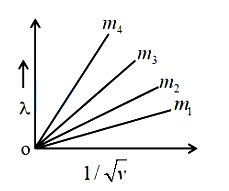
- Graph shows the variation of de-Broglie wavelength \(\lambda\) versus \(\frac{1}{\sqrt{V}}\) where \(V\) is the accelerating potential for four particles, P, Q, R, S carrying same charge but of mass \(m_1, m_2, m_3, m_4\). Which one represents a particle of smaller mass?
 MHT CET 2022 Hard