


MHT CET · Chemistry · Chemical Bonding and Molecular Structure
Identify the orbital having lowest energy from following.
- A 2 p
- B 3 s
- C 3 d
- D \(4 p\)
Answer & Solution
Correct Answer
(A) 2 p
Step-by-step Solution
Detailed explanation
The energy of an orbital in an atom depends on both the principal quantum number \((n)\) and the azimuthal quantum number \((l)\). According to the general trend, for orbitals with different principal quantum numbers, the one with the lower \(n\) typically has lower energy. For orbitals with the same \(n\), the one with the lower \(l\) value will have lower energy.
To identify the orbital with the lowest energy from the given options, consider:
The principal quantum number (\(n\)):
\(\begin{aligned}
& \text {2p: } n=2 \\
& 3 \mathrm{~s}: n=3 \\
& 3 \mathrm{~d}: n=3 \\
& \text {4p: } n=4
\end{aligned}\)
The azimuthal quantum number \((l)\) values for the different orbitals are:
\(\begin{aligned}
& 2 \mathrm{p}: l=1 \\
& 3 \mathrm{~s}: l=0 \\
& 3 \mathrm{~d}: l=2 \\
& 4 \mathrm{p}: l=1
\end{aligned}\)
The energy order for orbitals generally increases with increasing values of \((n+l)\), and for orbitals with the same \((n+l)\) value, the one with the smaller \(n\) has the lower energy.
Calculating \((n+l)\) :
\(2 \mathrm{p}: 2+1=3\)
\(3 \mathrm{~s}: 3+0=3\)
3d: \(3+2=5\)
\(4 \mathrm{p}: 4+1=5\)
Among the options with the same \((n+l)\) value (\(2 p\) and \(3 s\)), \(2 p\) has the lower principal quantum number (\(n=2\) vs. \(n=3\)). Thus, the orbital with the lowest energy is:
Option A: 2p
To identify the orbital with the lowest energy from the given options, consider:
The principal quantum number (\(n\)):
\(\begin{aligned}
& \text {2p: } n=2 \\
& 3 \mathrm{~s}: n=3 \\
& 3 \mathrm{~d}: n=3 \\
& \text {4p: } n=4
\end{aligned}\)
The azimuthal quantum number \((l)\) values for the different orbitals are:
\(\begin{aligned}
& 2 \mathrm{p}: l=1 \\
& 3 \mathrm{~s}: l=0 \\
& 3 \mathrm{~d}: l=2 \\
& 4 \mathrm{p}: l=1
\end{aligned}\)
The energy order for orbitals generally increases with increasing values of \((n+l)\), and for orbitals with the same \((n+l)\) value, the one with the smaller \(n\) has the lower energy.
Calculating \((n+l)\) :
\(2 \mathrm{p}: 2+1=3\)
\(3 \mathrm{~s}: 3+0=3\)
3d: \(3+2=5\)
\(4 \mathrm{p}: 4+1=5\)
Among the options with the same \((n+l)\) value (\(2 p\) and \(3 s\)), \(2 p\) has the lower principal quantum number (\(n=2\) vs. \(n=3\)). Thus, the orbital with the lowest energy is:
Option A: 2p
See the Complete Solution
Get step-by-step explanations for this and 2.5 Lakh+ more JEE, NEET & CET questions.
- Unlock all solutions
- Practice the full chapter
- Track accuracy across PYQs
4.8 rated on Google Play · 14,000+ reviews
More questions from Chemistry
- Which among the following elements is obtained in pure form by zone refining process?MHT CET 2020 Easy
- Find principle of green chemistry to show protection of selective group is not advantageous.MHT CET 2025 Easy
- What is the value of \(x\) and \(y\) in order to balance following redox reaction? \(\mathrm{xCuO}+\mathrm{yNH}_3 \longrightarrow \mathrm{xCu}+\mathrm{N}_2+\mathrm{xH}_2 \mathrm{O}\)MHT CET 2024 Easy
- Which of following enzymes is useful in conversion of glucose to fructose?MHT CET 2021 Medium
- Which element from following is used for cancer treatment?MHT CET 2023 Medium
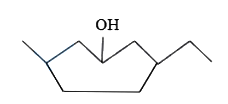
- What is IUPAC name of the following compound?
 MHT CET 2021 Easy
More PYQs from MHT CET
- A large number of bullets are fired in all directions with same speed ' \(U\) '. The maximum area on the ground on which the bullets will spread isMHT CET 2023 Medium
- The negation of is ….MHT CET 2019 Easy
- A diatomic molecule has moment of inertia 'I'. By applying Bohr's quantization condition, its rotational energy in the \(\mathrm{n}^{\text {th }}\) level is \([\mathrm{n} \geq 1]\) [h= Planck's constant \(]\)MHT CET 2024 Medium
- What is the product obtained when \(\mathrm{Br}_{2}\) water reacts with glucose?MHT CET 2020 Easy
- For following reaction, relation between \(\Delta \mathrm{H}\) and \(\Delta \mathrm{U}\) is \(2 \mathrm{SO}_{3(\mathrm{~g})}+\mathrm{O}_{2(\mathrm{~g})} \rightarrow 2 \mathrm{SO}_{3(\mathrm{~g})}\)MHT CET 2020 Easy
- Given below are two statements.
Statement I: Defecation is an involuntary process that takes place through anal opening guarded by sphincter muscles.
Statement II: Distension of rectum stimulates pressure sensitive receptors that initiate a neural reflex for egestion.
In light of above statements, select the correct answer from the option given below.MHT CET 2024 Easy